
Start here
The story, in brief
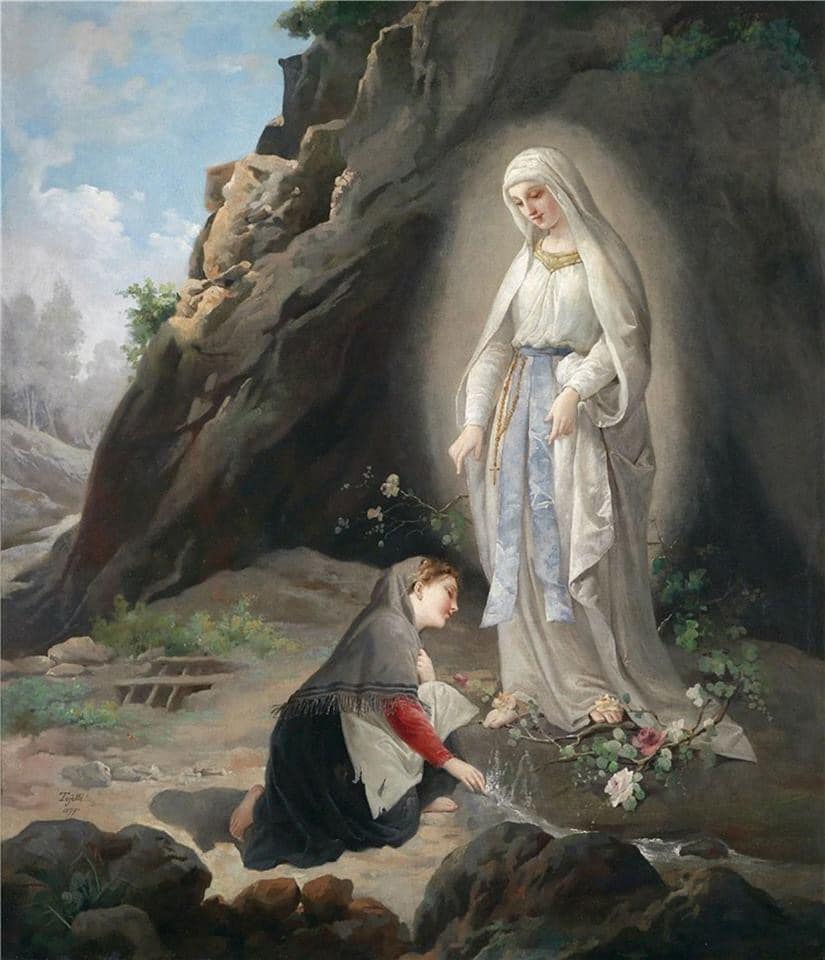
Lourdes began with a girl gathering fuel, not with a hospital or a basilica. In February 1858, fourteen-year-old Bernadette Soubirous reported seeing a figure in a grotto near her town. The crowds could watch Bernadette; they did not share her reported sight of the lady. That difference is the starting point for understanding both the devotion and the evidence. [L-01; B-01]
The story poses two questions that deserve separate answers: why did the Church find Bernadette credible, and why has a place associated with suffering become a destination of hope? The answer runs through her testimony, the meaning Catholics give to the water and the message, and an unusually structured system for examining reported cures. [L-02; L-03; L-05a]
One witness to the figure
The apparition narrative comes from Bernadette; a crowd observing her is not a crowd seeing Mary. [L-01]
A real Church judgment
Bishop Laurence recognized the apparitions in 1862, after an inquiry begun in 1858. [L-03]
Healing has its own inquiry
Medical assessment of a recovery and a bishop’s declaration of a miracle are distinct stages. [L-05a]
Explore the chapters
A girl who had little social standing
Bernadette’s family was living in poverty when the reports began. The official account situates the first encounter at Massabielle on 11 February, while she was out with her sister and a friend. The subsequent story includes questioning by civil officials and resistance to some visits. It was not simply a message delivered to an already compliant audience. [B-01; L-01]
Her social position matters to the Catholic reading of Lourdes: a person easily overlooked becomes someone whose testimony adults must take seriously. Poverty does not prove truthfulness, but it helps explain the shrine’s lasting emphasis on dignity, welcome, and attention to people whose suffering can make them socially invisible. [B-01; L-02]
The spring did not begin as a polished symbol
On 25 February, Bernadette scraped the ground and tried to drink the muddy water collecting there. On 2 March, she reported a request for a chapel and processions. These episodes connect the familiar practices of Lourdes to specific claims in her account; they are not independent demonstrations that the figure was present. [L-01]
The sanctuary interprets the water through conversion and the life given by Christ. In that reading, washing and drinking are embodied prayer: ordinary material actions expressing a turn toward God. The water does not function as a substitute savior or a guaranteed treatment. The sanctuary itself states that it has no special therapeutic property. [L-02; L-12]
Why the name mattered to the priest
Bernadette reported the title Immaculate Conception on 25 March. For Catholics, the title concerns Mary’s preservation from original sin from the beginning of her own life, through Christ’s saving grace. It does not mean the virginal conception of Jesus. Pius IX had defined the dogma in 1854, four years before the reports. [L-06a]
The sanctuary presents this as a decisive moment for the parish priest, Dominique Peyramale. Its account of Bernadette’s understanding is part of the received narrative, however; a modern reader should not treat claims about everything she could or could not have heard as a controlled experiment. The theological fit helps explain Catholic reception without resolving every historical question. [L-01; L-02]
What the 1862 decision actually did
Bishop Bertrand-Sévère Laurence established an inquiry in 1858 and issued his pastoral judgment on 18 January 1862. The sanctuary’s published account says he recognized the apparitions, permitted public devotion, and supported building a shrine. This is substantial ecclesiastical recognition, not merely the fact that a church was later built nearby. [L-03; L-04]
The exact decree facsimile has not been inspected for this file, so its wording remains attributed to the institutional account. Recognized private revelation also occupies a different theological category from the Gospel: Catholics are not receiving a new installment of the revelation of Christ. That distinction allows serious devotion without making every Lourdes detail a required article of faith. [L-04; L-06]
How a reported cure becomes a separate case
A person reports a recovery to the medical office. Investigators seek records of the illness and the subsequent state of health; specialists examine the change and its durability. The International Medical Committee can judge a recovery exceptional in relation to current medical knowledge. The bishop of the recovered person’s diocese then has a distinct religious judgment to make. [L-05a]
This process is interesting because the medical and theological questions do not collapse into one another. A verified diagnosis, a rapid change, and sustained recovery can narrow ordinary explanations. They do not allow a laboratory instrument to read divine intention. Early cure records were also less complete than later ones, according to a historical study; different cases deserve different evidential weight. [L-05a; L-11]
Lourdes developed a permanent Medical Bureau in 1883 under Dr Georges-Fernand Dunot de Saint-Maclou. The institution’s history explains the practical purpose: people reporting recovery should have their account subjected to collective medical scrutiny before leaving. A gathering of doctors, rather than devotional enthusiasm alone, became part of the shrine’s response. [L-05]
When consulted on September 7, 2026, the sanctuary’s published list identified 72 healings recognized as miraculous by the Church. That is a count of specifically recognized cases, not of every reported improvement, and it should not be presented as a scientific measurement of divine action. [L-13]
Why a pilgrim who remains ill might still care
The message includes conversion, prayer for others, and a hope that extends beyond present suffering. Lourdes therefore cannot fairly be reduced to a promise that enough belief will produce a cure. Its central religious claim concerns the person’s relationship with God and with other people, including when physical limitations remain. [L-02]
Bernadette’s own life does not support an easy prosperity reading of the story. The sanctuary’s biography follows her into religious life and continued illness. For a Catholic, her significance includes fidelity under difficult conditions; for a historical reader, her later life offers another body of material to examine beyond the few months at the grotto. [B-01]
The strongest questions to bring to Lourdes
One can take the 1862 judgment seriously and still ask how testimony was collected, what the earliest statements actually say, and how later retellings changed emphasis. The outstanding documentary task is to inspect the decree and primary testimony in full, rather than relying only on modern summaries. That would sharpen the historical account without pretending that a surviving document directly photographs a private experience. [L-03; L-04]
The most useful distinction is between the apparition, an individual healing, and the effects of pilgrimage. Evidence for one is not automatically evidence for all three. Lourdes becomes more intelligible when each receives its own question and its own standard of support. [L-01; L-05a; L-11]
The 2024 Vatican norms distinguish present pastoral permission from a declaration that a new phenomenon is supernatural. They help readers understand the range of Church decisions today without retroactively renaming Lourdes’s documented 1862 judgment. [L-07]
Catholic reflection & discussion
What would you bring to Lourdes?
Imagine approaching this story with a hope of your own. Revisit the article's treatment of prayer, the water, care for the sick and Bernadette's life, and consider which part calls for your attention.
These editorial prompts invite reflection on the article. They are distinct from Church teaching and the evidence findings.
Pause and reflect
- What would you hope to find on a pilgrimage: healing, companionship, time to pray, or a clearer understanding?
- How might a pilgrimage remain meaningful when a person returns home with the same illness?
- What practical act of welcome or care could you offer someone who feels overlooked?
Discuss with family or a group
Choose questions suited to your readers' ages and experiences. Anyone can pass or keep a response private.
- How does the article distinguish the apparition story, a particular healing and a pilgrim's experience? Why should we ask about each separately?
- What would a considerate response sound like when someone shares a hope for healing? How can hope make room for continued care?
Questions people ask
Open any question for a fuller answer and its sources.
Did everyone at the grotto see Mary?
No. The case centers on what Bernadette reported seeing and hearing. Other people witnessed her behavior and the developing public events. Those are relevant observations, but they are different testimony. [L-01]
Does the Church say the water itself is medicine?
Is a Lourdes cure automatically a recognized miracle?
No. A declaration begins an inquiry. Medical documentation, specialist assessment, and a distinct episcopal decision matter; the process can also leave a report pending or without further action. [L-05a]
Does accepting Catholicism require belief in Lourdes?
Recognized private revelations do not add to the deposit of faith. Lourdes has genuine ecclesiastical recognition, but its theological category remains different from the definitive revelation of Christ. [L-06]
What the evidence can establish
Evidence verdict: unresolved
Did a supernatural apparition appear to Bernadette Soubirous at Massabielle in 1858?
The reviewed record documents the testimony, the ecclesiastical judgment and the later medical review process. None of it establishes, or excludes, a supernatural cause for what the visionary reported.
Church or institutional status
Apparitions officially recognized by the Bishop of Tarbes in 1862.
- Authority
- Bishop Bertrand-Sévère Laurence of Tarbes, 18 January 1862.
- Scope of the finding
- According to the Sanctuary's published account, the episcopal judgment permits the cult and states that the faithful are justified in believing the apparitions to be real.
- Limits of the finding
- This ecclesiastical judgment does not scientifically prove every associated cure or detail, and recognized private revelation is not part of the deposit of faith.
Sources and notes
Back to the overviewSource labels describe a document's type and role, not the strength of a claim. Where provided, notes explain its use, access limits, and outstanding checks.
What records can you inspect?
A source link may open a complete document, an institutional summary, or only a catalogue entry. These notes explain the access recorded for this file and the gaps that still matter.
- The Church’s 1862 judgment
The sanctuary publishes an account of Bishop Laurence’s judgment and selected French excerpts. The decree facsimile and the documentary editions identified in the notes have not been inspected for this file, so exact wording remains attributed to the sanctuary’s account.
- The testimony behind the narrative
The chronology is drawn from the sanctuary’s received account. Primary testimony and the Laurentin–Billet documentary volumes remain acquisition and checking tasks; a bibliographic lead is not an inspected witness statement.
- The separate investigation of cures
The sanctuary explains its medical process and the bishop’s distinct religious judgment. The historical study of cures is cited from its abstract and bibliographic record. These sources concern individual healing reports, not direct observation of an apparition.
chronology of the 18 reported appearances — Strong for the received chronology and attribution, not proof of supernatural origin.
message summary — Current Catholic/Sanctuary presentation of the reported message.
- L-03Sanctuary of Our Lady of Lourdes, "The Recognition of the Lourdes Apparitions", 17 January 2023 (opens in a new tab)Official source
whole page — Commission established 1858; judgment 18 January 1862; devotion authorised; shrine invited.
Official summary and selected French excerpts; not a facsimile of the 1862 decree — Bibliographic lead only: Laurence, 1862 mandate, Recueil vol. II, pp. 285–302; Laurentin/Billet vol. VI, pp. 237–245, Article 1 at 244. Neither edition was inspected.
- L-05Sanctuary of Our Lady of Lourdes, "The Medical Bureau of the Sanctuary" (opens in a new tab)Official source
history and investigative role — Permanent medical office traced to 1883; receives and investigates reports. It does not declare divine causation.
- L-05aSanctuary of Our Lady of Lourdes, "Recognition of a Miracle" (opens in a new tab)Official source
current staged recognition process — Separates medical-office investigation, CMIL assessment, and the cured person’s diocesan bishop’s religious judgment.
nos. 66–67 — Recognised private revelations are not part of the deposit of faith.
- L-06aPius IX, Apostolic Constitution Ineffabilis Deus, 8 December 1854 (opens in a new tab)Primary source
definition — Use only for the fact and content of the 1854 definition; not evidence about Bernadette's knowledge.
- L-07Dicastery for the Doctrine of the Faith, "Norms for Proceeding in the Discernment of Alleged Supernatural Phenomena", 17 May 2024 (opens in a new tab)Official source
presentation; pars. 11–13 — Current framework; do not retroactively relabel the 1862 decision.
- L-08Ruth Harris, Lourdes: Body and Spirit in the Secular Age (London: Allen Lane, 1999), ISBN 0713991860 (opens in a new tab)Scholarly sourceResearch lead
A lead for further checking, not verified support for a claim.
catalogue and publisher description only; book not inspected — Broad scholarly framing only until page-checked; paraphrase.
- L-09Thérèse Taylor, Bernadette of Lourdes: Her Life, Death and Visions, 2nd ed. (London: Burns & Oates, 2008), ISBN 9780826420855 (opens in a new tab)Scholarly sourceResearch lead
A lead for further checking, not verified support for a claim.
publisher description only; book not inspected — Do not use for page-level detail until page-checked.
- L-10René Laurentin with Bernard Billet, Lourdes: Documents authentiques, multiple vols. (Paris: Lethielleux, 1957–1966) (opens in a new tab)Scholarly sourceResearch lead
A lead for further checking, not verified support for a claim.
bibliographic lead only; volumes and pages not inspected — Modern documentary edition containing primary materials; not itself an inspected primary source.
- L-11Bernard François, Esther M. Sternberg and Elizabeth Fee, "The Lourdes Medical Cures Revisited", Journal of the History of Medicine and Allied Sciences 69, no. 1 (2014): 135–162 (opens in a new tab)Peer-reviewed research
abstract and bibliographic metadata — Abstract supports weak/absent early cure records and later methodological development; not proof or disproof of divine causation.
statement that the spring water has no therapeutic or specific property — Current institutional statement, not an independent laboratory analysis.
current list inspected 27 August 2026 — Reports 72 cures recognized as miraculous by the Church. This is an institutional count, not a scientific finding of divine causation.
whole page — Devotional rather than independent.
Corrections and updates
Attributed the description of the 1862 episcopal judgment to the Sanctuary's published account. The decree facsimile remains unchecked, and the evidence verdict remains Unresolved.
Expanded this file with a sourced narrative, 7 chapters and 4 answers to common questions. The existing evidence verdict label and institutional status are retained. Independent human review remains pending.