
Start here
The story, in brief
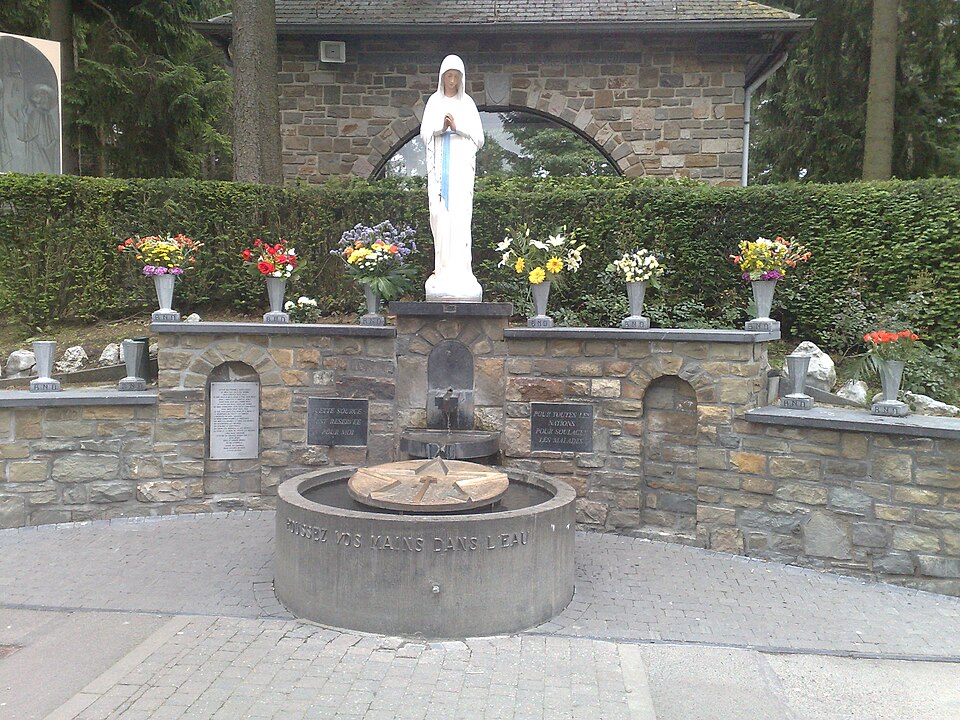
The spring was not meant to belong to Mariette alone. In the shrine’s account, the eleven-year-old initially misunderstood the reported promise, then heard that the spring was for all nations and the relief of the sick. That movement from one child toward other people is at the heart of Banneux. [BN-01]
Eight reported encounters
The received chronology runs from 15 January to 2 March 1933. [BN-01]
A title with practical meaning
Virgin of the Poor directs attention to people easily overlooked. [BN-01; BN-04]
Recognition followed inquiry
Bishop Kerkhofs’s definitive judgment came in 1949. [BN-03; BN-04]
Explore the chapters
A child returns to the garden
Mariette Beco reported seeing the lady near her home in January 1933. The shrine’s narrative describes repeated evening prayer and a sequence of encounters separated by days when nothing happened. The story is therefore not an uninterrupted spectacle: waiting and returning belong to the received account. [BN-01]
The narrative is preserved by the shrine from Mariette’s testimony. Its dates and reported actions can be stated as that tradition without pretending an outside observer independently confirmed the figure. [BN-01; BN-02]
The spring widens the story
Mariette’s reported walks to the spring connect the apparition account with a physical place. The attributed message gives the spring a universal horizon and associates it with the sick. In the devotion, the water becomes an occasion for prayer and hope, rather than a private possession of the visionary. [BN-01]
A promise of relief should not be turned into a guarantee that every visitor will recover. The Catholic interpretation of Banneux includes consolation, care, and fidelity amid suffering. A particular healing claim would still need its own evidence. [BN-01; BN-04]
Why “Virgin of the Poor” matters
John Paul II’s 1999 letter connects the title with care for the lowly, the despised, and people who suffer. Its point is ethical as well as devotional: someone who seeks comfort at the shrine is also asked to notice the burdens of other people. Mary’s example leads toward following Christ. [BN-04]
That makes the title more demanding than an attractive name. A community shaped by it should ask who receives welcome, whose needs remain invisible, and whether prayer becomes compassionate action. Those are applications of the papal interpretation, not additional words attributed to the apparition. [BN-04]
A small chapel and a continuing practice
The received message includes a request for a small chapel and repeated calls to prayer. The shrine dates the chapel’s construction and inauguration to the summer of 1933. The concrete response is a place where the original testimony can be remembered through ordinary worship. [BN-01]
The shrine’s later development also has a human history: promoters, pilgrims, infrastructure, and reported cures contributed to its growth. Historical study of that process neither proves nor disproves the apparition, but it explains how a private report became a sustained public devotion. [BN-06]
The bishop did not decide immediately
The official inquiry history describes Bishop Louis-Joseph Kerkhofs as initially skeptical. A commission heard seventy-three witnesses and consulted specialists in several fields. René Rutten’s critical examination of testimony formed part of the process. The underlying records are not reproduced on the summary page. [BN-02]
The recognition developed in stages, including qualified statements in 1942 and 1947. On 22 August 1949 the bishop recognized the eight apparitions without reserve, according to the shrine. John Paul II independently confirmed that date and the definitive character of the diocesan judgment in his anniversary letter. [BN-03; BN-04]
Faith, suffering, and the work of care
The papal letter explicitly commends people who accompany the sick and elderly. Its Catholic response to suffering includes the care represented by the Good Samaritan, not simply an explanation addressed to the person in pain. A pilgrimage’s meaning can continue after the visitor returns home. [BN-04]
That focus avoids a cruel inference: illness persisting after prayer is not evidence that the person has failed a spiritual test. The shrine’s message and the medical question should remain distinct. Meaningful care does not depend on an extraordinary cure. [BN-01; BN-04]
What an independent history still needs
The complete pastoral letter, early interview transcripts, commission minutes, and Rutten’s analysis remain to be inspected. They would allow a reader to compare the received narrative with the evidence actually considered. The 1949 decision can be reported confidently as an institutional act while the cause of Mariette’s experience remains a separate question. [BN-02; BN-03; BN-05]
Catholic reflection & discussion
Consider the message as well as the event
Explore the devotional meaning described in this article alongside the history of the report and the Church's response. Make space for both a personal response and questions about the record.
These editorial prompts invite reflection on the article. They are distinct from Church teaching and the evidence findings.
Pause and reflect
- Which part of the reported message or its reception would you like to understand more deeply?
- What exactly does the Church's recorded decision cover, and which questions does it leave open?
- What would it look like to approach this story with both a receptive heart and care for the truth?
Discuss with family or a group
Choose questions suited to your readers' ages and experiences. Anyone can pass or keep a response private.
- Identify who reported the experience, who investigated it, and who made a Church decision. Why does each person's role matter?
- How could you speak respectfully with someone whose response to this story differs from your own?
Questions people ask
Open any question for a fuller answer and its sources.
Who was the visionary?
Mariette Beco, eleven when the reported encounters began in 1933. [BN-01]
What is distinctive about the spring?
The received account describes it as intended for all nations and associated with relief for the sick. That is the reported religious meaning, not a laboratory finding about the water. [BN-01]
Was the bishop’s recognition only implied?
Does the message concern only physical cures?
The Catholic interpretation also includes compassion, consolation, conversion, and care for other people. Those commitments remain when illness does. [BN-04]
What the evidence can establish
Evidence verdict: unresolved
Did Mary supernaturally appear to Mariette Beco during the eight reported encounters at Banneux between 15 January and 2 March 1933?
The sources establish a received eight-encounter narrative, a diocesan inquiry process and Kerkhofs's 1949 ecclesial recognition. They do not provide independent, reproducible evidence capable of determining a supernatural cause.
Church or institutional status
Diocesan recognition of the eight Banneux apparitions — 22 August 1949.
- Authority
- Louis-Joseph Kerkhofs, Bishop of Liège; John Paul II's 1999 Vatican letter independently confirms the authority and date.
- Scope of the finding
- The operative 1949 text recognizes without reserve the reality of the eight apparitions reported by Mariette Beco on the eight listed dates.
- Limits of the finding
- This is a diocesan ecclesial judgment, not scientific verification of a supernatural cause, proof of every reported message, or authentication of later cure claims. The complete pastoral letter and underlying commission record still require archival page-checking, and private revelation is not obligatory Catholic belief.
Sources and notes
Back to the overviewSource labels describe a document's type and role, not the strength of a claim. Where provided, notes explain its use, access limits, and outstanding checks.
Whole page — Current official shrine presentation of the received eight-encounter narrative; use for attribution and institutional chronology, not independent proof of an apparition.
Whole page — Official shrine summary of the diocesan inquiry, seventy-three witnesses, consulted experts, and the 1942, 1947 and 1949 stages; underlying files were not exposed on the page.
Operative paragraphs — Official shrine reproduction attributed to Kerkhofs's pastoral letter of 22 August 1949, including the unreserved recognition and all eight dates; not a facsimile of the complete letter.
- BN-04John Paul II, "Letter to the Bishop of Liège on the 50th Anniversary of the Recognition of the Apparitions of Our Lady at Banneux", 31 July 1999 (opens in a new tab)Official source
Paragraph 1 — Official Vatican confirmation that Bishop Louis-Joseph Kerkhofs definitively recognized the reality of the Banneux apparitions on 22 August 1949.
- BN-05Dicastery for the Doctrine of the Faith, "Norms for Proceeding in the Discernment of Alleged Supernatural Phenomena", 17 May 2024 (opens in a new tab)Official source
Preface, introduction, paragraphs 11–13 and 17, and articles 14–15 — Current category limits for ecclesial discernment. Use to explain the distinction from empirical proof, not to retroactively relabel the 1949 act.
- BN-06Tine Van Osselaer, "Pilgrims and promoters at Beauraing and Banneux: The evolution from apparition to pilgrimage sites, 1932–1949", Trajecta 33, no. 1/2 (2025): 88–109 (opens in a new tab)Peer-reviewed research
Peer-reviewed historical context on site development, promoters, pilgrims, infrastructure and cure reports; it does not adjudicate supernatural origin.
Corrections and updates
Expanded this file with a sourced narrative, 7 chapters and 4 answers to common questions. The existing evidence verdict label and institutional status are retained. Independent human review remains pending.