
Start here
The story, in brief
Benoîte Rencurel’s story did not end with a single extraordinary afternoon. The Laus tradition follows decades of reported encounters and a life devoted to receiving pilgrims. A small Alpine chapel became the center of a ministry of prayer and reconciliation, while four men who knew her left the manuscripts through which her story survives. [LAUS-03; LAUS-05]
A long life of service
The sanctuary relates Benoîte’s reported experiences to welcoming pilgrims and conversion. [LAUS-03]
A manuscript tradition survives
Four contemporary authors stand behind the substantial Laus record. [LAUS-03; LAUS-05]
Formal recognition came in 2008
Earlier permission for pilgrimage must not be confused with the later signed decree. [LAUS-01; LAUS-03]
Explore the chapters
A young shepherdess in the Alps
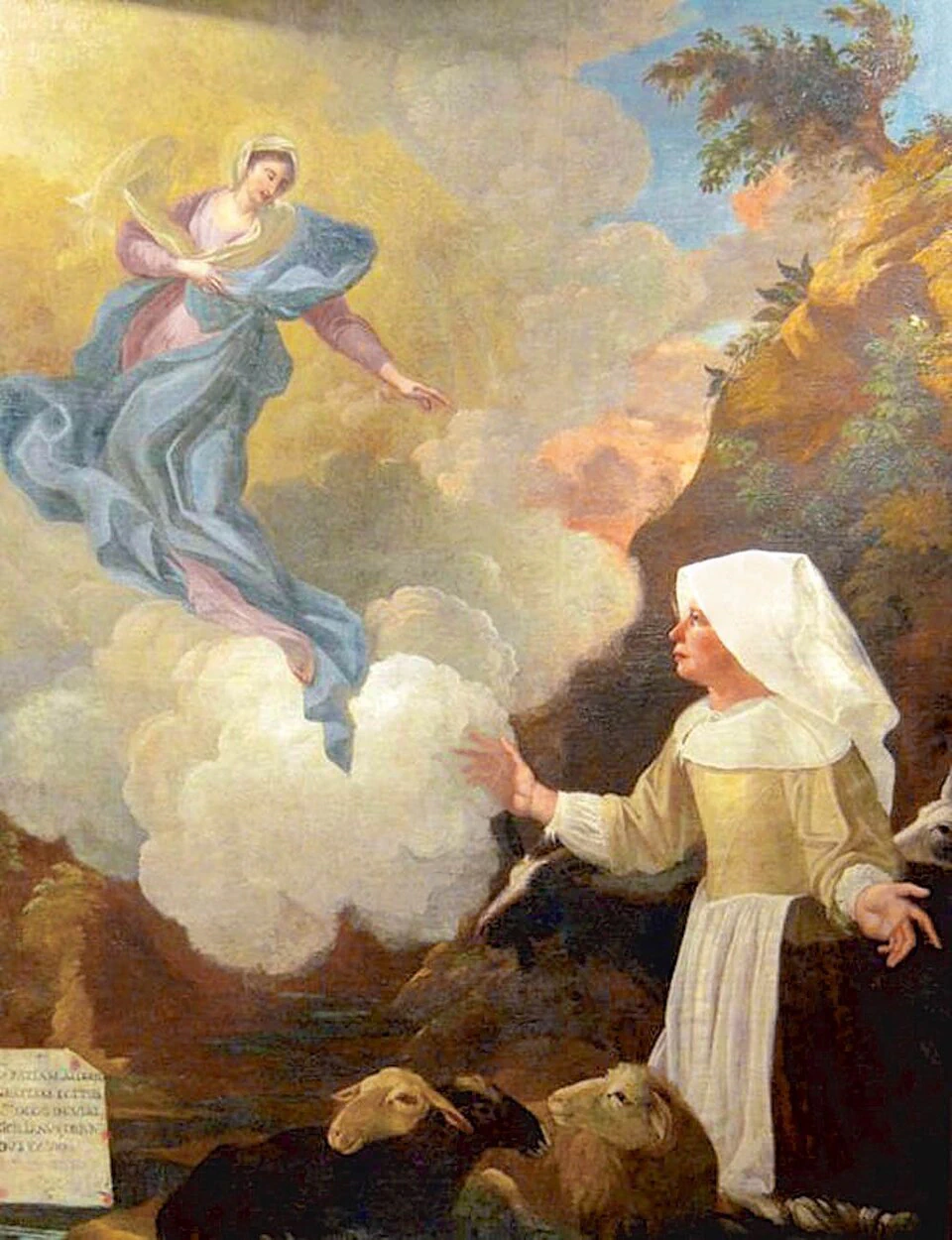
The sanctuary places Benoîte’s birth in 1647 and describes a modest family, her father’s death, and work as a shepherdess. Its account begins the reported Marian encounters in 1664 at the Vallon des Fours. These details establish the received biographical setting; they are not direct observation of the reported figure. [LAUS-03]
The human thread is a gradual vocation. In the shrine’s narrative, Benoîte is prepared for responsibility and sent toward other people. That gives the story a different rhythm from an apparition remembered principally for one public sign. [LAUS-03]
The chapel became a place to begin again
The sanctuary associates the chapel of Bon-Rencontre with the request for a place of conversion and for priests to receive pilgrims. The church was built around the chapel between 1666 and 1669. The reported vision thereby becomes connected with a durable place and a recognizable ministry. [LAUS-03]
In Catholic practice, reconciliation concerns repentance, forgiveness, and a changed life. Laus’s religious importance therefore includes what people do after arriving: pray, examine their lives, and seek sacramental reconciliation. That purpose is more substantial than collecting unusual experiences. [LAUS-03; LAUS-04]
Four voices preserve one woman’s story
François Grimaud, Jean Peytieu, Pierre Gaillard, and François Aubin knew Benoîte and wrote about the events. Their different roles—as judicial official, priests, and confidant—give the manuscript collection historical richness. They also mean the testimony is mediated through people who interpreted her life from within the devotion. [LAUS-03; LAUS-05]
The scholarly account warns that educated writers could render Benoîte’s spontaneous speech in theological language. A reader should therefore ask who wrote a particular passage and when. “The Laus manuscripts say” is an opening reference, not the end of source criticism. [LAUS-05]
How the papers survived
The shrine’s chronology says the papers were hidden during the Revolution, found again in 1824, and organized and copied in 1850 under episcopal direction. A reproduction of that authenticated copy followed in 1996 for research. This is a real transmission history with stages that can be examined. [LAUS-03]
The crucial next comparison is between surviving autographs and the later copy. It would help establish exact wording and connect individual claims with particular authors and dates. A large manuscript collection is valuable evidence; its size alone does not settle the cause of the experiences it describes. [LAUS-03; LAUS-05]
A pilgrimage can precede a formal judgment
The sanctuary dates permission for pilgrimage to 1665 but distinguishes it from formal recognition of the apparitions. In 2005 Bishop Jean-Michel di Falco sought procedural guidance, followed by commissions and a synthesis submitted in 2007, according to the official account. Those underlying reports and correspondence have not been inspected. [LAUS-02; LAUS-03]
On 4 May 2008 he signed the decree recognizing the supernatural origin of the facts lived and reported by Benoîte between 1664 and 1718. The signed diocesan act is directly relevant to status. The reported assent of the Congregation should not be recast as a separate public papal decree. [LAUS-01]
Why extraordinary side claims need their own sources
Popular accounts also describe fragrances, healings, knowledge of consciences, and other mystical phenomena. The 2008 decree is not a substitute for locating each claim in the manuscripts or examining its evidence. They should not be presented as a single scientifically established package. [LAUS-01; LAUS-03]
The Catholic purpose of the devotion can be explained without upgrading those claims. Recognized private revelation serves the existing faith; its value is not measured by the number of extraordinary effects a retelling can add. [LAUS-06; LAUS-07]
What makes Laus worth a closer look
Laus joins a woman’s long reported spiritual life, a pastoral community, and a substantial archive. Its most promising investigation is patient and specific: follow one episode through its earliest author, later copy, and institutional assessment. That approach respects the devotion while making its historical foundations intelligible. [LAUS-01; LAUS-03; LAUS-05]
Catholic reflection & discussion
Consider the message as well as the event
Explore the devotional meaning described in this article alongside the history of the report and the Church's response. Make space for both a personal response and questions about the record.
These editorial prompts invite reflection on the article. They are distinct from Church teaching and the evidence findings.
Pause and reflect
- Which part of the reported message or its reception would you like to understand more deeply?
- What exactly does the Church's recorded decision cover, and which questions does it leave open?
- What would it look like to approach this story with both a receptive heart and care for the truth?
Discuss with family or a group
Choose questions suited to your readers' ages and experiences. Anyone can pass or keep a response private.
- Identify who reported the experience, who investigated it, and who made a Church decision. Why does each person's role matter?
- How could you speak respectfully with someone whose response to this story differs from your own?
Questions people ask
Open any question for a fuller answer and its sources.
Were the apparitions formally recognized in the seventeenth century?
The sanctuary distinguishes the 1665 pilgrimage permission from the formal recognition issued in 2008. Those dates answer different questions. [LAUS-03]
Is the story preserved only by oral tradition?
Does the decree canonize Benoîte?
What the evidence can establish
Evidence verdict: unresolved
Did the experiences Benoîte Rencurel reported between 1664 and 1718 have an external supernatural cause?
The manuscript tradition, pilgrimage history, modern discernment process and signed 2008 decree are documented. The full primary corpus and commission record have not been inspected, the testimony is human and theologically mediated, and no repeatable evidence establishes or excludes an external supernatural cause.
Church or institutional status
Supernatural origin recognized by the Bishop of Gap and Embrun on 4 May 2008.
- Authority
- Jean-Michel di Falco Léandri, Bishop of Gap and Embrun, decree dated 4 May 2008.
- Scope of the finding
- The bishop recognized the supernatural origin of the facts lived and reported by Benoîte Rencurel between 1664 and 1718 and encouraged prayer at the sanctuary.
- Limits of the finding
- The decree is a local episcopal act, not a scientific demonstration or a separate papal decree, and it does not independently authenticate every message, miracle or later devotional claim. Official sources report prior CDF assent, but the assent document was not inspected.
Sources and notes
Back to the overviewSource labels describe a document's type and role, not the strength of a claim. Where provided, notes explain its use, access limits, and outstanding checks.
- LAUS-01Jean-Michel di Falco Léandri, Bishop of Gap and Embrun, Decree recognizing the facts lived and reported by Benoîte Rencurel, 4 May 2008 PDF (opens in a new tab)Primary source
One-page signed and sealed act — Exact operative scope: supernatural origin of the facts lived and reported by Benoîte between 1664 and 1718; encouragement to pray at the sanctuary.
- LAUS-02French Bishops’ Conference, "Reconnaissance officielle des Apparitions à Notre-Dame du Laus" (opens in a new tab)Official source
Official announcement linking the recognition decree and identifying the acting bishop and 4 May 2008 promulgation.
Official sanctuary chronology and manuscript-provenance account — Distinguishes 1665 pilgrimage authorization from 2008 formal recognition; describes the four authors, autographs, 1850 authenticated copy and 2005–08 process. Institutional source, not independent proof of supernatural origin.
- LAUS-04Diocese of Gap and Embrun, "Notre-Dame du Laus" (opens in a new tab)Official sourceFurther reading
Additional reading; inclusion here does not make it evidence for a claim.
Official diocesan account of the sanctuary, manuscript tradition and recognition chronology. Use for institutional chronology; underlying commission files still require inspection.
- LAUS-05Marcel Bernos, "Benoîte Rencurel et les pèlerins du Laus au XVIIe siècle", Provence historique 45, no. 182 (1995): 509–527 (opens in a new tab)Peer-reviewed research
Especially pp. 509–511 — Historical study of the manuscript tradition. Describes four eyewitness authors and the authenticated 1850 copy while warning that their expressions may theologically translate Benoîte's spontaneous language.
- LAUS-06Dicastery for the Doctrine of the Faith, "Norms for Proceeding in the Discernment of Alleged Supernatural Phenomena", 17 May 2024 (opens in a new tab)Official source
Presentation and pars. 11–13 — Current framework separating pastoral authorization from certainty of supernatural origin. It does not retroactively replace the 2008 decree.
Nos. 66–67 — Recognized private revelations do not belong to the deposit of faith and do not complete Christ's definitive revelation.
Corrections and updates
Expanded this file with a sourced narrative, 7 chapters and 4 answers to common questions. The existing evidence verdict label and institutional status are retained. Independent human review remains pending.