
Start here
The story, in brief
The Barbedette boys were helping their father prepare fodder when Eugène went to the barn doorway. In the sanctuary’s narrative, he saw a woman above the house opposite; his brother Joseph said he saw her too. Adults gathered but did not report sharing the same sight. The scene unfolded in January 1871, amid the fear of the Franco-Prussian War. [PM-02]
Children’s testimony is central
Adult participation in the gathering is not evidence that adults saw the figure. [PM-02]
The Church judgment is real
Bishop Wicart issued a positive judgment in 1872. [PM-01; PM-03]
The archive includes difficulties
Differences, prior exposure to apparition stories, and a later retraction must remain visible. [PM-01]
Explore the chapters
A village waiting for news
Pontmain’s official narrative places the community amid wartime uncertainty, with men away and families anxious for news. The parish priest, Michel Guérin, and villagers gathered in prayer as the children described what they said they saw. That setting explains why the event became associated with hope. [PM-02]
It also creates a historical question: how did shared fear, prayer, and communication shape the evening? Context need not be reduced to an accusation of invention. It is part of understanding what witnesses experienced and how their reports were interpreted. [PM-01; PM-02]
The figure in the children’s account
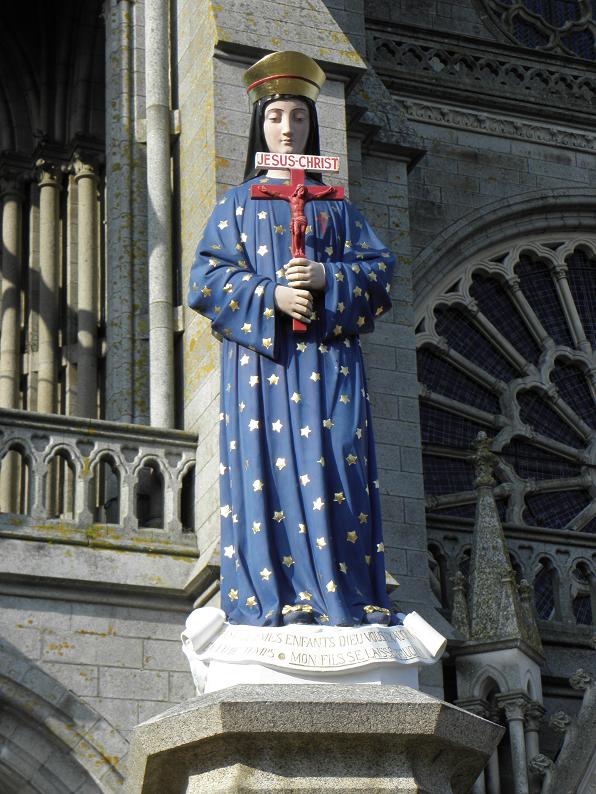
The received description includes a blue robe with stars, a crown, and a changing visual sequence. The sanctuary connects the event with prayer and trust in God. The adults’ participation was principally in listening and praying; the claim about the figure depends on the children’s testimony. [PM-02]
Descriptions of banners or exact visual timing deserve comparison with the earliest depositions. A devotional retelling may combine several accounts into a smooth sequence. Historical analysis must return to the individual statements to discover where that sequence is secure and where it is reconstructed. [PM-01; PM-02]
The archive was found again in 1992
The diocesan archivist describes the rediscovery of the canonical file at Laval in April 1992. Its inventory includes questioning of children and other witnesses, a three-doctor report, theological analyses, and commission minutes. Two listed studies were missing. This recovered file makes the case more substantial and more complicated than a short shrine summary. [PM-01]
The archive gives access to institutional reasoning as well as testimony. Missing pieces matter because they may have contained arguments needed to understand the final judgment. An inventory is an excellent research map, but it is not a substitute for inspecting each original. [PM-01]
Differences must be kept in the story
The archivist records differences in visual detail and excludes Eugène Friteau from the retained seers because his answers diverged. He also describes changing statements by the Barbedette brothers about their prior knowledge of Lourdes and La Salette. These details complicate claims of perfect agreement and complete independence. [PM-01]
Most seriously, Jeanne-Marie Lebossé said in 1919 that she had not seen the Virgin and had repeated the other children’s words. A later retraction has to be weighed, not hidden. It does not mechanically decide every other witness’s case, but it prevents describing all four as an uncontested, uniform body of evidence. [PM-01]
What Bishop Wicart judged
The official record attributes a positive apparition judgment to Bishop Casimir Wicart on 2 February 1872, naming Eugène and Joseph Barbedette, Françoise Richer, and Jeanne-Marie Lebossé. The act is a real part of Church history. It does not erase information that surfaced afterward. [PM-01; PM-02; PM-03]
The archivist also raises concerns about superficial inquiry and a hurried institutional attitude. Reporting these concerns beside the judgment respects the source more faithfully than choosing only its reassuring or only its adverse passages. [PM-01]
Did the apparition stop an army?
The devotional story connects Pontmain with the halt of the Prussian advance and the later armistice. The inspected record does not include military and diplomatic analysis establishing that the apparition caused either. Events occurring close together are not, by that fact alone, a demonstrated causal chain. [PM-02]
A Catholic may pray for peace and interpret deliverance as providential. That religious interpretation should remain distinct from a historical assertion about troop orders. The latter needs the appropriate military records. [PM-02; PM-05]
Hope without an edited archive
Pontmain’s devotional appeal is understandable: a frightened community prays together and remembers hope in a time of danger. Its historical interest is equally real, because the recovered archive exposes the work and difficulties behind recognition. The next useful step is comparison of original depositions, the retraction, and later decisions—not another unqualified retelling. [PM-01; PM-02]
The contemporary Vatican norms ordinarily distinguish permission for devotion from supernatural authentication. Pontmain’s 1872 judgment belongs to its own documented history and should be stated in those terms, without recasting it as a modern nihil obstat. [PM-04]
Catholic reflection & discussion
Consider the message as well as the event
Explore the devotional meaning described in this article alongside the history of the report and the Church's response. Make space for both a personal response and questions about the record.
These editorial prompts invite reflection on the article. They are distinct from Church teaching and the evidence findings.
Pause and reflect
- Which part of the reported message or its reception would you like to understand more deeply?
- What exactly does the Church's recorded decision cover, and which questions does it leave open?
- What would it look like to approach this story with both a receptive heart and care for the truth?
Discuss with family or a group
Choose questions suited to your readers' ages and experiences. Anyone can pass or keep a response private.
- Identify who reported the experience, who investigated it, and who made a Church decision. Why does each person's role matter?
- How could you speak respectfully with someone whose response to this story differs from your own?
Questions people ask
Open any question for a fuller answer and its sources.
Did the adults see Mary?
The official narrative distinguishes the children’s reported sight from adults gathering and praying. A crowd at the scene does not mean a shared crowd vision. [PM-02]
Did one recognized seer retract her account?
The diocesan archivist reports Jeanne-Marie Lebossé’s 1919 retraction. It remains a material part of this dossier. [PM-01]
Was there a positive Church judgment?
Is military intervention proved?
No. The necessary independent military and diplomatic record has not been supplied in the inspected sources. The devotional interpretation is not a demonstrated account of causation. [PM-02]
What the evidence can establish
Evidence verdict: unresolved
Did four children independently perceive the same external Marian figure at Pontmain on 17 January 1871?
The canonical file documents multiple child reports, extensive inquiry and a positive diocesan judgment. Account divergences, changed statements about prior exposure, uneven questioning, two missing studies, the bishop's early public commitment and Jeanne-Marie Lebossé's later retraction prevent the reviewed record from establishing or excluding four independent perceptions of one external supernatural figure.
Church or institutional status
Apparition judged genuine by the Bishop of Laval on 2 February 1872.
- Authority
- Casimir-Alexis-Joseph Wicart, Bishop of Laval, pastoral judgment dated 2 February 1872.
- Scope of the finding
- The judgment states that the Immaculate Virgin truly appeared at Pontmain on 17 January 1871 to Eugène Barbedette, Joseph Barbedette, Françoise Richer and Jeanne-Marie Lebossé.
- Limits of the finding
- This diocesan judgment is not scientific proof of four independent perceptions, does not establish military causation and does not erase Jeanne-Marie Lebossé's later retraction or the divergences in the recovered file.
Sources and notes
Back to the overviewSource labels describe a document's type and role, not the strength of a claim. Where provided, notes explain its use, access limits, and outstanding checks.
- PM-01Louis Raimbault, "Heurs et malheurs d’un procès canonique perdu et retrouvé", Archives de l’Église de France, Bulletin 39 (Spring 1993): 15–21 PDF (opens in a new tab)Official source
Official diocesan-archivist report — Documents the 13 April 1992 recovery and 18-piece inventory; quotes or summarizes the 1871–72 questioning, account divergences, prior-exposure statements, missing pieces 11 and 16, Lebossé's 1919 retraction, the bishop's early public commitment and the timing of the 1872 judgment. It is not a facsimile edition of the full dossier.
Current official sanctuary account — Preserves the received narrative and exact core wording of the 1872 judgment. Its linkage of the event with wartime developments is a devotional interpretation, not independent military causal analysis.
Official diocesan chronology corroborating Bishop Wicart and the 2 February 1872 recognition. Use for institutional history, not proof of supernatural or military causation.
- PM-04Dicastery for the Doctrine of the Faith, "Norms for Proceeding in the Discernment of Alleged Supernatural Phenomena", 17 May 2024 (opens in a new tab)Official source
Presentation and pars. 11–13 — Current framework separating pastoral authorization from certainty of supernatural origin. It does not retroactively replace the 1872 judgment.
Nos. 66–67 — Recognized private revelations do not belong to the deposit of faith and do not complete Christ's definitive revelation.
Corrections and updates
Expanded this file with a sourced narrative, 7 chapters and 4 answers to common questions. The existing evidence verdict label and institutional status are retained. Independent human review remains pending.