
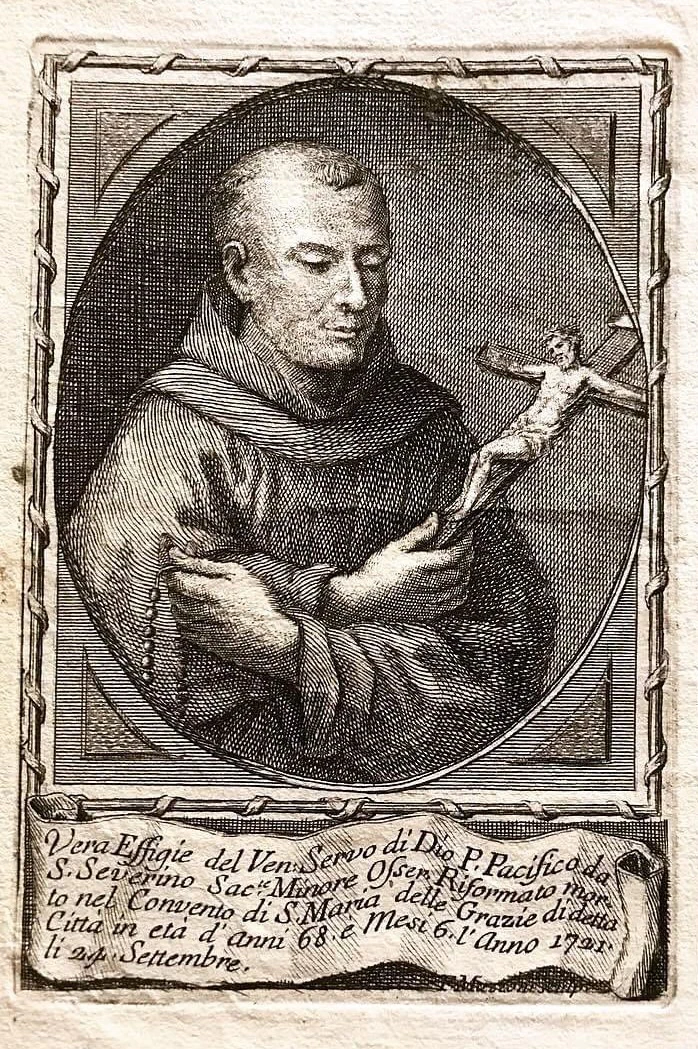
Start here
The story, in brief
What remains of a vocation when health no longer supports the old pace? Pacificus of San Severino’s official biography joins a long religious ministry with increasing physical frailty. It gives a quiet human question to a case often introduced only through attributed remains. [SAINT-SAINT-PACIFICUS-OF-SAN-SEVERINO-S01]
Community and ministry
His offices and transfers locate him within Franciscan life. [SAINT-SAINT-PACIFICUS-OF-SAN-SEVERINO-S01]
Worth beyond stamina
Declining health belongs to the remembered life. [SAINT-SAINT-PACIFICUS-OF-SAN-SEVERINO-S01]
An open material question
The source does not establish the state of attributed remains. [SAINT-SAINT-PACIFICUS-OF-SAN-SEVERINO-S01]
Explore the chapters
Carlo Antonio enters the Franciscans
Born Carlo Antonio Divini in San Severino in 1653, he was orphaned young and raised by his maternal uncle. At seventeen he entered the Friars Minor and took the name Pacificus. These are the concrete early-life anchors supplied by the Dicastery. [SAINT-SAINT-PACIFICUS-OF-SAN-SEVERINO-S01]
Responsibilities within a community
The biography records service as vicar of the San Severino convent and a later move to Forano. Prayer and apostolic work are presented together. Even a short institutional account can therefore show something more than a sequence of titles: his religious life involved duties to other people and continuity within a community. [SAINT-SAINT-PACIFICUS-OF-SAN-SEVERINO-S01]
A body that became less dependable
The official account describes increasingly fragile health before his death in 1721. It does not provide enough medical detail to diagnose that decline. The human significance is still clear: the value of his life is not portrayed as ending when physical strength diminished. This is an interpretation of the biography’s pattern, not an invented account of his symptoms. [SAINT-SAINT-PACIFICUS-OF-SAN-SEVERINO-S01]
Why prayer belongs to the explanation
The Dicastery particularly identifies solitude and prayer before the Blessed Sacrament. In the Catholic account, this is a relationship with Christ rather than a substitute activity chosen only because useful work is impossible. The contemplative dimension gives his story meaning even where the source cannot support a long catalogue of public achievements. [SAINT-SAINT-PACIFICUS-OF-SAN-SEVERINO-S01]
The recognition that is documented
The official record dates beatification to 1786 and canonization to 1839. Those acts establish Catholic recognition. The source does not supply a complete cause history or the precise miracles considered, so those should not be invented to make the timeline appear fuller. [SAINT-SAINT-PACIFICUS-OF-SAN-SEVERINO-S01]
A modest claim about what can be known
The preservation question remains unresolved because the biography does not contain anatomy, custody, or conservation evidence for the attributed remains. A fuller archival life and case-specific examination records would enrich different parts of the file. The present account stays compact because a short source should not be inflated into a detailed biography it cannot sustain. [SAINT-SAINT-PACIFICUS-OF-SAN-SEVERINO-S01]
Catholic reflection & discussion
Look for the person within the story
Spend a moment with the choices, relationships and hardships in this life. Consider what you might learn from the person as well as from the extraordinary claims examined in the file.
These editorial prompts invite reflection on the article. They are distinct from Church teaching and the evidence findings.
Pause and reflect
- Which choice or experience in this life stays with you, and why?
- What would you like to understand better about the person's faith and the world they lived in?
- Is there a small act of patience, courage or service that this reading invites you to consider?
Discuss with family or a group
Choose questions suited to your readers' ages and experiences. Anyone can pass or keep a response private.
- Ask each person to choose a moment from the life described here. What makes that moment worth remembering?
- Which details have clear sources, and which remain uncertain? How could you tell the story honestly without losing its human meaning?
Questions people ask
Open any question for a fuller answer and its sources.
What was his birth name?
The official biography gives Carlo Antonio Divini; Pacificus was his Franciscan religious name. [SAINT-SAINT-PACIFICUS-OF-SAN-SEVERINO-S01]
Do the sources diagnose his illness?
The inspected profile describes declining health without enough detail for a medical diagnosis. [SAINT-SAINT-PACIFICUS-OF-SAN-SEVERINO-S01]
What did Catholics particularly remember?
The source emphasizes prayer, solitude, penance, and Franciscan ministry. [SAINT-SAINT-PACIFICUS-OF-SAN-SEVERINO-S01]
Why is this narrative shorter than some others?
The official biography is compact. Its limits should remain visible instead of being filled with unsourced scenes or repetitive claims. [SAINT-SAINT-PACIFICUS-OF-SAN-SEVERINO-S01]
What the evidence can establish
Evidence verdict: unresolved
Does the available evidence establish that the displayed or attributed remains of Saint Pacificus of San Severino are the naturally preserved, substantially intact body of that person, without undisclosed embalming, reconstruction, wax covering, replacement, or later conservation treatment?
Canonized Catholic saint. Official sources confirm that status or custody for Saint Pacificus of San Severino. They do not provide the independent anatomical evidence, custody documentation, or treatment history needed to answer whether the remains are naturally preserved.
Sources: [SAINT-SAINT-PACIFICUS-OF-SAN-SEVERINO-S01]
Church or institutional status
Canonized Catholic saint
- Authority
- Dicastery for the Causes of Saints
- Scope of the finding
- The cited official record documents the person's Catholic canonization and saintly title.
- Limits of the finding
- It does not authenticate the attributed remains, establish natural preservation, or prove a miracle.
- Official sources
- [SAINT-SAINT-PACIFICUS-OF-SAN-SEVERINO-S01]
Sources and notes
Back to the overviewSource labels describe a document's type and role, not the strength of a claim. Where provided, notes explain its use, access limits, and outstanding checks.
- SAINT-SAINT-PACIFICUS-OF-SAN-SEVERINO-S01Dicastery for the Causes of Saints profile — Saint Pacificus of San Severino (opens in a new tab)Official source
Identifies this person and records the stated Catholic beatification/canonization or liturgical status; it does not establish the physical preservation claim. What it does not establish: This institutional record establishes only the stated act, status, teaching, or account; it does not independently establish material identity, preservation mechanism, or supernatural causation.
Corrections and updates
Expanded this file with a sourced narrative, 6 chapters and 4 answers to common questions. The existing evidence verdict label and institutional status are retained. Independent human review remains pending.