
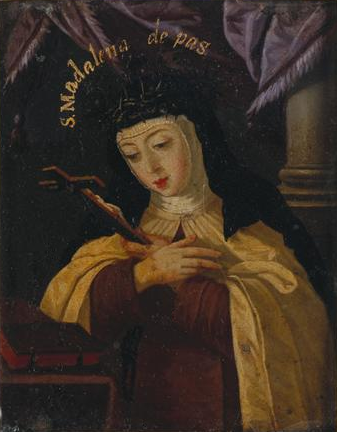
Start here
The story, in brief
A convent can appear remote from public life, yet Mary Magdalene de’ Pazzi’s recorded concerns reached toward the reform of the whole Church. Benedict XVI’s 2007 letter describes manuscripts of her experiences and letters addressed to Church leaders. [SAINT-SAINT-MARY-MAGDALENE-DE-PAZZI-S01]
The same letter says her body remained incorrupt. Both statements deserve accurate presentation, but they are different kinds of evidence: an account of texts and spirituality, and an institutional claim about bodily condition. [SAINT-SAINT-MARY-MAGDALENE-DE-PAZZI-S01]
A manuscript legacy
The community preserved a substantial record of spiritual experience. [SAINT-SAINT-MARY-MAGDALENE-DE-PAZZI-S01]
Renewal and service
Her concerns reached Church reform and novice formation. [SAINT-SAINT-MARY-MAGDALENE-DE-PAZZI-S01]
A scoped official claim
The papal incorruption statement is not a forensic report. [SAINT-SAINT-MARY-MAGDALENE-DE-PAZZI-S01]
Explore the chapters
Caterina becomes a Carmelite
Born in Florence in 1566 as Caterina, she entered the Carmelite community of Saint Mary of the Angels and took the name Mary Magdalene. The papal account places her religious profession during serious illness in 1584. Her intellectual and spiritual legacy was formed inside an actual community with vows, responsibilities, and other women recording what they witnessed. [SAINT-SAINT-MARY-MAGDALENE-DE-PAZZI-S01]
How the experiences reached later readers
Benedict XVI identifies five manuscripts preserving accounts of extraordinary experiences, including The Forty Days, The Colloquies, and Revelations and Intelligences. That transmission matters. Readers encounter a textual record preserved by her community, not direct access to her inner state. A serious reading can examine the content and history without pretending the mediation is irrelevant. [SAINT-SAINT-MARY-MAGDALENE-DE-PAZZI-S01]
Theology with a wide horizon
The papal letter describes her contemplation ranging from the Incarnation to Pentecost. The point is not fascination with unusual states for their own sake. In the Catholic interpretation, the experiences direct attention to the Christian account of salvation and union with God. That subject gives them theological content beyond a claim that something extraordinary happened. [SAINT-SAINT-MARY-MAGDALENE-DE-PAZZI-S01]
The years without consolation
The same account describes five years of inward trial and purification. Her story therefore does not portray mystical life as uninterrupted exhilaration. Spiritual commitment is presented as continuing when the felt sense of grace diminishes. This remains a theological interpretation of her recorded life, not a diagnosis or a general explanation for every form of distress. [SAINT-SAINT-MARY-MAGDALENE-DE-PAZZI-S01]
Letters calling for renewal
A manuscript called The Renovation of the Church contains twelve letters directed toward Church authorities. Benedict XVI notes that they may never have been sent. That qualification is consequential: the letters establish a concern and a literary record, not proof that each recipient read them or that they caused a particular reform. [SAINT-SAINT-MARY-MAGDALENE-DE-PAZZI-S01]
Service within the community
After the period of trial, the papal account emphasizes service to the community and the formation of novices. The interior life is interpreted through these relationships. It is a useful corrective to the assumption that mystical distinction makes ordinary responsibilities secondary. [SAINT-SAINT-MARY-MAGDALENE-DE-PAZZI-S01]
Recognition and a claim about the body
She died in 1607 and was canonized in 1669. Benedict XVI’sletter explicitly describes her body as incorrupt. This establishes the existence of that Holy See statement, while anatomy, conservation, and mechanism still require case-specific records. The manuscripts meanwhile remain an independent and substantial route into why the Church remembers her. [SAINT-SAINT-MARY-MAGDALENE-DE-PAZZI-S01]
Catholic reflection & discussion
Look for the person within the story
Spend a moment with the choices, relationships and hardships in this life. Consider what you might learn from the person as well as from the extraordinary claims examined in the file.
These editorial prompts invite reflection on the article. They are distinct from Church teaching and the evidence findings.
Pause and reflect
- Which choice or experience in this life stays with you, and why?
- What would you like to understand better about the person's faith and the world they lived in?
- Is there a small act of patience, courage or service that this reading invites you to consider?
Discuss with family or a group
Choose questions suited to your readers' ages and experiences. Anyone can pass or keep a response private.
- Ask each person to choose a moment from the life described here. What makes that moment worth remembering?
- Which details have clear sources, and which remain uncertain? How could you tell the story honestly without losing its human meaning?
Questions people ask
Open any question for a fuller answer and its sources.
Did she write to the Pope?
The papal account describes letters addressed to Church leaders but says they may never have been sent. Their composition and delivery must be distinguished. [SAINT-SAINT-MARY-MAGDALENE-DE-PAZZI-S01]
Are the mystical experiences documented?
They are recorded in manuscripts preserved by her community. That establishes a transmitted account, not direct measurement of an interior event. [SAINT-SAINT-MARY-MAGDALENE-DE-PAZZI-S01]
Does a Holy See source call the body incorrupt?
Yes. Benedict XVI’s 2007 letter does. It does not publish an anatomical examination or conservation history. [SAINT-SAINT-MARY-MAGDALENE-DE-PAZZI-S01]
What gives her story substance beyond ecstasies?
The theological content, concern for Church renewal, and service in novice formation are all part of the official account. [SAINT-SAINT-MARY-MAGDALENE-DE-PAZZI-S01]
What the evidence can establish
Evidence verdict: unresolved
Does the available evidence establish that the displayed or attributed remains of Saint Mary Magdalene de' Pazzi are the naturally preserved, substantially intact body of that person, without undisclosed embalming, reconstruction, wax covering, replacement, or later conservation treatment?
An official Holy See source states that Mary Magdalene de' Pazzi's body has remained incorrupt. That is an official or custodial account and is recorded under Church status. The inspected record does not include the independent anatomical evidence, custody documentation, or treatment history needed to establish natural preservation, so the physical claim remains unresolved.
Sources: [SAINT-SAINT-MARY-MAGDALENE-DE-PAZZI-S01]
Church or institutional status
Canonized Catholic saint
- Authority
- Holy See
- Scope of the finding
- Benedict XVI records her canonization and states that her body has remained incorrupt and is a pilgrimage destination.
- Limits of the finding
- The papal letter is an institutional statement, not a published anatomical or conservation report.
- Official sources
- [SAINT-SAINT-MARY-MAGDALENE-DE-PAZZI-S01]
Sources and notes
Back to the overviewSource labels describe a document's type and role, not the strength of a claim. Where provided, notes explain its use, access limits, and outstanding checks.
- SAINT-SAINT-MARY-MAGDALENE-DE-PAZZI-S01Holy See document — Saint Mary Magdalene de' Pazzi (opens in a new tab)Official source
Records her canonization and states that her body has remained incorrupt. What it does not establish: This institutional record establishes only the stated act, status, teaching, or account; it does not independently establish material identity, preservation mechanism, or supernatural causation.
Corrections and updates
Expanded this file with a sourced narrative, 7 chapters and 4 answers to common questions. The existing evidence verdict label and institutional status are retained. Independent human review remains pending.