
Start here
The story, in brief
Margaret Mary Alacoque’s influence traveled far beyond her convent at Paray-le-Monial. Her reported experiences helped give Sacred Heart devotion an enduring vocabulary and imagery centered on Christ’s love for humanity. [SAINT-SAINT-MARGARET-MARY-ALACOQUE-S01]
Her story is therefore about the power of testimony within a religious community, as well as the difficult process of discerning it. Canonization, the spread of devotion, particular reported messages, and a later bodily preservation claim are not one interchangeable conclusion. [SAINT-SAINT-MARGARET-MARY-ALACOQUE-S01]
A Christ-centered devotion
The Sacred Heart expresses Christ’s love and self-giving. [SAINT-SAINT-MARGARET-MARY-ALACOQUE-S01]
Mediated testimony
Her experiences reached readers through writing and spiritual guidance. [SAINT-SAINT-MARGARET-MARY-ALACOQUE-S01]
Distinct cause miracles
The 1918 record concerns two miracles attributed to intercession. [SAINT-SAINT-MARGARET-MARY-ALACOQUE-S01]
Explore the chapters
Entering the Visitation
Born in Burgundy in 1647, Margaret Mary entered the Visitation in adulthood after family resistance. The official account describes an enclosed religious life marked by prayer and demanding community circumstances. Her later influence should not obscure that institutional setting: her experiences were interpreted and transmitted through relationships with other religious. [SAINT-SAINT-MARGARET-MARY-ALACOQUE-S01]
A testimony that met resistance
The biography describes disbelief and suspicion toward her reported experiences. It also identifies the Jesuit Claude de la Colombière as an important spiritual guide who encouraged an account of them. These details explain how private experience became a written record; they do not give a modern reader unmediated access to the experiences themselves. [SAINT-SAINT-MARGARET-MARY-ALACOQUE-S01]
What the Sacred Heart is meant to express
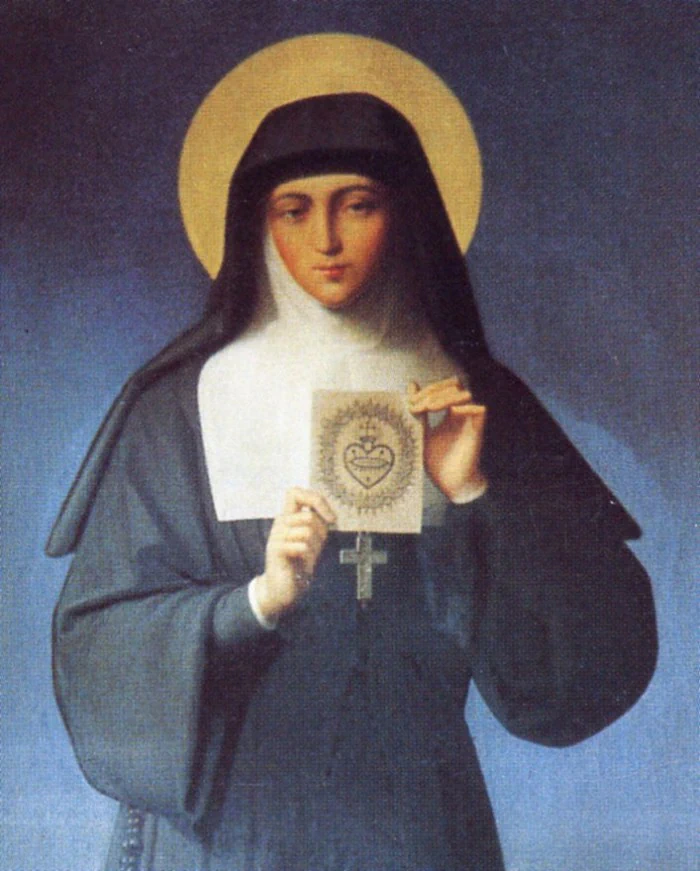
The devotion focuses on Jesus’s love, represented by his heart and interpreted through his suffering and self-giving. In Margaret Mary’s account, the wounded heart, thorns, and cross are connected images. The religious object is Christ, not an anatomical organ detached from the person or a power independent of him. [SAINT-SAINT-MARGARET-MARY-ALACOQUE-S01]
From an enclosed testimony to public devotion
The official biography links her experiences from 1673 onward with the promotion of Sacred Heart devotion. Its later public expression includes prayer, art, and liturgical observance. That historical influence can be described without assuming every step in a long devotional development was produced by one person alone. [SAINT-SAINT-MARGARET-MARY-ALACOQUE-S01]
How to read the reported promises
The page recounts a promise associated with Communion on nine consecutive first Fridays. It belongs to the reported revelation and its devotional reception. It should not be presented as a mechanical transaction that removes the meaning of conversion or sacramental life. The source’s own emphasis on love and dedication gives the practice its religious setting. [SAINT-SAINT-MARGARET-MARY-ALACOQUE-S01]
The cause was a separate investigation
Beatification occurred in 1864 and canonization in 1920. The official page reproduces Benedict XV’s 1918 address after approval of two miracles attributed to her intercession. This is a more precise statement than saying that her visions themselves were the canonization miracles. Identifying the two medical or other cases requires their specific records. [SAINT-SAINT-MARGARET-MARY-ALACOQUE-S01]
What a reader can assess directly
A reader can examine her transmitted testimony, the development of devotion, and the Church’s stated theological interpretation. A claim about her remains requires its own material history. Her central significance lies in how a religious community learned to speak about Christ’s love, not in an unsupported inference from a saintly title to an untreated body. [SAINT-SAINT-MARGARET-MARY-ALACOQUE-S01]
Catholic reflection & discussion
Look for the person within the story
Spend a moment with the choices, relationships and hardships in this life. Consider what you might learn from the person as well as from the extraordinary claims examined in the file.
These editorial prompts invite reflection on the article. They are distinct from Church teaching and the evidence findings.
Pause and reflect
- Which choice or experience in this life stays with you, and why?
- What would you like to understand better about the person's faith and the world they lived in?
- Is there a small act of patience, courage or service that this reading invites you to consider?
Discuss with family or a group
Choose questions suited to your readers' ages and experiences. Anyone can pass or keep a response private.
- Ask each person to choose a moment from the life described here. What makes that moment worth remembering?
- Which details have clear sources, and which remain uncertain? How could you tell the story honestly without losing its human meaning?
Questions people ask
Open any question for a fuller answer and its sources.
Do Catholics worship a separate heart?
The devotion concerns Jesus Christ and his love, expressed through the imagery of his heart and Passion. [SAINT-SAINT-MARGARET-MARY-ALACOQUE-S01]
Were her visions the miracles used for canonization?
The official page records approval of two miracles attributed to her intercession in 1918. It does not identify those with the reported lifetime visions. [SAINT-SAINT-MARGARET-MARY-ALACOQUE-S01]
Who was Claude de la Colombière?
The Jesuit spiritual guide identified in the biography helped her give a written account of her experiences. [SAINT-SAINT-MARGARET-MARY-ALACOQUE-S01]
Does canonization verify every reported message?
The documented act recognizes her as a saint. Each extraordinary claim still needs its particular source and the exact scope of any Church decision. [SAINT-SAINT-MARGARET-MARY-ALACOQUE-S01]
What the evidence can establish
Evidence verdict: unresolved
Does the available evidence establish that the displayed or attributed remains of Saint Margaret Mary Alacoque are the naturally preserved, substantially intact body of that person, without undisclosed embalming, reconstruction, wax covering, replacement, or later conservation treatment?
Canonized Catholic saint. Official sources confirm that status or custody for Saint Margaret Mary Alacoque. They do not provide the independent anatomical evidence, custody documentation, or treatment history needed to answer whether the remains are naturally preserved.
Sources: [SAINT-SAINT-MARGARET-MARY-ALACOQUE-S01]
Church or institutional status
Canonized Catholic saint
- Authority
- Dicastery for the Causes of Saints
- Scope of the finding
- The cited official record documents the person's Catholic canonization and saintly title.
- Limits of the finding
- It does not authenticate the attributed remains, establish natural preservation, or prove a miracle.
- Official sources
- [SAINT-SAINT-MARGARET-MARY-ALACOQUE-S01]
Sources and notes
Back to the overviewSource labels describe a document's type and role, not the strength of a claim. Where provided, notes explain its use, access limits, and outstanding checks.
- SAINT-SAINT-MARGARET-MARY-ALACOQUE-S01Dicastery for the Causes of Saints profile — Saint Margaret Mary Alacoque (opens in a new tab)Official source
Identifies this person and records the stated Catholic beatification/canonization or liturgical status; it does not establish the physical preservation claim. What it does not establish: This institutional record establishes only the stated act, status, teaching, or account; it does not independently establish material identity, preservation mechanism, or supernatural causation.
Corrections and updates
Expanded this file with a sourced narrative, 7 chapters and 4 answers to common questions. The existing evidence verdict label and institutional status are retained. Independent human review remains pending.