
Start here
The story, in brief
Maria Goretti was a child before she was a symbol. She came from a poor rural family and was killed in 1902 after resisting sexual assault. A responsible account begins with her dignity and the violence done to her, without graphic retelling. [MGR-01] [MGR-02]
The shrine’s description also resolves a persistent visual misunderstanding: the glass casket contains a wax figure enclosing skeletal remains. Her body is not an incorrupt body of visible flesh. [MGR-01]
A child’s dignity
Her life deserves careful treatment beyond the violence of her death. [MGR-02]
A wax representation
The custodian says the visible figure encloses skeletal remains. [MGR-01]
No incorrupt-body claim
The shrine explicitly says her body underwent natural degradation. [MGR-01]
Explore the chapters
A short life should not disappear into a death
Maria lived from 1890 to 1902. Catholic commemoration focuses on her martyrdom, but the child’s ordinary human identity must remain visible. Her worth was not created by suffering, and the violence against her should never be presented as a desirable path for a child to follow. The sources establish a particular life and death, not a standard for how victims must react. [MGR-01] [MGR-02]
How Catholics interpret her witness
Pius XII canonized Maria as a virgin and martyr in 1950. The Church’s account honors her fidelity and forgiveness. That religious interpretation should be explained as the meaning Catholics find in her response, not as a suggestion that another survivor’s dignity depends on resistance, injury, or an ability to forgive immediately. [MGR-02]
Forgiveness does not remove responsibility
The custodial pilgrimage material emphasizes Maria’s forgiveness of her attacker. Forgiveness in this story does not make the assault acceptable or turn the attacker into its central victim. Keeping Maria’s personhood in view prevents a narrative of another person’s conversion from displacing the child whose life was taken. [MGR-01]
What lies inside the casket
The custodian says a wax statue encloses her skeletal remains and that none of the remains are visible. It describes the skeleton as substantially complete, while identifying small removed fragments and the right arm separately kept at Corinaldo. The visible face and hands must therefore be understood as part of the artistic presentation. [MGR-01]
How the likeness was made
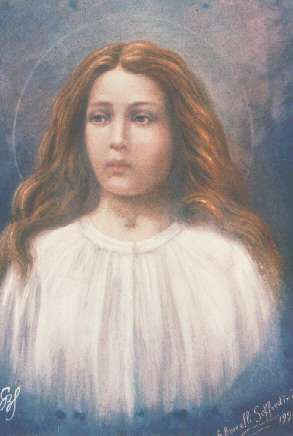
The custodian explains that artists used a painted portrait based on her mother’s description. It says no photograph of Maria was available. The likeness is consequently a mediated memorial image, not a death mask or photographic record. That history makes the figure more understandable while preventing it from being mistaken for anatomical evidence. [MGR-01]
What the custodian explicitly rejects
The source directly states that Maria’s body is not incorrupt and underwent natural degradation after burial. This is not a skeptical speculation imposed from outside the shrine. It is information supplied by the custodial presentation itself, and it should be visible wherever the figure is discussed. [MGR-01]
A reason to care without a spectacle
The case remains significant because it concerns a child’s dignity, violence, religious witness, and the difficult meaning of forgiveness. The casket is a devotional memorial containing remains. Readers can understand its religious role without claiming that the wax exterior demonstrates supernatural preservation. [MGR-01] [MGR-02]
The familiar portrait also needs a careful caption. The registered image is Giuseppe Brovelli-Soffredini’s 1929 painting, made long after Maria’s death from a description. It is a devotional likeness, not a photograph of Maria alive or a record of the condition of her remains. [MGR-03]
Catholic reflection & discussion
Look for the person within the story
Spend a moment with the choices, relationships and hardships in this life. Consider what you might learn from the person as well as from the extraordinary claims examined in the file.
These editorial prompts invite reflection on the article. They are distinct from Church teaching and the evidence findings.
Pause and reflect
- Which choice or experience in this life stays with you, and why?
- What would you like to understand better about the person's faith and the world they lived in?
- Is there a small act of patience, courage or service that this reading invites you to consider?
Discuss with family or a group
Choose questions suited to your readers' ages and experiences. Anyone can pass or keep a response private.
- Ask each person to choose a moment from the life described here. What makes that moment worth remembering?
- Which details have clear sources, and which remain uncertain? How could you tell the story honestly without losing its human meaning?
Questions people ask
Open any question for a fuller answer and its sources.
Is the body in the casket incorrupt?
No. The custodian explicitly rejects that description and identifies skeletal remains inside a wax figure. [MGR-01]
Can visitors see her actual remains?
The source says none are visible within the display. [MGR-01]
Was the face modeled from a photograph?
The custodian says the likeness drew on a portrait based on her mother’s description, not a photograph. [MGR-01]
Does honoring Maria set a test for other victims?
This article does not turn her particular witness into a requirement that another victim resist in a certain way, endure injury, or forgive on demand. The Catholic recognition concerns Maria’s life; abuse never removes another person’s dignity. [MGR-02]
What the evidence can establish
Evidence verdict: debunked
Is the lifelike figure visible in Maria Goretti's glass casket her naturally incorrupt flesh?
The custodial source says that the visible figure is a wax statue enclosing skeletal remains, that none of the remains are visible, and that her body naturally degraded after burial.
Sources: [MGR-01]
Church or institutional status
Canonized saint, virgin, and martyr since 24 June 1950.
- Authority
- Pope Pius XII, solemn canonization formula of 24 June 1950.
- Scope of the finding
- Formal canonization and universal liturgical commemoration among virgins and martyrs.
- Limits of the finding
- Canonization recognizes Maria Goretti's sainthood and martyrdom; it does not authenticate the casket figure as flesh or establish supernatural preservation.
- Official sources
- [MGR-02]
Sources and notes
Back to the overviewSource labels describe a document's type and role, not the strength of a claim. Where provided, notes explain its use, access limits, and outstanding checks.
Custodial page produced for the major-relic pilgrimage. It identifies the wax statue, enclosed skeletal remains, nonvisibility of the remains, and natural degradation. It is direct institutional/custodial evidence for the present display claim, not the underlying primary exhumation or conservation file.
- MGR-02Pius XII, solemn canonization of Maria Goretti, 24 June 1950 (opens in a new tab)Official source
Primary Holy See text. The operative formula declares Maria Goretti a saint and prescribes universal commemoration among virgins and martyrs; it makes no preservation finding.
Image rights: a 1929 painting by Giuseppe Brovelli-Soffredini; the reproduction source is unknown. Commons marks the two-dimensional reproduction with the Public Domain Mark and records the artist's 1936 death and pre-1931 US publication basis. Commercial reuse is permitted under that status, no ShareAlike condition applies, and the displayed 293-by-436-pixel copy appears unaltered. Context is a later portrait based on a description, not a photograph or preservation evidence; attribution and source-linking remain prudent.
Corrections and updates
Expanded this file with a sourced narrative, 7 chapters and 4 answers to common questions. The existing evidence verdict label and institutional status are retained. Independent human review remains pending.