
Start here
The story, in brief
For this case, there is no intact body waiting for a better scan. The Archdiocese of Valencia says Louis Bertrand’s remains, historically described as incorrupt, were completely burned in 1936. That makes the earlier preservation account a question about surviving testimony. [SAINT-SAINT-LOUIS-BERTRAND-S01]
The living man deserves equal attention: a Dominican preacher and teacher whose years in New Granada placed his religious mission inside the realities of colonial rule. [SAINT-SAINT-LOUIS-BERTRAND-S01]
A transatlantic life
His mission connected Valencia and New Granada. [SAINT-SAINT-LOUIS-BERTRAND-S01]
A lost physical subject
The archdiocese records complete destruction of the body in 1936. [SAINT-SAINT-LOUIS-BERTRAND-S01]
An archival opportunity
Original process testimony may clarify historical claims. [SAINT-SAINT-LOUIS-BERTRAND-S01]
Explore the chapters
A Dominican formed in Valencia
Born in Valencia in 1526, Louis received the Dominican habit in 1544 and was ordained in 1547. His work included preaching, prayer, and the formation of novices. The order’s historical institute and the archdiocese place him within a city where buildings, devotional objects, and local commemorations still preserve his memory. [SAINT-SAINT-LOUIS-BERTRAND-S01] [SAINT-SAINT-LOUIS-BERTRAND-S02]
Seven years in New Granada
In 1562 he traveled to New Granada, remaining for seven years. Valencia’s account emphasizes his defense of Indigenous dignity and the dangers and illness he encountered. This establishes the Church’s interpretation of his mission. A fuller historical study would also seek Indigenous perspectives and colonial records rather than treating a missionary biography as the entire social history. [SAINT-SAINT-LOUIS-BERTRAND-S01]
Formation after the journey
After returning to Spain, Louis held responsibilities as prior and teacher. The archdiocese reports repeated service as master of novices and identifies sermons and spiritual writing among his works. His legacy therefore includes the less visible task of forming other religious, not only the dramatic image of a missionary abroad. [SAINT-SAINT-LOUIS-BERTRAND-S01]
Miracle stories enter the landscape
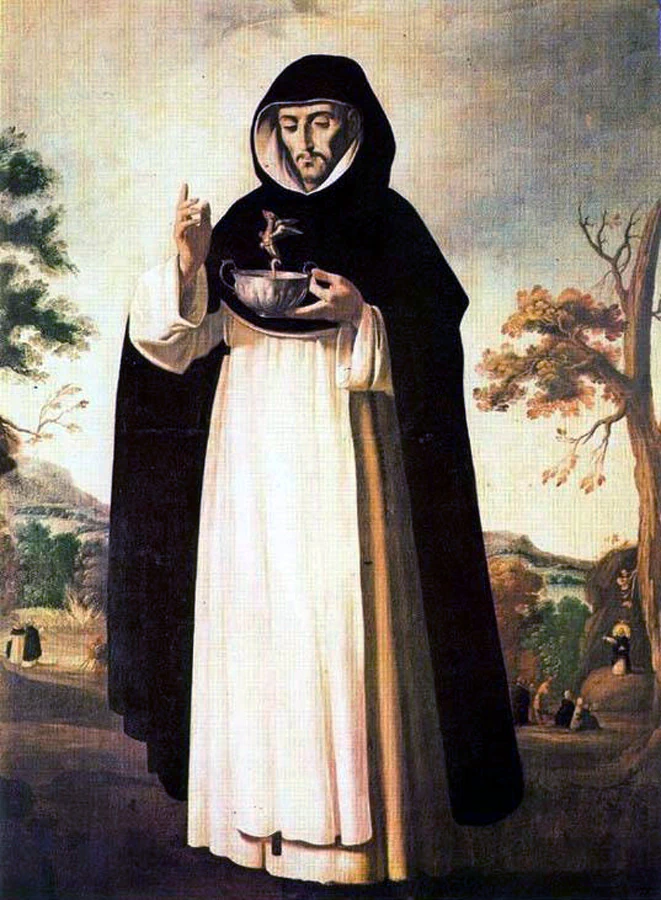
Local art and devotion preserve stories of a fire stopped, a weapon transformed, and bitter water changed. The institutional sources explicitly place some of these within tradition and artistic representation. Their cultural persistence is documented; the paintings are not independent eyewitness records establishing the events or their supernatural cause. [SAINT-SAINT-LOUIS-BERTRAND-S01] [SAINT-SAINT-LOUIS-BERTRAND-S02]
Recognition and a surviving archive
Beatification in 1608 and canonization in 1671 are recorded by the archdiocese. Its account also identifies process testimony preserved at the Dominican convent archive in Valencia. That is a concrete research lead: original testimony could clarify which claims were considered and how, instead of allowing every popular story to acquire the same evidentiary weight. [SAINT-SAINT-LOUIS-BERTRAND-S01]
The destruction changes the question
The archdiocese describes the body as historically incorrupt, then records its complete burning in 1936. A present substantially intact-body claim cannot be maintained against that custodial statement. Earlier examinations, photographs, inventories, and eyewitness testimony could still illuminate what had been preserved before destruction, but they would answer a historical question. [SAINT-SAINT-LOUIS-BERTRAND-S01]
Why the life remains worth investigating
Louis’s life raises enduring questions about religious mission, the defense of vulnerable people, and the moral compromises of a colonial setting. Those questions survive the loss of the body. A balanced account neither treats devotional memory as laboratory evidence nor assumes that the destruction of a relic makes the person’s history irrelevant. [SAINT-SAINT-LOUIS-BERTRAND-S01] [SAINT-SAINT-LOUIS-BERTRAND-S02]
Catholic reflection & discussion
Look for the person within the story
Spend a moment with the choices, relationships and hardships in this life. Consider what you might learn from the person as well as from the extraordinary claims examined in the file.
These editorial prompts invite reflection on the article. They are distinct from Church teaching and the evidence findings.
Pause and reflect
- Which choice or experience in this life stays with you, and why?
- What would you like to understand better about the person's faith and the world they lived in?
- Is there a small act of patience, courage or service that this reading invites you to consider?
Discuss with family or a group
Choose questions suited to your readers' ages and experiences. Anyone can pass or keep a response private.
- Ask each person to choose a moment from the life described here. What makes that moment worth remembering?
- Which details have clear sources, and which remain uncertain? How could you tell the story honestly without losing its human meaning?
Questions people ask
Open any question for a fuller answer and its sources.
Can the allegedly incorrupt body be examined now?
The archdiocese says it was completely burned in 1936. The investigation must therefore rely on earlier documentation, not a present intact specimen. [SAINT-SAINT-LOUIS-BERTRAND-S01]
Why is Colombia part of his story?
He worked in New Granada for seven years and is remembered as a patron of Colombia. [SAINT-SAINT-LOUIS-BERTRAND-S01]
Are the miracle scenes historical proof?
They document traditions and their artistic expression. They do not independently establish the depicted supernatural events. [SAINT-SAINT-LOUIS-BERTRAND-S01] [SAINT-SAINT-LOUIS-BERTRAND-S02]
Where could stronger historical evidence come from?
The archdiocese identifies cause testimony at the Dominican archive in Valencia, a specific lead for document-level research. [SAINT-SAINT-LOUIS-BERTRAND-S01]
What the evidence can establish
Evidence verdict: debunked
Does a preserved intact body of Louis Bertrand currently survive or remain on display?
No. The Archdiocese of Valencia says the body was completely burned in 1936. The archdiocese preserves a historical tradition that the body was incorrupt, but it also states that the body was completely burned in 1936. A present-day intact-body claim is therefore false. The earlier report is historical testimony and is no longer physically testable from an intact body.
Sources: [SAINT-SAINT-LOUIS-BERTRAND-S01; SAINT-SAINT-LOUIS-BERTRAND-S02]
Church or institutional status
Canonized Catholic saint
- Authority
- Archdiocese of Valencia and Dominican Historical Institute
- Scope of the finding
- Roman Catholic saint, canonized by Clement X in 1671. An older archdiocesan page gives a conflicting 1691 date.
- Limits of the finding
- Ecclesial recognition, commemoration, or custodial attribution is separate from physical identity and preservation evidence.
- Official sources
- [SAINT-SAINT-LOUIS-BERTRAND-S01; SAINT-SAINT-LOUIS-BERTRAND-S02]
Sources and notes
Back to the overviewSource labels describe a document's type and role, not the strength of a claim. Where provided, notes explain its use, access limits, and outstanding checks.
- SAINT-SAINT-LOUIS-BERTRAND-S01Archdiocese of Valencia — 500th anniversary of Saint Louis Bertrand (opens in a new tab)Official source
It reports the historical description of the body as incorrupt, its veneration first at the Dominican convent and then Saint Stephen’s, and says it was taken outside and completely burned in 1936. It also gives beatification in 1608 and canonization in 1671. What it does not establish: it is a current institutional history, not the underlying 1936 destruction record and not a modern test of the earlier “incorrupt” report.
- SAINT-SAINT-LOUIS-BERTRAND-S02Dominican Historical Institute — 350th anniversary (opens in a new tab)Official source
It confirms canonization by Clement X in 1671. What it does not establish: status/history only.
Corrections and updates
Expanded this file with a sourced narrative, 7 chapters and 4 answers to common questions. The existing evidence verdict label and institutional status are retained. Independent human review remains pending.