
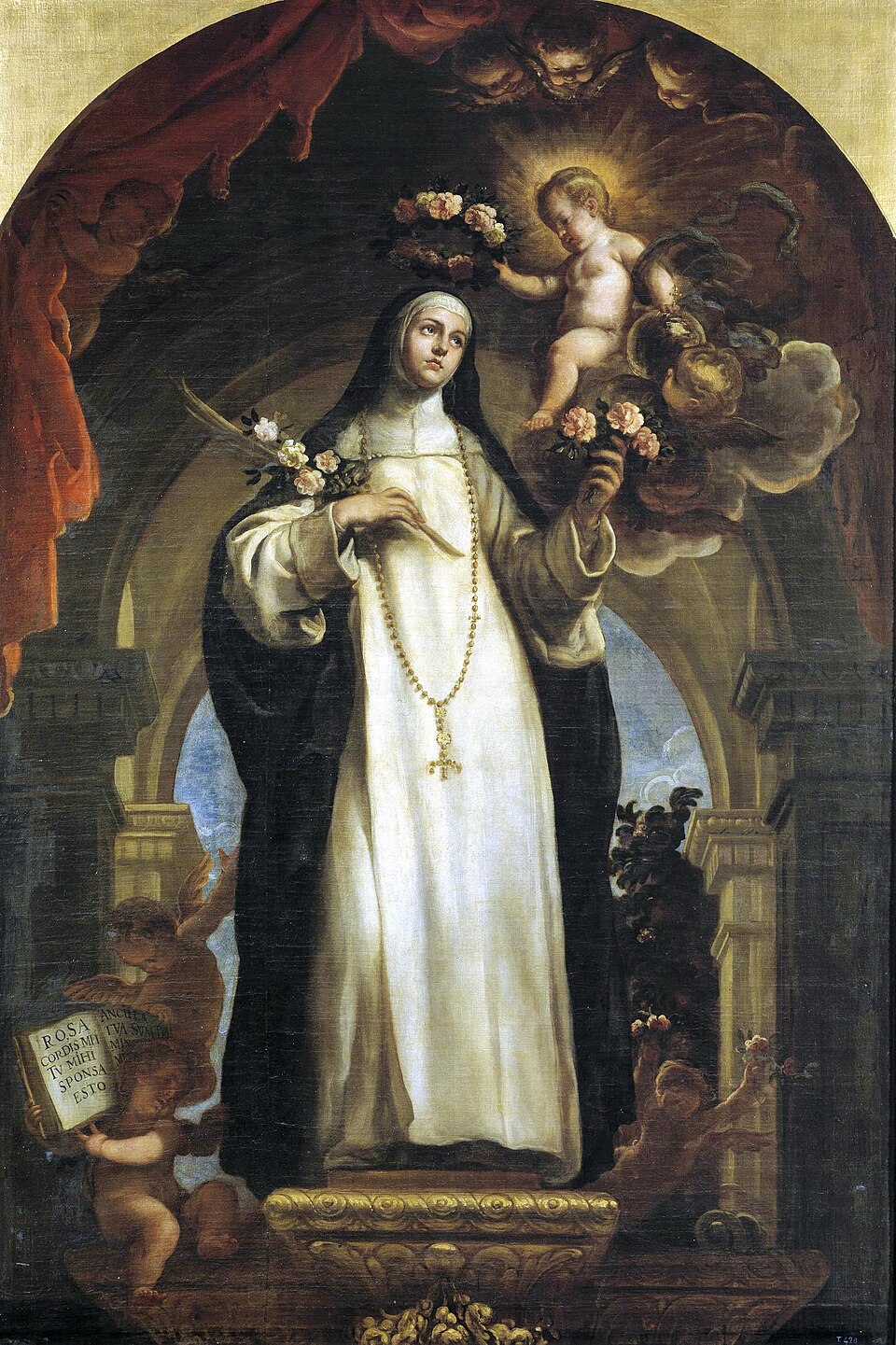
Start here
The story, in brief
Rose of Lima’s religious life included earning, working, and making space for people who needed care. The Dicastery biography describes gardening, embroidery, domestic work, and a refuge for vulnerable people in her family home. [SAINT-SAINT-ROSE-OF-LIMA-S01]
That domestic setting makes her story more immediate than the familiar superlative of first canonized saint born in the Americas. Her significance begins with what people found at the door. [SAINT-SAINT-ROSE-OF-LIMA-S01]
A household mission
Work and care formed part of her religious life. [SAINT-SAINT-ROSE-OF-LIMA-S01]
A lay vocation
Her Dominican commitment did not require enclosure. [SAINT-SAINT-ROSE-OF-LIMA-S01]
A continental milestone
The 1671 canonization gave her memory a wider public role. [SAINT-SAINT-ROSE-OF-LIMA-S01]
Explore the chapters
Isabel Flores de Oliva
Born in Lima in 1586, Isabel became known as Rose. The official account places her within a Spanish family whose circumstances later declined. Manual work therefore belongs to the story of her religious vocation, not merely to an ornamental account of humility. [SAINT-SAINT-ROSE-OF-LIMA-S01]
A household becomes a place of care
The biography describes assistance for abandoned children and older people, particularly Indigenous people. It also situates her life within colonial inequality. The Catholic account praises her care, but a fuller social history should also attend to the people receiving it and to the structures that made them vulnerable. [SAINT-SAINT-ROSE-OF-LIMA-S01]
A lay Dominican vocation
Rose followed the Dominican penitential tradition with Catherine of Siena as an important model. She remained in the world rather than becoming an enclosed nun. Her small place of prayer in the family garden belonged beside work and care in the same overall life. [SAINT-SAINT-ROSE-OF-LIMA-S01]
What suffering meant to her
The source interprets her devotion through union with Christ’s Passion and prayer for others. It also reports severe mortifications. The theological point is self-giving love; the historical descriptions should not be converted into instructions for bodily harm or a claim that pain itself makes a person holy. [SAINT-SAINT-ROSE-OF-LIMA-S01]
Extraordinary stories need their own reading
The biography recounts visions and miracles, including traditions associated with threats to Lima. Those passages document devotional claims. They are not interchangeable with a modern independent investigation, and the existence of a story in an official profile does not establish every proposed mechanism or event detail. [SAINT-SAINT-ROSE-OF-LIMA-S01]
Why the 1671 canonization mattered
The Dicastery records beatification in 1668 and canonization in 1671. Her recognition as the first canonized saint born in the Americas gave her memory wider significance. Yet the distinction is most useful when it directs attention back to her actual setting: a laywoman’s work, prayer, and care in colonial Lima. [SAINT-SAINT-ROSE-OF-LIMA-S01]
The preservation question remains separate
The official biography establishes a Catholic recognition history and a remembered pattern of life. It does not supply a complete record of the anatomy, custody, and treatment of attributed remains. The physical question should stay open on its own evidence while the reader investigates the human and religious legacy. [SAINT-SAINT-ROSE-OF-LIMA-S01]
Catholic reflection & discussion
Look for the person within the story
Spend a moment with the choices, relationships and hardships in this life. Consider what you might learn from the person as well as from the extraordinary claims examined in the file.
These editorial prompts invite reflection on the article. They are distinct from Church teaching and the evidence findings.
Pause and reflect
- Which choice or experience in this life stays with you, and why?
- What would you like to understand better about the person's faith and the world they lived in?
- Is there a small act of patience, courage or service that this reading invites you to consider?
Discuss with family or a group
Choose questions suited to your readers' ages and experiences. Anyone can pass or keep a response private.
- Ask each person to choose a moment from the life described here. What makes that moment worth remembering?
- Which details have clear sources, and which remain uncertain? How could you tell the story honestly without losing its human meaning?
Questions people ask
Open any question for a fuller answer and its sources.
Was Rose a cloistered nun?
The official account describes a lay Dominican life connected with her family home. [SAINT-SAINT-ROSE-OF-LIMA-S01]
How did she help support the household?
The biography names domestic work, gardening, and embroidery. [SAINT-SAINT-ROSE-OF-LIMA-S01]
Should readers copy her severe penances?
The article treats them as historical features of her devotional life, not instructions. Its explanation centers love and care rather than pain as an end. [SAINT-SAINT-ROSE-OF-LIMA-S01]
What does the first-saint distinction mean?
She is described as the first canonized saint born in the Americas, with canonization in 1671. It is a recognition milestone, not an anatomical claim. [SAINT-SAINT-ROSE-OF-LIMA-S01]
What the evidence can establish
Evidence verdict: unresolved
Does the available evidence establish that the displayed or attributed remains of Saint Rose of Lima are the naturally preserved, substantially intact body of that person, without undisclosed embalming, reconstruction, wax covering, replacement, or later conservation treatment?
Canonized Catholic saint. Official sources confirm that status or custody for Saint Rose of Lima. They do not provide the independent anatomical evidence, custody documentation, or treatment history needed to answer whether the remains are naturally preserved.
Sources: [SAINT-SAINT-ROSE-OF-LIMA-S01]
Church or institutional status
Canonized Catholic saint
- Authority
- Dicastery for the Causes of Saints
- Scope of the finding
- The cited official record documents the person's Catholic canonization and saintly title.
- Limits of the finding
- It does not authenticate the attributed remains, establish natural preservation, or prove a miracle.
- Official sources
- [SAINT-SAINT-ROSE-OF-LIMA-S01]
Sources and notes
Back to the overviewSource labels describe a document's type and role, not the strength of a claim. Where provided, notes explain its use, access limits, and outstanding checks.
- SAINT-SAINT-ROSE-OF-LIMA-S01Dicastery for the Causes of Saints profile — Saint Rose of Lima (opens in a new tab)Official source
Identifies this person and records the stated Catholic beatification/canonization or liturgical status; it does not establish the physical preservation claim. What it does not establish: This institutional record establishes only the stated act, status, teaching, or account; it does not independently establish material identity, preservation mechanism, or supernatural causation.
Corrections and updates
Expanded this file with a sourced narrative, 7 chapters and 4 answers to common questions. The existing evidence verdict label and institutional status are retained. Independent human review remains pending.