
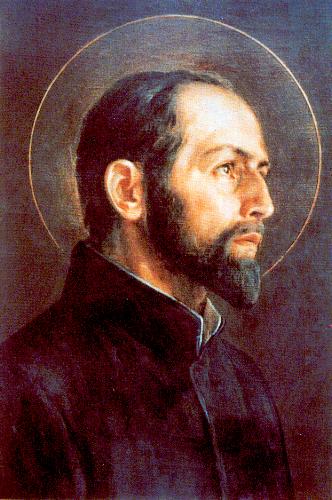
Start here
The story, in brief
Anthony Maria Zaccaria trained in medicine before choosing priestly ministry. His reforming project then gathered several kinds of people: priests, religious women, and married laypeople. The ambition was a renewed Christian life extending beyond one profession or one kind of religious vocation. [SAINT-SAINT-ANTHONY-ZACCARIA-S01]
A changed profession
Medicine preceded priesthood. [SAINT-SAINT-ANTHONY-ZACCARIA-S01]
A broad spiritual family
Priests, women religious, and married laypeople belonged in the project. [SAINT-SAINT-ANTHONY-ZACCARIA-S01]
A substantive Catholic purpose
The Cross, Eucharist, and continuing conversion explain its unity. [SAINT-SAINT-ANTHONY-ZACCARIA-S01]
Explore the chapters
From Padua to Cremona
Born in Cremona in 1502, Zaccaria completed medical studies in Padua in 1524. Back in Cremona, he began explaining the Gospel and Christian doctrine before ordination in 1528. The change of vocation preserved a concern for people while shifting the form of his work toward teaching and pastoral life. [SAINT-SAINT-ANTHONY-ZACCARIA-S01]
Why Paul became the model
John Paul II’s 2002 message, reproduced by the Dicastery, presents the apostle Paul as Zaccaria’s central spiritual model. The emphasis is continuing transformation in Christ: Christian life involves growth rather than a settled minimum of observance. This gives substance to the word “reform” in his biography. [SAINT-SAINT-ANTHONY-ZACCARIA-S01]
Three branches of one spiritual family
The official account identifies the Clerics Regular of Saint Paul, the Angelic Sisters, and married laypeople associated with Saint Paul. Their different states of life mattered. Zaccaria’s project sought renewal in clerical, religious, and household settings, treating lay participation as integral to evangelization. [SAINT-SAINT-ANTHONY-ZACCARIA-S01]
The Cross and the Eucharist
The papal message describes love of Christ crucified and Eucharistic devotion as the movement’s center. Prayer, reconciliation, spiritual guidance, and education appear as practical means of formation. The Catholic explanation is therefore a coherent spiritual program, rather than the claim that founding institutions is itself a miracle. [SAINT-SAINT-ANTHONY-ZACCARIA-S01]
Reform could attract suspicion
The brief biography says Zaccaria faced accusations of heresy and rebellion and was acquitted. That episode should be preserved without inventing a detailed trial narrative the summary does not provide. New religious initiatives could provoke scrutiny; the fuller proceedings would show precisely what was alleged and answered. [SAINT-SAINT-ANTHONY-ZACCARIA-S01]
A short life with a continuing mission
Zaccaria died in 1539. The 2002 papal message addresses the continuing educational and pastoral responsibilities of his spiritual family. It calls for theological preparation, prayer, and service to young people. That later document is evidence of how the Church interprets and applies his legacy centuries afterward. [SAINT-SAINT-ANTHONY-ZACCARIA-S01]
Where the physical question begins
The official page establishes a Catholic saint and explains his spiritual influence. It does not publish a complete anatomical inventory or treatment history for attributed remains. Investigating that claim requires additional material records, while the documented reforming project already offers a substantial reason to explore his life. [SAINT-SAINT-ANTHONY-ZACCARIA-S01]
Catholic reflection & discussion
Look for the person within the story
Spend a moment with the choices, relationships and hardships in this life. Consider what you might learn from the person as well as from the extraordinary claims examined in the file.
These editorial prompts invite reflection on the article. They are distinct from Church teaching and the evidence findings.
Pause and reflect
- Which choice or experience in this life stays with you, and why?
- What would you like to understand better about the person's faith and the world they lived in?
- Is there a small act of patience, courage or service that this reading invites you to consider?
Discuss with family or a group
Choose questions suited to your readers' ages and experiences. Anyone can pass or keep a response private.
- Ask each person to choose a moment from the life described here. What makes that moment worth remembering?
- Which details have clear sources, and which remain uncertain? How could you tell the story honestly without losing its human meaning?
Questions people ask
Open any question for a fuller answer and its sources.
Was Zaccaria trained as a doctor?
Yes. The official biography records medical graduation in 1524 before his priestly ordination. [SAINT-SAINT-ANTHONY-ZACCARIA-S01]
Were laypeople part of his project?
Yes. Married laypeople formed one branch of the spiritual family described by the Holy See. [SAINT-SAINT-ANTHONY-ZACCARIA-S01]
What did reform mean for him?
The papal interpretation emphasizes growth in Christ through prayer, sacramental life, teaching, and active love. [SAINT-SAINT-ANTHONY-ZACCARIA-S01]
Does the biography settle bodily preservation?
No. It is not the material examination or conservation record needed for that claim. [SAINT-SAINT-ANTHONY-ZACCARIA-S01]
What the evidence can establish
Evidence verdict: unresolved
Does the available evidence establish that the displayed or attributed remains of Saint Anthony Zaccaria are the naturally preserved, substantially intact body of that person, without undisclosed embalming, reconstruction, wax covering, replacement, or later conservation treatment?
Canonized Catholic saint. Official sources confirm that status or custody for Saint Anthony Zaccaria. They do not provide the independent anatomical evidence, custody documentation, or treatment history needed to answer whether the remains are naturally preserved.
Sources: [SAINT-SAINT-ANTHONY-ZACCARIA-S01]
Church or institutional status
Canonized Catholic saint
- Authority
- Dicastery for the Causes of Saints
- Scope of the finding
- The cited official record documents the person's Catholic canonization and saintly title.
- Limits of the finding
- It does not authenticate the attributed remains, establish natural preservation, or prove a miracle.
- Official sources
- [SAINT-SAINT-ANTHONY-ZACCARIA-S01]
Sources and notes
Back to the overviewSource labels describe a document's type and role, not the strength of a claim. Where provided, notes explain its use, access limits, and outstanding checks.
- SAINT-SAINT-ANTHONY-ZACCARIA-S01Dicastery for the Causes of Saints profile — Saint Anthony Zaccaria (opens in a new tab)Official source
Identifies this person and records the stated Catholic beatification/canonization or liturgical status; it does not establish the physical preservation claim. What it does not establish: This institutional record establishes only the stated act, status, teaching, or account; it does not independently establish material identity, preservation mechanism, or supernatural causation.
Corrections and updates
Expanded this file with a sourced narrative, 7 chapters and 4 answers to common questions. The existing evidence verdict label and institutional status are retained. Independent human review remains pending.