
Start here
The story, in brief
In the Guadalupe narrative, Juan Diego opens his cloak before the bishop and the flowers he has carried fall away, revealing the image of Mary. The Basilica’s own spiritual guide presents this as the sign that brings his mission to its turning point. That narrative explains why the cloth matters before any claim about unusual fibers or pigments is introduced. [SRC-02]
The Church’s interpretation goes beyond saying that the image is approved. It sees a message of God’s regard for the humble, a call to faith expressed within Indigenous life, and a summons to dignity and solidarity. Material research asks a different set of questions about the cloth and image that now bear that meaning. [SRC-01; EX-01; SRC-03]
The story centers on a messenger
Juan Diego’s uncertainty, his sick uncle, and his return to the bishop give the narrative its human stakes. [SRC-02]
Catholic recognition is specific
John Paul II canonized Juan Diego on 31 July 2002 and explained Guadalupe through evangelization and Indigenous dignity. [SRC-01; EX-01]
The cited study is interpretive
The 2025 article analyzes iconography and cultural readings; it is not a comprehensive laboratory authentication. [SRC-03]
Explore the chapters
Juan Diego’s task does not unfold smoothly
The Basilica’s guide reads the Nican Mopohua as a spiritual journey. Juan Diego worries that someone more socially important would be a better messenger. He encounters disbelief and becomes concerned about his gravely ill uncle Juan Bernardino. The narrative’s eventual sign follows hesitation and responsibility toward a family member; it is not simply an unexplained picture appearing on a wall. [SRC-02]
What the flowers and image mean in the account
The shrine’s guide presents the flowers and image as an answer to the request for a sign. The bishop’s response is part of that narrative, as is Juan Diego’s subsequent service at the shrine. These are the Church’s transmitted account of the event. Describing that account accurately does not remove the separate task of examining its historical sources. [SRC-02]
The Catholic explanation: dignity, faith, and culture
At Juan Diego’s 2002 canonization, John Paul II interpreted his story as God choosing someone humble rather than socially powerful. He also emphasized embracing Christian faith without discarding Indigenous identity and called for justice, solidarity, and respect for Indigenous peoples. This gives Guadalupe a moral and communal meaning that a list of supposed scientific anomalies would miss. [SRC-01; EX-01]
Why the image can be read in more than one way
Jorge Arredondo Sevilla’s 2025 study explores proposed Nahua meanings in the image’s clothing, appearance, and surrounding symbols. The author explicitly describes aspects of the reading as conjectural and distinguishes possible interpretive approaches. A proposed symbolic association should therefore be presented as an argument, not a recovered transcript of what every sixteenth-century viewer thought. [SRC-03]
The cloth has a history of examination
The same study surveys earlier descriptions of the fabric and painting, including disagreement about preparation layers and retouching. Those historical disagreements are useful because they show that the material story cannot be reduced to one timeless, unanimously observed claim. They are not new measurements made by the 2025 author. [SRC-03]
The practical question is what a particular examination actually sampled or observed, when it occurred, and whether the results can be checked. An art-historical account of earlier investigators should not be relabeled a present laboratory demonstration of supernatural authorship. [SRC-03]
What canonization answers
The 31 July 2002 homily documents Juan Diego’s Catholic recognition and gives the pope’s interpretation of the Guadalupe event. It is a primary source for what that celebration proclaimed. It does not provide a complete conservation report, pigment analysis, or experimental exclusion of every human method of image-making. [SRC-01; EX-01]
How to look without making the image carry every claim
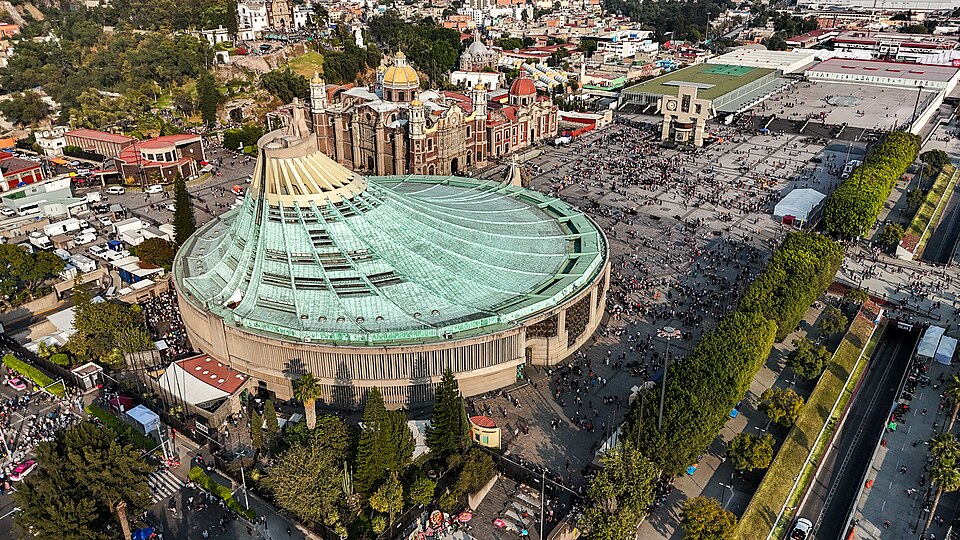
The registered aerial photograph shows the basilica setting, not the fibers or painted surface of the tilma. That context can help a reader place the devotion, while any material conclusion needs evidence about the actual cloth. The source and scale of an image matter. [MEDIA-01]
The most informative next work would connect dated conservation and examination records with the history of the object and its earliest representations. Meanwhile, a visitor can understand the Catholic story and its significance without being asked to treat cultural influence as a substitute for material proof. [SRC-02; SRC-03]
Catholic reflection & discussion
Let the object open a larger question
Pause over what this object brings to mind: a person, a place, an act of devotion, or a question about the past. Let that curiosity guide a careful reading of both its history and its meaning.
These editorial prompts invite reflection on the article. They are distinct from Church teaching and the evidence findings.
Pause and reflect
- What draws your attention to this object, and what are you hoping to understand through it?
- How does the article distinguish the object's documented history from the meaning people give it?
- If an attribution remains uncertain, which questions about faith, memory or devotion would still be worth exploring?
Discuss with family or a group
Choose questions suited to your readers' ages and experiences. Anyone can pass or keep a response private.
- Begin with a familiar family keepsake. What can an object help someone remember, and what would be needed to establish its history?
- Choose one image or description in the file. Which things can you observe, and which would you need a source to know?
Questions people ask
Open any question for a fuller answer and its sources.
Is the tilma simply another name for the apparition?
The tilma is the cloak bearing the image. The apparition narrative explains its religious association; the object’s physical history is a related but distinct investigation. [SRC-02]
What did the 2002 ceremony recognize?
Does the 2025 study prove an encoded Indigenous message?
It proposes and compares iconographical readings and explicitly acknowledges conjecture. Its arguments do not establish what every early viewer understood. [SRC-03]
Does that study prove a miraculous physical origin?
No. It examines history and interpretation rather than performing a comprehensive laboratory authentication of the image. [SRC-03]
Why discuss Juan Diego’s social position?
The canonization homily makes humility, Indigenous dignity, and the encounter of faith with culture central to the Church’s explanation. They are part of what the devotion asks Catholics to take seriously. [EX-01]
What the evidence can establish
Evidence verdict: unresolved
Does official evidence establish the tilma's custody and devotional status, and does material scholarship prove a supernatural origin?
Official Church sources document Guadalupe devotion, Juan Diego's canonization, and the tilma's central place. Peer-reviewed scholarship discusses its image history without establishing supernatural authorship.
Church or institutional status
Juan diego canonized; tilma officially venerated; material authenticity unresolved
- Authority
- Holy See / Basilica of Guadalupe
- Scope of the finding
- Juan Diego's sainthood and the tilma's devotional status.
- Limits of the finding
- Neither act declares the image's physical origin scientifically proven.
Sources and notes
Back to the overviewSource labels describe a document's type and role, not the strength of a claim. Where provided, notes explain its use, access limits, and outstanding checks.
Documents Juan Diego's canonization and the Church's Guadalupe narrative. What it does not establish: Canonization does not authenticate every physical claim about the tilma.
Documents the shrine's official devotional/historical account. What it does not establish: Does not supply independent material authentication.
- SRC-03International Journal of Latin American Religions — 2025 study (opens in a new tab)Peer-reviewed research
Examines historical/iconographic claims surrounding the image and preservation discourse. What it does not establish: Not a comprehensive laboratory authentication of the cloth.
Documents the image source and CC BY-SA 4.0 rights record. What it does not establish: Basilica aerial context; the tilma is not visible and no physical claim is evidenced.
- EX-01John Paul II: Juan Diego canonization homily, readable official HTML (opens in a new tab)Official sourceCited in this file
Read the source note for the passage used and any limits on what it supports.
Full primary homily read as HTML because the preserved PDF endpoint returned only a brief non-content response. Establishes the 2002 celebration and theological interpretation, not a material examination.
Corrections and updates
Expanded this file with a sourced narrative, 7 chapters and 5 answers to common questions. The existing evidence verdict label and institutional status are retained. Independent human review remains pending.