
Start here
The story, in brief
At the Church of the Holy Sepulchre, the Stone of Anointing commemorates the preparation of Jesus’s body for burial. In the Custody’s account of the Good Friday funeral rite, a representation of Christ is taken down from the cross, anointed at the stone, and carried to the tomb. The sequence gives this place its meaning. [SRC-01; SRC-02]
The association is traditional
The Custody itself uses the language of tradition when describing the stone. [SRC-01]
Its ritual role is documented
The Good Friday account describes burial preparation at the stone within the Funeral of Christ. [SRC-02]
The slab needs separate evidence
A documented holy place and ritual do not identify the current material as the surface used in the first century. [SRC-01; SRC-02]
Explore the chapters
A place between Calvary and the tomb
The Custody presents the basilica through connected memories: Calvary, the Stone of Anointing, and the tomb in the Rotunda. The stone belongs to the passage between death and burial. It recalls the handling of Jesus’s body, not simply an isolated sacred surface. [SRC-01]
What anointing adds to the story
Burial preparation directs attention to care for a body after violence. In the rite described by the Custody, nails and the crown of thorns are removed before the image is anointed and taken to the tomb. For the worshipper, these actions make the Passion a story of persons who grieve and care as well as a sequence of locations. [SRC-02]
The Funeral of Christ in Jerusalem
The Custody’s 3 April 2026 account describes the evening procession returning to the Holy Sepulchre for the Funeral of Christ. Its movement follows Calvary, the stone, and the tomb. This is contemporary institutional evidence that the stone participates in a living liturgical tradition. It does not describe a reenactment filmed in antiquity. [SRC-02]
Why Catholics care about the place
The Custody understands the basilica as a place of Christ’s Passion and Resurrection. The stone helps hold together real death and the Christian hope that death is overcome. Its meaning arises from the events being remembered and the community’s prayer; the source does not make that meaning depend on a laboratory determination of the slab’s age. [SRC-01; SRC-02]
Does “traditional” mean historically proven?
The word identifies an inherited association. It does not specify how old the present slab is, whether it replaces an earlier surface, or whether a documented chain connects this material with burial preparation in the first century. Those are archaeological and historical questions beyond what the cited Custody pages establish. [SRC-01]
What the evidence can show a visitor
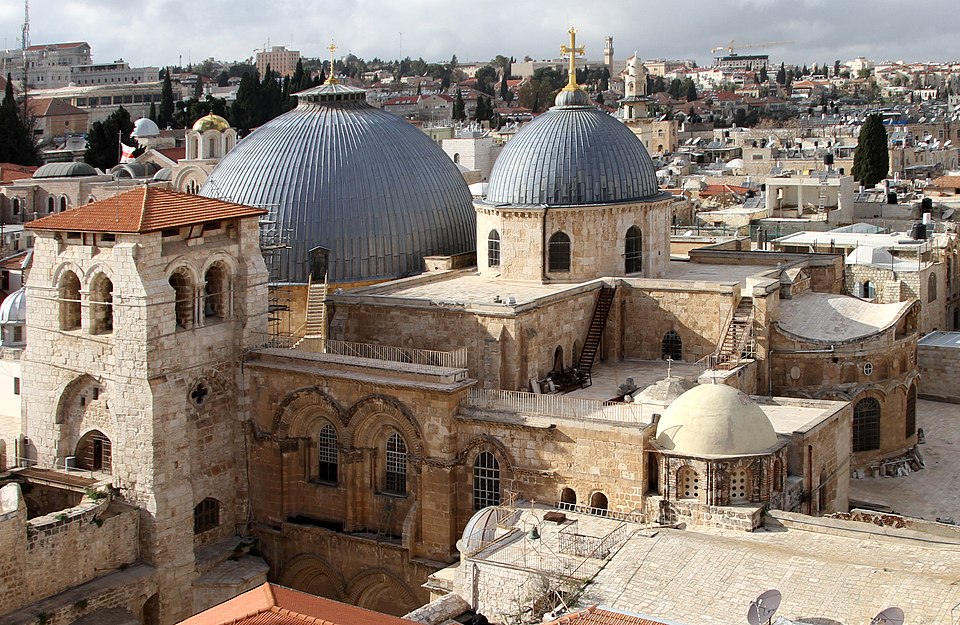
The registered exterior photograph supplies context for the Church of the Holy Sepulchre, not a close view of the stone. The Custody’s text supplies the traditional identification and ritual use. To settle the material question, an investigation would need construction and replacement records, material study, and a careful history of the location. [MEDIA-01; SRC-01; SRC-02]
Catholic reflection & discussion
Let the object open a larger question
Pause over what this object brings to mind: a person, a place, an act of devotion, or a question about the past. Let that curiosity guide a careful reading of both its history and its meaning.
These editorial prompts invite reflection on the article. They are distinct from Church teaching and the evidence findings.
Pause and reflect
- What draws your attention to this object, and what are you hoping to understand through it?
- How does the article distinguish the object's documented history from the meaning people give it?
- If an attribution remains uncertain, which questions about faith, memory or devotion would still be worth exploring?
Discuss with family or a group
Choose questions suited to your readers' ages and experiences. Anyone can pass or keep a response private.
- Begin with a familiar family keepsake. What can an object help someone remember, and what would be needed to establish its history?
- Choose one image or description in the file. Which things can you observe, and which would you need a source to know?
Questions people ask
Open any question for a fuller answer and its sources.
Is this the same thing as Jesus’s tomb?
No. The Custody distinguishes the Stone of Anointing from the tomb in the Rotunda. They are different parts of the basilica’s commemorative geography. [SRC-01]
Do the Franciscans claim archaeological proof for the slab?
What is placed on it in the Good Friday account?
The account describes the image of Christ used in the Funeral of Christ rite being anointed and prepared for burial. [SRC-02]
What remains unresolved?
Whether the present physical slab is the first-century surface used for Jesus’s burial preparation. Current veneration alone cannot establish that identity. [SRC-01]
What the evidence can establish
Evidence verdict: unresolved
Does the Church of the Holy Sepulchre preserve the Stone of Anointing tradition, and is the present slab the first-century burial-preparation surface?
The Custody of the Holy Land documents the traditional Stone of Anointing and current ritual memory. The source does not establish that the present slab is the surface used for Jesus.
Church or institutional status
Official holy place custody and liturgical memory
- Authority
- Custody of the Holy Land
- Scope of the finding
- The present Stone of Anointing site and its tradition.
- Limits of the finding
- No cited archaeological result identifies the slab as first-century or as Jesus's burial-preparation surface.
Sources and notes
Back to the overviewSource labels describe a document's type and role, not the strength of a claim. Where provided, notes explain its use, access limits, and outstanding checks.
Identifies the Stone of Anointing in the Holy Sepulchre and describes its traditional association. What it does not establish: Uses 'traditional'; does not provide archaeological authentication.
Documents current liturgical use of the Stone of Anointing in the Good Friday rite. What it does not establish: Liturgical commemoration is not historical proof.
Documents the image source and CC BY-SA 4.0 rights record. What it does not establish: Church exterior only; site context, not the stone itself.
Corrections and updates
Expanded this file with a sourced narrative, 6 chapters and 4 answers to common questions. The existing evidence verdict label and institutional status are retained. Independent human review remains pending.