
Start here
The story, in brief
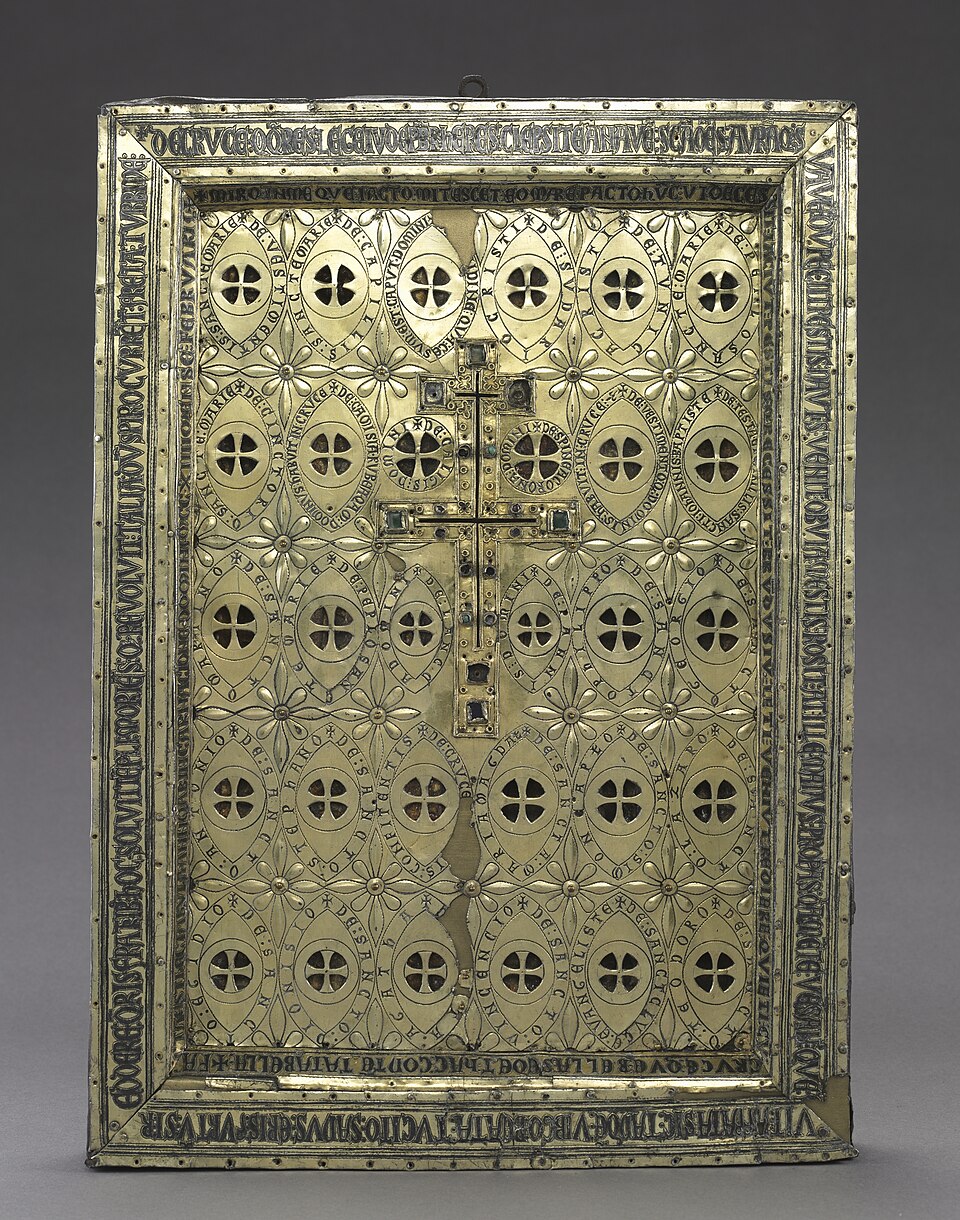
This investigation concerns one particular object in Cleveland: a cross mounted within a medieval panel, identified by the museum as a reliquary of the True Cross. Its frame invites the viewer to read a long account of the relic’s travels. The object therefore offers more than an anonymous splinter; it preserves a claim about its own past. [SRC-01]
The inscription provides a date
The text places the panel’s creation in February 1214. [SRC-01]
The assembly has more than one origin
The museum attributes the cross to the Latin Kingdom of Jerusalem and the panel to the Rhine-Meuse region. [SRC-01]
A narrative is evidence with limits
The inscription records a medieval account; it does not independently authenticate the wood as part of Jesus’s cross. [SRC-01]
Explore the chapters
One object, several materials
The catalog lists silver, gilded silver, niello, precious stones, and a walnut core. These describe a crafted reliquary approximately forty-four centimeters high. The walnut core belongs to the object’s construction; it should not be casually relabeled as the alleged fragment of the Cross. Material lists must be read component by component. [SRC-01]
The journey told around the frame
The Latin inscription recounts a theft, a sea storm, a warning attributed to the Virgin, and the return of the stolen relic to the Templars. It continues with a death at sea, the calming of the storm, and arrival at Brindisi. These are the events the medieval inscription asks its reader to believe. The dramatic sequence is not supplied by a modern eyewitness. [SRC-01]
Why an inscription is valuable even when disputed
An inscribed account gives a historian a concrete text to date, transcribe, and compare. Here its February 1214 date anchors the panel’s claimed creation. The story also reveals how the object’s community explained legitimate possession: an improperly taken relic was restored. That is evidence about medieval religious memory even before the earlier journey can be independently checked. [SRC-01]
How the relic acquired such a costly setting
The Met’s history of relics explains why material associated with Christ received exceptional honor and precious containers. Christians connected the wood of the Cross with the saving death of Jesus. Gold or silver expressed the significance of that relationship; their expense did not function as a historical test of the wood. [EX-02]
What the museum photograph shows
The registered photograph depicts the actual Cleveland reliquary rather than an unrelated artistic crucifix. It helps the reader identify the assembly being discussed. It cannot establish the ancient source of a small enclosed fragment or make the inscription’s reported supernatural events independently observable. [MEDIA-01; SRC-01]
What remains open
The museum documents the object, its construction, and the traditional identity of its contents. The historical claim that the wood came from Jesus’s cross remains unresolved. Its inscription would need to be compared with independent records, and the material history of the particular fragment would need to be traced beyond the medieval container. [SRC-01]
Catholic reflection & discussion
Let the object open a larger question
Pause over what this object brings to mind: a person, a place, an act of devotion, or a question about the past. Let that curiosity guide a careful reading of both its history and its meaning.
These editorial prompts invite reflection on the article. They are distinct from Church teaching and the evidence findings.
Pause and reflect
- What draws your attention to this object, and what are you hoping to understand through it?
- How does the article distinguish the object's documented history from the meaning people give it?
- If an attribution remains uncertain, which questions about faith, memory or devotion would still be worth exploring?
Discuss with family or a group
Choose questions suited to your readers' ages and experiences. Anyone can pass or keep a response private.
- Begin with a familiar family keepsake. What can an object help someone remember, and what would be needed to establish its history?
- Choose one image or description in the file. Which things can you observe, and which would you need a source to know?
Questions people ask
Open any question for a fuller answer and its sources.
Is this a study of every True Cross fragment?
No. It concerns Cleveland Museum of Art object 1952.89. Other fragments require their own records. [SRC-01]
Does the inscription prove the sea miracle?
It establishes that the medieval object carries that account. Independent evidence would be needed to verify the narrated events. [SRC-01]
Does the walnut core identify the sacred wood?
The catalog lists walnut as a construction material. That does not by itself identify the material of the small relic claimed as the True Cross. [SRC-01]
What does the date 1214 establish?
It appears in the inscription as the date of the panel’s creation. It is not the date of Christ’s crucifixion or a direct measurement of the fragment’s age. [SRC-01]
What the evidence can establish
Evidence verdict: unresolved
Does the Cleveland museum object contain a fragment traditionally attributed to the True Cross, and what does its provenance establish?
The museum catalog documents a medieval reliquary and its traditional contents/provenance. It does not authenticate the wood as part of the historical cross.
Sources: [SRC-01]
Church or institutional status
No formal church authentication located; official museum custody
- Authority
- Cleveland Museum of Art
- Scope of the finding
- The specific medieval reliquary shown on this page.
- Limits of the finding
- No cited current ecclesiastical act authenticates its wood as the True Cross.
- Official sources
- [SRC-01]
Sources and notes
Back to the overviewSource labels describe a document's type and role, not the strength of a claim. Where provided, notes explain its use, access limits, and outstanding checks.
Documents the object, date, materials, provenance, and traditional relic attribution. What it does not establish: Museum cataloguing does not prove the sacred identity of the wood.
Documents the image source and Cleveland Museum of Art Open Access / CC0 1.0 rights record. What it does not establish: Exact medieval museum reliquary; does not authenticate the wood's sacred identity.
- EX-02The Metropolitan Museum of Art: Relics and Reliquaries in Medieval Christianity (opens in a new tab)Official sourceCited in this file
Read the source note for the passage used and any limits on what it supports.
Museum scholarship explaining bodily relics, contact relics, intercession, precious containers, and medieval Christian devotion; general historical context, not authentication of this particular object.
Corrections and updates
Expanded this file with a sourced narrative, 6 chapters and 4 answers to common questions. The existing evidence verdict label and institutional status are retained. Independent human review remains pending.