
Start here
The story, in brief
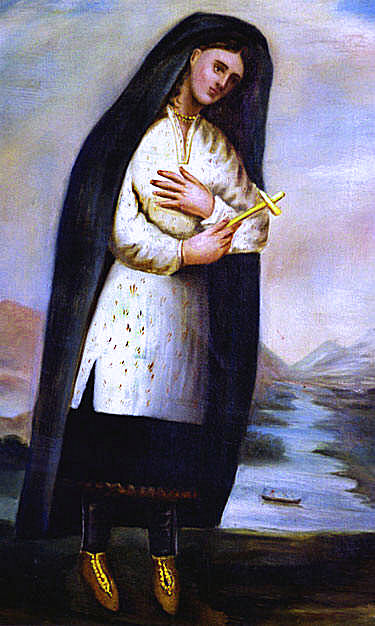
A relic of Kateri Tekakwitha accompanies those of three Jesuit martyrs in Martyrs’ Shrine’s public presentation. Her presence changes the story. She was an Indigenous woman with her own spiritual life, not simply a supporting figure in the biographies of European missionaries. [SRC-01; EX-01]
Understanding the relic begins with understanding Kateri: the places she lived, the choices she made, and why the Catholic Church remembers her. The exact material and its complete provenance remain separate questions.
The person
Kateri was an Indigenous Catholic woman whose prayer and commitment shaped her own life.
The recognition
Benedict XVI canonized her on 21 October 2012.
The object
The shrine identifies a relic, but this file does not establish its material or full provenance.
Explore the chapters
A life crossing two familiar map labels
At her canonization, Benedict XVI described Kateri’s birth in 1656 in what is now New York State, to a Mohawk father and a Christian Algonquin mother. She was baptized at twenty and later lived at the Saint Francis Xavier mission near Montreal. Modern national borders can obscure the connected Indigenous geography of that life. [EX-01]
Her history should therefore begin with her own relationships and decisions. Calling her a North American saint locates her broadly; it does not explain her particular identity or give permission to treat different Indigenous peoples as interchangeable.
The faith she chose to practice
Benedict’s homily emphasizes prayer, participation in the Eucharist, and Kateri’s desire to give her life to Christ. She died young, in 1680. Her sainthood is not a claim that she had held public office, founded a large institution, or produced a long written theology. [EX-01]
The Catholic interest lies in a whole life’s orientation. Prayer, work, and daily decisions can carry a commitment as serious as more publicly visible achievements. Kateri’s story asks the visitor to attend to that quiet agency rather than measure her importance only by dramatic events.
What the canonization recognized
The 21 October 2012 canonization is a formal Church act. The Dicastery’s cause material also describes the examination of Jacob Finkbonner’s healing, including a medical consultation in September 2011 and subsequent theological and ecclesiastical judgments. These are records of the process behind recognition. [EX-01; EX-02]
They do not authenticate every object later circulated under Kateri’s name. A judgment about sanctity, a judgment about an attributed healing, and an identification of physical material are related to the same person but answer different questions. Keeping them distinct makes the Church’s actual decisions clearer.
Why her relic travels with the martyrs
The public tour brings Kateri’s attributed relic together with Brébeuf’s skull and bones attributed to Garnier and Lalemant. Thunder Bay’s diocesan report records that grouping at its February 2025 celebration. It gives a concrete instance of communities gathering around the memory of several saints with different lives. [SRC-01; EX-03]
Kateri should not be described as one of those murdered Jesuits or as a martyr merely because her relic travels beside theirs. The 2012 liturgical notice identifies her as a laywoman. The shared pilgrimage offers a way to encounter more than one form of Christian witness. [EX-05]
What is known about the object
The shrine identifies a Kateri relic in its custody. The public material cited here does not supply an item-specific authenticum, a full acquisition history, or a material examination. This file therefore does not identify it as a particular bone, body part, or contact object. [SRC-01]
An investigation would need to start with the object itself: its inventory reference, label, container, seals, material description, and accompanying documents. Those details would establish what claim is actually being made before attempting to judge whether the attribution is sound. The current verdict remains unresolved.
An encounter that respects her identity
For Catholic readers, Kateri’s life offers a witness to prayer and freely embraced faith. For a broader audience, it also raises questions about how an Indigenous woman is represented within institutional memory. Her story deserves to be told with her choices at its center. [EX-01]
A useful visit would leave a person knowing more than the existence of a relic: who Kateri was, what the Church recognized, and which claims about this material remain unproven. The object can begin that encounter, but it cannot replace it.
Catholic reflection & discussion
Let the object open a larger question
Pause over what this object brings to mind: a person, a place, an act of devotion, or a question about the past. Let that curiosity guide a careful reading of both its history and its meaning.
These editorial prompts invite reflection on the article. They are distinct from Church teaching and the evidence findings.
Pause and reflect
- What draws your attention to this object, and what are you hoping to understand through it?
- How does the article distinguish the object's documented history from the meaning people give it?
- If an attribution remains uncertain, which questions about faith, memory or devotion would still be worth exploring?
Discuss with family or a group
Choose questions suited to your readers' ages and experiences. Anyone can pass or keep a response private.
- Begin with a familiar family keepsake. What can an object help someone remember, and what would be needed to establish its history?
- Choose one image or description in the file. Which things can you observe, and which would you need a source to know?
Questions people ask
Open any question for a fuller answer and its sources.
Was Kateri one of the Canadian Jesuit martyrs?
No. She was an Indigenous laywoman with a distinct life and is listed as such in the 2012 canonization notice. Traveling with their relics does not make her part of that martyr group. [EX-05]
When was she canonized?
Benedict XVI canonized her on 21 October 2012. His homily explains her faith and its significance for the Church. [EX-01]
Does this file identify a particular body part?
No. The available shrine attribution does not supply enough item-level detail to name the material or a specific anatomical part. [SRC-01]
What the evidence can establish
Evidence verdict: unresolved
Does Martyrs' Shrine currently identify a Kateri Tekakwitha relic, and what does that establish?
The official shrine tour identifies the Kateri relic in current custody; the public source does not establish the material's biological identity or complete provenance.
Sources: [SRC-01]
Church or institutional status
Official shrine custody
- Authority
- Martyrs' Shrine, Midland
- Scope of the finding
- Custody and veneration of the attributed relic.
- Limits of the finding
- Custody does not independently authenticate the material.
- Official sources
- [SRC-01]
Sources and notes
Back to the overviewSource labels describe a document's type and role, not the strength of a claim. Where provided, notes explain its use, access limits, and outstanding checks.
Identifies the Kateri relic and its current shrine context. What it does not establish: Does not publish the authenticum or independent material testing.
- EX-01Benedict XVI, canonization homily, 21 October 2012 (opens in a new tab)Official sourceCited in this file
Read the source note for the passage used and any limits on what it supports.
Primary canonization homily explaining Kateri’s life, Indigenous identity, and Catholic witness; not an object authentication.
- EX-02Dicastery for the Causes of Saints: Kateri Tekakwitha (opens in a new tab)Official sourceCited in this file
Read the source note for the passage used and any limits on what it supports.
Institutional cause materials and recognition process, including the 2011 healing reviews; not independent examination of the Midland relic.
- EX-03Diocese of Thunder Bay: relic visit at Saint Dominic Church, February 2025 (opens in a new tab)Official sourceCited in this file
Read the source note for the passage used and any limits on what it supports.
Host diocese identifies the skull and bone relics from Midland and reports the 10 February 2025 celebration; does not provide biological testing. The page’s broad historical introductory wording is not adopted.
- EX-05Holy See Press Office, canonization notice, 16 October 2012 (opens in a new tab)Official sourceCited in this file
Read the source note for the passage used and any limits on what it supports.
Primary liturgical notice names Kateri as a laywoman among those canonized on 21 October 2012; distinguishes her from separately listed martyrs.
Corrections and updates
Expanded this file with a sourced narrative, 6 chapters and 4 answers to common questions. The existing evidence verdict label and institutional status are retained. Independent human review remains pending.