
Start here
The story, in brief
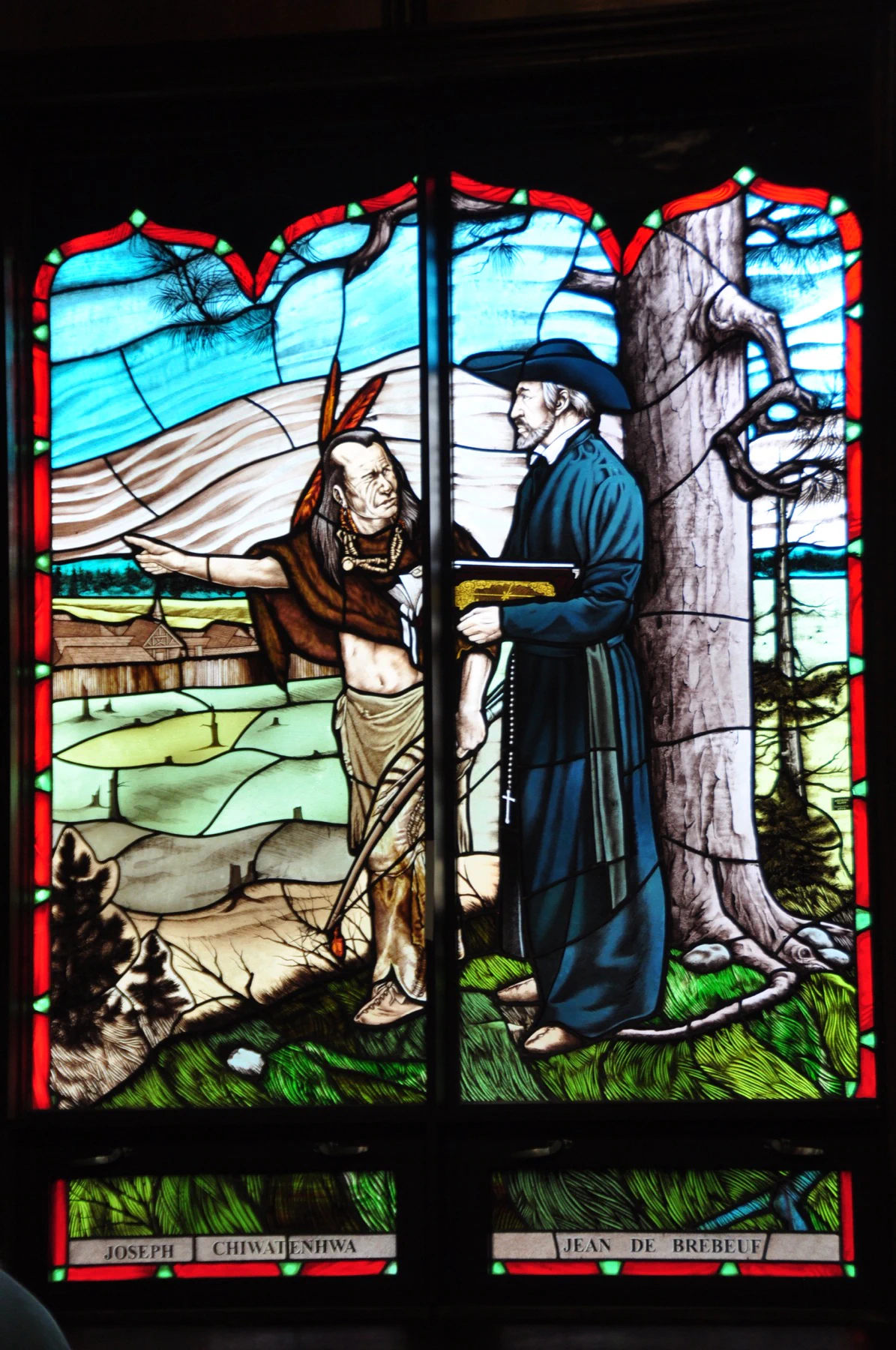
A skull is a powerful reminder that a celebrated name belonged to a mortal person. Martyrs’ Shrine identifies this relic as Jean de Brébeuf’s. Yet the most revealing introduction to him may be a much less dramatic image: a learned European becoming a beginner in someone else’s language. [SRC-01; EX-01]
The relic brings together missionary history, Indigenous Christian memory, Catholic devotion, and an unresolved question of physical identity. Each deserves more than a label.
The life
Brébeuf’s mission required learning the language and customs of the Wendat.
The remembrance
The shrine honors him among the Canadian Martyrs.
The evidence
The skull’s custodial attribution is documented; independent identity remains unresolved.
Explore the chapters
The missionary as a student
Xavier University’s Jesuit resource describes Brébeuf arriving in New France in 1625 and serving there in two periods. It recalls his insistence that missionaries learn the language of the people among whom they lived, even when doing so meant setting aside their European academic standing. [EX-01]
That detail gives a visitor something specific to consider. Religious conviction did not remove the practical need to understand another person’s words. The desire to teach could require humility about how much one still had to learn. This is a more searching encounter with the saint than treating physical endurance as his only distinguishing feature.
A community caught in destruction
The university’s account places the mission among the Wendat and describes the settlement of Sainte-Marie. The attacks of 1648–1649 devastated communities and killed both missionaries and Indigenous Christians. Brébeuf died in 1649. The history is larger than a conflict between a single saint and unnamed opponents. [EX-01]
Remembering that wider world matters when writing about a relic. Indigenous peoples were not one undifferentiated group, and Indigenous Christians were participants in their own religious communities. A modern visitor should resist allowing one object to stand for every person or every political relationship in that complex history.
Why the Church remembers a martyr
In his 1984 homily at the shrine, John Paul II joined remembrance of the martyrs with recognition of Indigenous Christian families and a call to respect cultural inheritance. The address places their witness in a wider community of faith rather than treating a European biography as the whole story. [EX-02]
The Catholic claim is that a martyr witnesses to Christ through fidelity even when facing death. It is not that violence becomes holy because a saint endured it. Applied to Brébeuf, that distinction permits reverence for courage alongside serious historical questions about the mission’s wider setting. [EX-02]
From recovered remains to a public relic
Martyrs’ Shrine’s historical account relates the recovery and translation of remains associated with Brébeuf and Lalemant. Its tour page identifies the skull attributed to Brébeuf. These are substantive custodial claims, but the original recovery documents and the complete sequence connecting them to the present object still require checking. [SRC-01; SRC-02]
Modern host institutions repeat a specific attribution: Thunder Bay’s February 2025 report and Ottawa’s March event notice both name Brébeuf’s skull. They show that the object is publicly presented under that identity; neither publishes a modern anatomical identification. [EX-03; EX-04]
What a skull can and cannot establish
An examination might describe human material, estimate age, or identify conservation and reconstruction. Such observations would not by themselves produce a name. Identification would require a reasoned connection between the physical findings and the documentary history. No such independent biological conclusion is supplied in the cited public sources. [SRC-01; SRC-02]
The question about reconstruction is also practical. A visitor looking through a reliquary cannot assume that every visible surface is original bone. An item-level conservation record would help distinguish surviving material from any support, repair, or later additions without having to guess from appearance.
Looking through the object to the person
The relic’s devotional purpose is to focus remembrance and prayer. Ottawa’s notice situates its veneration alongside Mass and a talk, making the object part of a larger encounter with faith and history. It is not presented as a substitute for learning who Brébeuf was. [EX-04]
The reader can therefore hold two conclusions together: Brébeuf’s life offers a distinctive account of learning, mission, and fidelity; the skull attributed to him still lacks independent biological authentication in this file. Respectful curiosity allows both the person and the historical question to remain in view. [EX-01; SRC-01]
Catholic reflection & discussion
Let the object open a larger question
Pause over what this object brings to mind: a person, a place, an act of devotion, or a question about the past. Let that curiosity guide a careful reading of both its history and its meaning.
These editorial prompts invite reflection on the article. They are distinct from Church teaching and the evidence findings.
Pause and reflect
- What draws your attention to this object, and what are you hoping to understand through it?
- How does the article distinguish the object's documented history from the meaning people give it?
- If an attribution remains uncertain, which questions about faith, memory or devotion would still be worth exploring?
Discuss with family or a group
Choose questions suited to your readers' ages and experiences. Anyone can pass or keep a response private.
- Begin with a familiar family keepsake. What can an object help someone remember, and what would be needed to establish its history?
- Choose one image or description in the file. Which things can you observe, and which would you need a source to know?
Questions people ask
Open any question for a fuller answer and its sources.
Is the skull independently proven to be Brébeuf’s?
Why does language learning matter to his story?
Xavier’s account highlights the humility and work required to communicate among the Wendat. It helps readers understand his mission beyond its violent ending. [EX-01]
Does the shrine’s history give a complete chain of custody?
It provides a recovery and translation narrative. The primary records and their connection to the present skull remain matters for further checking. [SRC-02]
What the evidence can establish
Evidence verdict: unresolved
Does Martyrs' Shrine document the skull attributed to Jean de Brébeuf and its translation history?
The shrine's official pages identify the skull relic and describe its historical recovery/translation. Independent biological authentication remains unresolved.
Church or institutional status
Official shrine custody
- Authority
- Martyrs' Shrine, Midland
- Scope of the finding
- Custody, veneration, and shrine-reported translation history.
- Limits of the finding
- No modern independent biological identification is cited.
Sources and notes
Back to the overviewSource labels describe a document's type and role, not the strength of a claim. Where provided, notes explain its use, access limits, and outstanding checks.
Identifies the skull of Jean de Brébeuf in the shrine collection. What it does not establish: Does not publish independent identity testing.
Provides the shrine's account of the recovery and translation history. What it does not establish: Primary records and chain-of-custody details should still be checked.
- EX-01Xavier University, Jesuit Resource: Jean de Brébeuf (opens in a new tab)Official sourceCited in this file
Read the source note for the passage used and any limits on what it supports.
University account of Brébeuf’s mission, language learning, and death. Quoted letters are discussed through this account; this file does not claim to have inspected their manuscripts.
- EX-02John Paul II, homily at the Martyrs’ Shrine, 15 September 1984 (opens in a new tab)Official sourceCited in this file
Read the source note for the passage used and any limits on what it supports.
Primary explanation of Catholic martyrdom, Indigenous Christian agency, cultural respect, and reconciliation; not an anatomical or provenance report.
- EX-03Diocese of Thunder Bay: relic visit at Saint Dominic Church, February 2025 (opens in a new tab)Official sourceCited in this file
Read the source note for the passage used and any limits on what it supports.
Host diocese identifies the skull and bone relics from Midland and reports the 10 February 2025 celebration; does not provide biological testing. The page’s broad historical introductory wording is not adopted.
- EX-04Archdiocese of Ottawa-Cornwall: Canadian Martyrs relic tour, 28 March 2025 (opens in a new tab)Official sourceCited in this file
Read the source note for the passage used and any limits on what it supports.
Official host notice identifies the relics and connects veneration with Mass, a talk, and intercession. It is evidence of attributed objects and a scheduled event, not proof of identity.
Corrections and updates
Expanded this file with a sourced narrative, 6 chapters and 4 answers to common questions. The existing evidence verdict label and institutional status are retained. Independent human review remains pending.