
Start here
The story, in brief
María Mueses and her daughter Rosa stand at the beginning of Las Lajas’ received story. Near Ipiales, in the canyon of the Guáitara River, the child is said to have recognized Mary and the infant Jesus in a rocky refuge. The Colombian bishops’ conference retells the account; regional tourism explicitly identifies it as tradition. [EX-01; EX-03]
The sanctuary that later rose over the canyon is itself remarkable. Yet the devotion asks a more personal question than how such a building was possible: why did a mother’s fear for her child become a place where so many other people bring their own fears and hopes? [EX-01; EX-03]
A mother and daughter
The 1754 origin tradition centers on María Mueses and Rosa.
The building came later
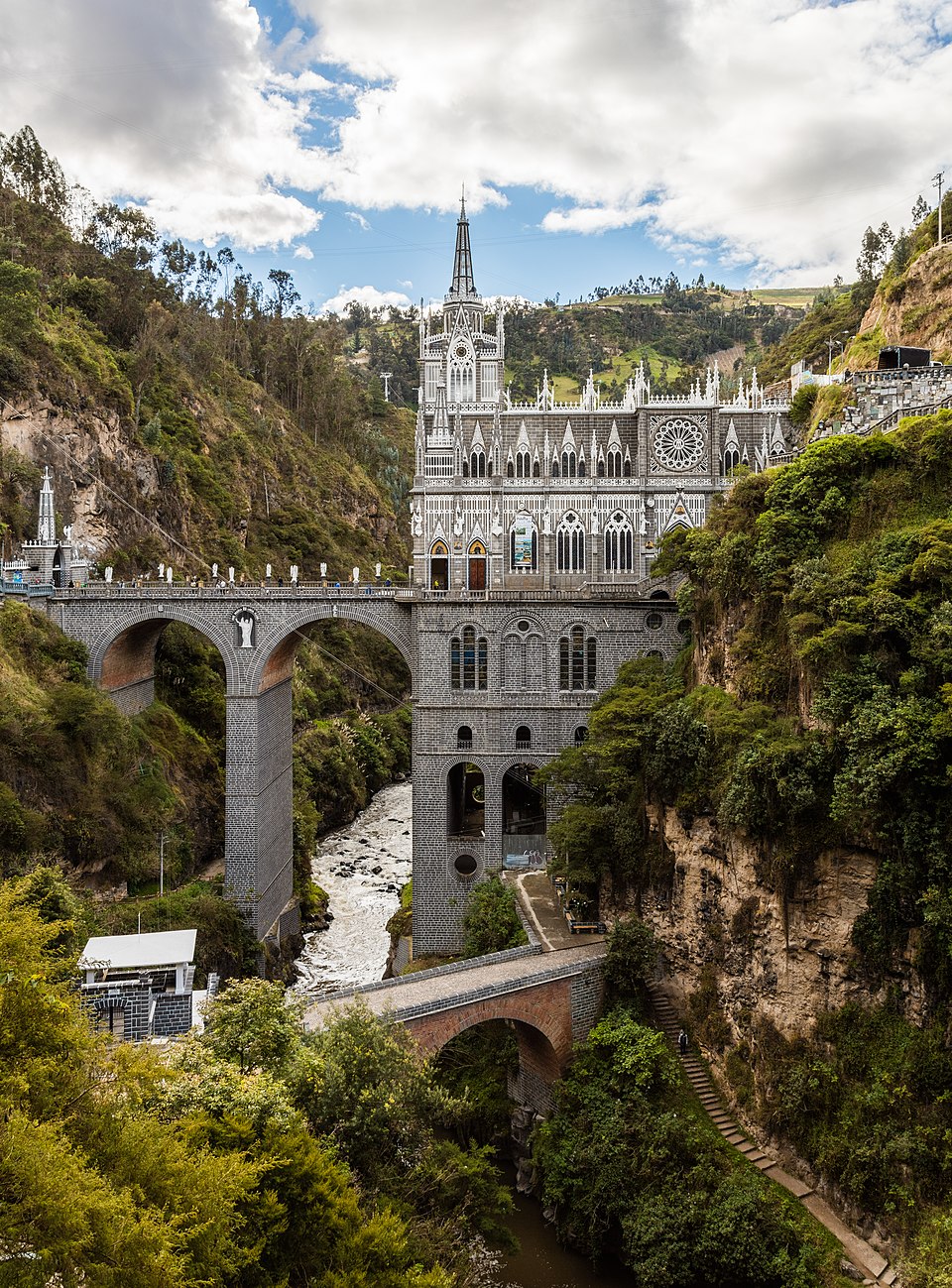
The present sanctuary was constructed between 1916 and 1949.
Devotion and judgment differ
Episcopal celebration is documented; this dossier does not reproduce a formal apparition decree.
Explore the chapters
What the origin story says
In the account republished by the bishops’ conference, María first seeks refuge near the river and invokes Our Lady of the Rosary. On a later journey with Rosa, the child—described as unable to hear or speak from birth—speaks about a mother and child she sees there. María initially cannot see what her daughter describes. [EX-01]
The narrative develops through repeated visits, María’s search for Rosa, and the mother’s appeal after the child’s reported death. News eventually draws people from Ipiales to the image in the rock. These are elements of the received religious story, including extraordinary claims about speech and life; the article is not an original medical or witness investigation. [EX-01]
Why the image belongs to the place
Las Lajas is associated with an image in the canyon’s rock, rather than an object simply carried into a completed church. Regional heritage interpretation describes the sanctuary as built around that location. This relationship between image, stone and building gives the site its distinctive character. [EX-03]
The story also identifies Mary and the child through language familiar to the local community. A mother and daughter encounter a maternal presence within their own landscape. That helps explain the devotion’s personal and regional resonance without establishing the supernatural cause claimed for the image. [EX-01; EX-03]
Generations built the sanctuary
The present building followed earlier places of worship. The regional government dates its construction from 1916 to 1949 and describes three naves rising above a bridge with two arches across the Guáitara. The bishops’ conference recounts successive projects, difficulties and the contributions of builders and benefactors. [EX-01; EX-03]
These human efforts are part of the story’s interest. A place now encountered in a striking photograph was built through planning, labor, donations and persistence. The image used with this dossier shows the actual sanctuary exterior; it illustrates that setting, not the original reported appearance. [EX-01; MEDIA-01]
A pilgrimage that crosses borders
The Diocese of Ipiales’ 2022 patronal invitation welcomed pilgrims from Colombia, neighboring Ecuador and farther afield. The celebrations included worship and community activities. Las Lajas is therefore a gathering place for relationships that extend beyond the immediate village and beyond a national boundary. [EX-01]
The bishops’ 2020 account also identifies the shrine’s pastoral care, including diocesan clergy and the Franciscan Sisters of Mary Immaculate. This institutional setting matters because pilgrimage is sustained through hospitality, prayer and the work of people who care for visitors. [SRC-02]
What the Church wants the devotion to produce
The bishop’s 2022 invitation called for a celebration of life and peace. The 2020 national Marian prayer initiative connected Las Lajas with suffering communities and violence in southern Colombia. These are concrete concerns: devotion is meant to shape how believers regard neighbors living with danger, displacement or exclusion. [SRC-02; EX-01]
The 2024 Marian congress placed the Eucharist at the center of its theme. In the published proceedings, Francesca Cocchini reflects on pilgrimage as movement from an isolated individual toward a community, drawing on Mary’s visit to Elizabeth. Her theological interpretation asks how a journey to a shrine can deepen faith through encounter with others. [SRC-01; EX-02]
What the anniversaries establish
The 2024 congress marked 270 years of the apparition tradition and gathered bishops, priests, religious and lay participants. The episcopal conference’s publication gives clear evidence of public Church reception and a continuing effort to explain the devotion. [SRC-01; EX-02]
It does not reproduce a competent decree formally deciding that the original events were supernatural. Likewise, a later account of a child speaking or being restored to life is not equivalent to the original medical and witness documentation. Keeping those distinctions visible allows a reader to understand both the devotion’s strength and the historical question. [EX-01; EX-02]
The questions worth taking further
The most useful historical work would trace the earliest versions of María and Rosa’s story, compare their wording, and establish what records survive from the first growth of pilgrimage. The image’s material history is a further question requiring a documented examination, not an inference from its revered location. [EX-01; EX-03]
Meanwhile, Las Lajas already offers a substantial story: an Andean mother-and-child tradition, a difficult architectural undertaking, cross-border pilgrimage, and a Church appeal to build peace. Those dimensions give the visitor something meaningful to explore while the supernatural claims remain separately assessed. [SRC-02; EX-01; EX-03]
Catholic reflection & discussion
Consider the message as well as the event
Explore the devotional meaning described in this article alongside the history of the report and the Church's response. Make space for both a personal response and questions about the record.
These editorial prompts invite reflection on the article. They are distinct from Church teaching and the evidence findings.
Pause and reflect
- Which part of the reported message or its reception would you like to understand more deeply?
- What exactly does the Church's recorded decision cover, and which questions does it leave open?
- What would it look like to approach this story with both a receptive heart and care for the truth?
Discuss with family or a group
Choose questions suited to your readers' ages and experiences. Anyone can pass or keep a response private.
- Identify who reported the experience, who investigated it, and who made a Church decision. Why does each person's role matter?
- How could you speak respectfully with someone whose response to this story differs from your own?
Questions people ask
Open any question for a fuller answer and its sources.
Who were María Mueses and Rosa?
They are the mother and daughter at the center of the received 1754 origin story. The episcopal conference retells that tradition, including extraordinary events associated with the child; it does not publish contemporary clinical evidence for them. [EX-01]
Is the present basilica from 1754?
No. The current sanctuary was built between 1916 and 1949 after earlier places of worship. The age of the tradition and the age of the building are different. [EX-03]
Does the rock image prove it has no human origin?
Its place within the sanctuary establishes the focus of the devotion. Determining its material origin would require a documented technical examination; the cited institutional accounts do not provide one. [EX-03]
Why does peace appear so prominently in the shrine’s celebrations?
What the evidence can establish
Evidence verdict: unresolved
What do Colombian bishops' conference sources document about the Las Lajas tradition and shrine, and is a formal apparition decree available?
The bishops' conference documents the apparition tradition and current Marian shrine life. It does not reproduce a decree formally judging the original event supernatural.
Church or institutional status
Official shrine devotion and episcopal commemoration
- Authority
- Catholic Church in Colombia
- Scope of the finding
- The Las Lajas sanctuary and devotional tradition.
- Limits of the finding
- No primary formal apparition-approval decree was located.
Sources and notes
Back to the overviewSource labels describe a document's type and role, not the strength of a claim. Where provided, notes explain its use, access limits, and outstanding checks.
- SRC-01Colombian Episcopal Conference — 2024 Marian congress in Ipiales (opens in a new tab)Official source
Documents current episcopal commemoration and the long apparition tradition. What it does not establish: Commemoration and liturgy do not prove the event or reproduce a decree.
- SRC-02Colombian Episcopal Conference — Colombia in the heart of Mary (opens in a new tab)Official source
Documents current shrine and devotional significance. What it does not establish: Not a formal supernatural judgment.
Documents the image source and CC BY-SA 4.0 rights record. What it does not establish: Exact sanctuary exterior; not evidence of an apparition or image origin.
- EX-01Colombian Episcopal Conference — Ipiales patronal feast and Las Lajas history (2022) (opens in a new tab)Official sourceCited in this file
Read the source note for the passage used and any limits on what it supports.
Reports the bishop’s invitation, received María Mueses/Rosa narrative and building history. Later devotional retelling, not an original inquiry; inconsistent September 15/16 wording is not resolved here.
- EX-02Colombian Episcopal Conference — Notas de Actualidad Litúrgica 88, Marian congress proceedings PDF (opens in a new tab)Official sourceCited in this file
Read the source note for the passage used and any limits on what it supports.
Congress introduction and Francesca Cocchini’s theological reflection on pilgrimage. Scanned PDF retrieved and read through OCR; not a formal apparition judgment.
- EX-03Government of Nariño — Sanctuary of Our Lady of the Rosary of Las Lajas (opens in a new tab)Official sourceCited in this file
Read the source note for the passage used and any limits on what it supports.
Regional tourism record explicitly attributes the origin story to tradition and documents architectural chronology and setting; no supernatural or scientific authentication.
Corrections and updates
Expanded this file with a sourced narrative, 7 chapters and 4 answers to common questions. The existing evidence verdict label and institutional status are retained. Independent human review remains pending.