
Start here
The story, in brief
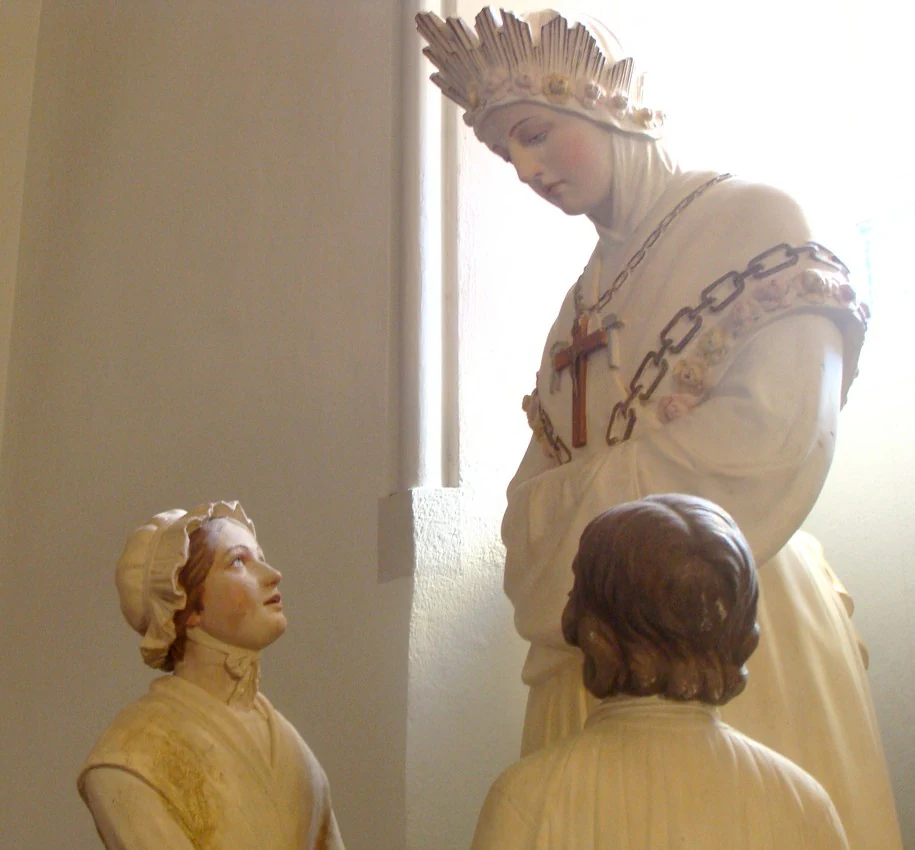
A woman in tears is the arresting image at the beginning of La Salette. Maximin Giraud, eleven, and Mélanie Calvat, fourteen, said they encountered her while tending cattle on 19 September 1846. The official sanctuary’s story places the light around a crucifix on her breast: suffering and reconciliation belong at the center from the start. [LS-02]
The public message comes first
The received account is a call to conversion addressed to the people. [LS-02]
Recognition was diocesan
Bishop de Bruillard issued a positive judgment in 1851. [LS-01]
Later secrets need separate work
The mandate does not authenticate every expanded prophecy later associated with La Salette. [LS-01]
Explore the chapters
Two children on the mountain
The sanctuary describes the reported woman as initially seated and weeping, then rising to speak in French and local patois. This language setting matters: the account reached investigators through speech, translation, and writing, rather than through a document delivered by the figure. [LS-02; LS-08]
Maximin and Mélanie are not interchangeable narrators. Their respective questioning and the earliest written versions are the material needed to understand what each reported. A modern combined story is useful for orientation, but cannot demonstrate that their testimony was independently identical. [LS-01; LS-08]
A crucifix, tools, chains, and roses
The received description includes a crucifix with a hammer and pincers, a heavy chain, and roses. Those details place the image in the symbolic world of Christ’s Passion. They make the tears intelligible as sorrow connected with human estrangement from God, rather than simply an unexplained emotional display. [LS-02]
This is the Catholic meaning offered by the devotion: an appeal to return to Christ. Interpreting the symbols is a theological exercise; it does not independently establish that the children saw an external supernatural figure. Both questions can remain visible while the story is told. [LS-02; LS-07]
From a spoken account to a written message
An official missionary account names Baptiste Pra, Pierre Selme, and Jean Moussier as men who wrote down the reported message the following evening. Translation from patois into French was part of that process. The earliest manuscript and its complete custody history have not been inspected here. [LS-08]
The distinction matters when a modern text is presented as word-for-word speech. A faithful transmission is possible, but exactness must be demonstrated by comparing versions. The record’s human intermediaries are part of its history, not something to hide behind an uninterrupted devotional voice. [LS-08; LS-09]
What the bishop examined
The 1851 mandate describes a diocesan commission, questioning, and consideration of arguments for and against the claim. It relied on Pierre-Joseph Rousselot’s published work. Rousselot was an investigator and advocate within the ecclesiastical process, which makes his material a primary record of the inquiry but not a neutral scientific experiment. [LS-01; LS-05]
On 19 September 1851 Bishop Philibert de Bruillard judged the apparition credible and authorized the cult. That explicit judgment is stronger institutional evidence than a shrine’s popularity or a later commemorative visit. Its precise scope remains the relevant starting point. [LS-01]
An uncomfortable detail in the mandate
The same act controlled special devotional publications and prohibited public opposition to the proclaimed fact among the diocese’s clergy and faithful. That historical restriction belongs alongside the positive decision. It means subsequent local agreement cannot simply be counted as a series of wholly independent confirmations. [LS-01]
This does not prove the children false. It does change how later consensus should be interpreted. Serious engagement with La Salette includes reading the institution’s procedures, including details that a brief devotional summary might omit. [LS-01; LS-05]
The secrets are a separate documentary problem
The mandate notes that each child sent a private secret to Pius IX. It does not publish those texts or authenticate every later expansion, prophecy, or claimed fulfillment. A quotation’s association with La Salette is therefore insufficient to establish that it belongs to the recognized 1846 message. [LS-01]
The sanctuary also reports an 1855 confirmation by Bishop Ginoulhiac. Its exact act has not been inspected here. Until the early secrets, later versions, and episcopal documents are mapped carefully, sweeping claims of blanket approval outrun the available evidence. [LS-01; LS-02]
What a visitor can take seriously now
The Church’s reception makes La Salette a recognized place of Catholic conversion and reconciliation. The historical record gives a definite event claim, named children, an inquiry, and a signed episcopal judgment. It also leaves documentary work to do. Reading the public message first keeps the devotion’s moral purpose in view while that work continues. [LS-01; LS-02; LS-07]
The 2024 Vatican norms now ordinarily favor a pastoral determination rather than a declaration of supernatural origin. That contemporary procedure helps distinguish different kinds of Church recognition; it does not replace the actual wording or historical significance of La Salette’s 1851 judgment. [LS-06]
Catholic reflection & discussion
Consider the message as well as the event
Explore the devotional meaning described in this article alongside the history of the report and the Church's response. Make space for both a personal response and questions about the record.
These editorial prompts invite reflection on the article. They are distinct from Church teaching and the evidence findings.
Pause and reflect
- Which part of the reported message or its reception would you like to understand more deeply?
- What exactly does the Church's recorded decision cover, and which questions does it leave open?
- What would it look like to approach this story with both a receptive heart and care for the truth?
Discuss with family or a group
Choose questions suited to your readers' ages and experiences. Anyone can pass or keep a response private.
- Identify who reported the experience, who investigated it, and who made a Church decision. Why does each person's role matter?
- How could you speak respectfully with someone whose response to this story differs from your own?
Questions people ask
Open any question for a fuller answer and its sources.
Was the apparition approved by a pope?
The operative act examined here is Bishop de Bruillard’s 1851 diocesan mandate. Sending secrets to Pius IX is not the same as a papal authentication of all their contents. [LS-01]
Were the first words recorded in one language?
Does approval cover every later prophecy?
No such blanket scope is established by the mandate. Each later text requires its own date, attribution, and relation to the early record. [LS-01]
Why focus on the tears?
They connect the story’s emotional force with its call to conversion and its crucifix imagery. That is the central devotional reading, before questions about later secrets arise. [LS-02]
What the evidence can establish
Evidence verdict: unresolved
Did an external supernatural Marian apparition appear to Maximin Giraud and Mélanie Calvat at La Salette on 19 September 1846?
The sources establish that two children made reports, a diocesan inquiry occurred and the local bishop issued a positive judgment. Adult transcription and translation of the earliest account, incomplete primary-document inspection, lack of repeatable evidence and the mandate's restriction on public opposition prevent the historical record from establishing or excluding an external supernatural cause.
Church or institutional status
Apparition judged certain and cult authorized by the Bishop of Grenoble in 1851.
- Authority
- Philibert de Bruillard, Bishop of Grenoble, mandate dated 19 September 1851.
- Scope of the finding
- Article 1 judged the reported 19 September 1846 apparition to two shepherds indubitable and certain; Article 3 authorized the cult of Notre-Dame de La Salette.
- Limits of the finding
- This local episcopal act is not a papal decree or scientific demonstration, does not authenticate every later secret or prophecy, and Article 5 restricted public diocesan opposition to the proclaimed event.
Sources and notes
Back to the overviewSource labels describe a document's type and role, not the strength of a claim. Where provided, notes explain its use, access limits, and outstanding checks.
Original 1851 print, 8 numbered pages — Articles 1–3 contain the judgment and authorization; Articles 4–5 regulate publications and prohibit public diocesan opposition; Articles 6–8 concern the shrine, pastoral application and publication of the mandate. The preamble identifies the commission sessions and Rousselot reports relied on.
Current official sanctuary chronology — Names the claimants, quotes the 1851 judgment and reports a further inquiry and confirmation by Bishop Ginoulhiac in 1855. The 1855 act itself was not inspected.
- LS-03Missionaries of Our Lady of La Salette, "Documents" (opens in a new tab)Official sourceFurther reading
Additional reading; inclusion here does not make it evidence for a claim.
Official institutional index identifying the 1851 mandate, the 1852 pastoral letter and a 4 August 1855 letter to Bishop Ginoulhiac; use as a document locator, not independent proof of the event.
- LS-04Philibert de Bruillard, Pastoral Letter and Mandate announcing the sanctuary's foundation stone, 1 May 1852 (opens in a new tab)Primary sourceFurther reading
Additional reading; inclusion here does not make it evidence for a claim.
Official Missionaries transcription — Shows how the bishop understood and promoted his 1851 judgment; devotional and pastoral interpretation, not new independent evidence.
- LS-05Pierre-Joseph Rousselot, La vérité sur l'événement de La Salette du 19 septembre 1846, ou Rapport à Mgr l'évêque de Grenoble (1848) (opens in a new tab)Primary source
Digitized contemporary bishop-facing report — A primary record of the ecclesiastical inquiry and arguments. Rousselot was an investigator and advocate whose report the 1851 mandate expressly relied on; do not treat it as neutral scientific adjudication.
- LS-06Dicastery for the Doctrine of the Faith, "Norms for Proceeding in the Discernment of Alleged Supernatural Phenomena", 17 May 2024 (opens in a new tab)Official source
Presentation and pars. 11–13 — Current framework distinguishing pastoral authorization from certainty of supernatural origin. It does not retroactively replace the 1851 judgment.
Nos. 66–67 — Recognized private revelations do not belong to the deposit of faith and do not complete Christ's definitive revelation.
- LS-08Missionaries of Our Lady of La Salette, René Butler, M.S., "Faire le récit" (opens in a new tab)Official source
Official institutional article — Says Pra, Selme and Moussier wrote the reported message on 20 September 1846 and translated patois into French. It provides no inspectable facsimile or full custody analysis; use with the disclosed verification caveat.
- LS-09Archives départementales de l'Isère, FRAD038/204J1, archives du château de Virieu, detailed catalogue PDF (opens in a new tab)Official sourceFurther reading
Additional reading; inclusion here does not make it evidence for a claim.
Official archive catalogue — Records a September 1851 copy of the Grenoble mandate in the Virieu-Pupetières collection; corroborates the printed act's archival existence.
Corrections and updates
Expanded this file with a sourced narrative, 7 chapters and 4 answers to common questions. The existing evidence verdict label and institutional status are retained. Independent human review remains pending.