
Start here
The story, in brief
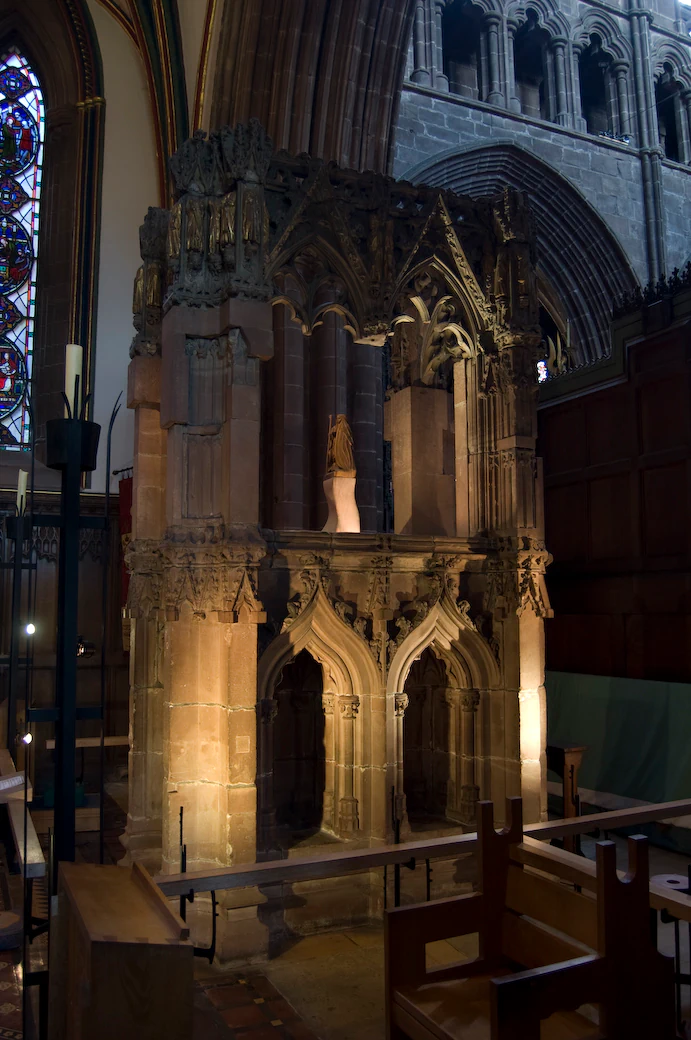
There is more than one shrine story in Chester. Medieval stonework in the cathedral was reassembled after the older relic shrine’s destruction; the Catholic parish also created its own twentieth-century memorial to Werburgh. [SAINT-SAINT-WERBURGH-S01]
Neither should be mistaken for a surviving intact body. The parish’s history explicitly states that the relics were lost, making this a case about what a community preserves when the physical center of a devotion has disappeared. [SAINT-SAINT-WERBURGH-S01]
Relics were lost
The present object is not an intact body. [SAINT-SAINT-WERBURGH-S01]
Two memorial histories
Medieval cathedral stonework and the 1931 parish shrine are distinct. [SAINT-SAINT-WERBURGH-S01]
Shared remembrance
Both Anglican and Catholic settings preserve the tradition. [SAINT-SAINT-WERBURGH-S01] [SAINT-SAINT-WERBURGH-S03]
Explore the chapters
A royal woman becomes an abbess
The parish account identifies Werburgh with Mercian royal ancestry and the religious world of Ely. It recounts an early medieval life and later reforming reputation. Because this part of the modern page depends on later summaries, it is a starting point for biographical research rather than a complete primary record of the seventh century. [SAINT-SAINT-WERBURGH-S01]
The 708 preservation tradition
The account describes a finding of an intact body during a transfer in 708. That is a historical devotional claim, not a modern examination. Its chronological scope matters: a reported appearance at one opening does not prove uninterrupted preservation or the presence of a body now. [SAINT-SAINT-WERBURGH-S01]
From Hanbury to Chester
The relic tradition associates relocation with the threat of Viking raids and the safety of Chester’s walls. Later, the medieval shrine became part of the abbey church’s identity. These movements show how religious memory was shaped by political danger and the places available for protection. [SAINT-SAINT-WERBURGH-S01] [SAINT-SAINT-WERBURGH-S03]
Destruction and reassembly
The shrine was broken up at the Dissolution, and the parish states that Werburgh’s relics were lost. Surviving stonework was reassembled in 1876. A reconstructed shrine can therefore be an authentic historic object without containing the remains once associated with its earlier form. [SAINT-SAINT-WERBURGH-S01] [SAINT-SAINT-WERBURGH-S02]
A separate 1931 parish memorial
The Catholic parish’s own shrine was installed in 1931. Its history identifies architectural planning, a carved wooden statue, and a window by Trena Cox. These are unusually concrete records of modern devotion: named makers, materials, and changes in the use of church space. They should not be confused with the cathedral’s medieval shrine fragments. [SAINT-SAINT-WERBURGH-S01]
The geese in the window
Cox’s window refers to the famous goose-restoration legend through a pilgrim-sign design. The image documents the tradition’s artistic reception. It does not independently establish that dead birds returned to life. A visitor can appreciate the iconography while asking when the narrative first appeared and how it changed. [SAINT-SAINT-WERBURGH-S01]
What crosses the Reformation divide
Werburgh remains remembered in both Catholic and Anglican settings. The present cathedral and parish preserve different physical expressions of that memory. The lost relics make a current intact-body claim untenable, but they do not erase the shared religious and cultural history that survives in buildings, art, and commemoration. [SAINT-SAINT-WERBURGH-S01] [SAINT-SAINT-WERBURGH-S02] [SAINT-SAINT-WERBURGH-S03]
Catholic reflection & discussion
Look for the person within the story
Spend a moment with the choices, relationships and hardships in this life. Consider what you might learn from the person as well as from the extraordinary claims examined in the file.
These editorial prompts invite reflection on the article. They are distinct from Church teaching and the evidence findings.
Pause and reflect
- Which choice or experience in this life stays with you, and why?
- What would you like to understand better about the person's faith and the world they lived in?
- Is there a small act of patience, courage or service that this reading invites you to consider?
Discuss with family or a group
Choose questions suited to your readers' ages and experiences. Anyone can pass or keep a response private.
- Ask each person to choose a moment from the life described here. What makes that moment worth remembering?
- Which details have clear sources, and which remain uncertain? How could you tell the story honestly without losing its human meaning?
Questions people ask
Open any question for a fuller answer and its sources.
Are Werburgh’s remains in the reconstructed shrine?
The Catholic parish says the relics were lost; the cathedral shrine consists of surviving reassembled stonework. [SAINT-SAINT-WERBURGH-S01]
Is the parish statue medieval?
The parish account dates its memorial installation to 1931. [SAINT-SAINT-WERBURGH-S01]
What do the geese mean?
They refer to a restoration-to-life legend associated with Werburgh and represented in the stained glass. [SAINT-SAINT-WERBURGH-S01]
Why distinguish the two shrines?
The cathedral’s medieval fragments and the Catholic parish’s modern memorial are different objects with different histories. [SAINT-SAINT-WERBURGH-S01] [SAINT-SAINT-WERBURGH-S02]
What the evidence can establish
Evidence verdict: debunked
Does an intact body of Werburgh currently survive in, or remain displayed by, the reconstructed Chester shrine?
No. The current Catholic parish says the relics were lost; the surviving display is reassembled shrine stonework. Current Church custodians distinguish the medieval relic tradition from the reconstructed shrine. The Catholic parish explicitly says Werburgh’s relics were lost. The surviving shrine is stonework, so a current intact-body claim is false; the old 708 report remains historical testimony.
Sources: [SAINT-SAINT-WERBURGH-S01; SAINT-SAINT-WERBURGH-S02; SAINT-SAINT-WERBURGH-S03]
Church or institutional status
Anglican cathedral custodial tradition; pre-Reformation Catholic saint
- Authority
- Current Anglican and Catholic custodians
- Scope of the finding
- Ancient English saint with continuing Anglican and Catholic commemoration. No exact formal Roman canonization or confirmation act was located.
- Limits of the finding
- Ecclesial recognition, commemoration, or custodial attribution is separate from physical identity and preservation evidence.
- Official sources
- [SAINT-SAINT-WERBURGH-S01; SAINT-SAINT-WERBURGH-S02; SAINT-SAINT-WERBURGH-S03]
Sources and notes
Back to the overviewSource labels describe a document's type and role, not the strength of a claim. Where provided, notes explain its use, access limits, and outstanding checks.
- SAINT-SAINT-WERBURGH-S01Saint Werburgh’s Roman Catholic Parish, Chester — shrine (opens in a new tab)Official source
It recounts the traditional 708 finding of the body as intact, the relics’ transfer to Chester, the shrine’s destruction at the Dissolution, and states that Werburgh’s relics were lost. It says surviving stonework was reassembled in 1876. What it does not establish: the 708 description is a historical ecclesial tradition, not modern physical evidence; the page cannot identify lost remains.
It recounts the relics’ placement in the shrine and the shrine’s destruction in 1540. What it does not establish: site history, not relic authentication.
It places the Werburgh tradition in the cathedral’s history. What it does not establish: no current body or physical examination is claimed.
Corrections and updates
Expanded this file with a sourced narrative, 7 chapters and 4 answers to common questions. The existing evidence verdict label and institutional status are retained. Independent human review remains pending.