
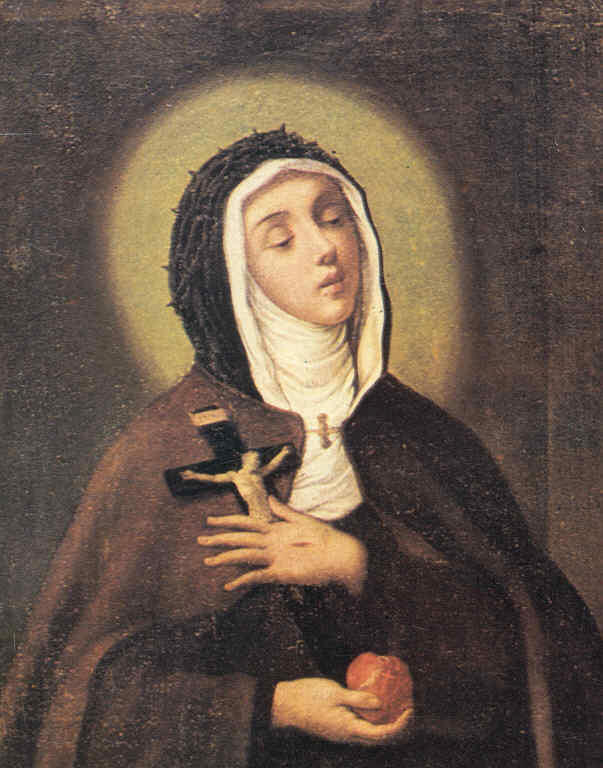
Start here
The story, in brief
Veronica Giuliani left a record too substantial to reduce to a picture of wounds. Benedict XVI’saccount describes a diary spanning thirty-four years and approximately 22,000 manuscript pages, alongside letters and other writing. [SAINT-SAINT-VERONICA-GIULIANI-S01]
The same religious life included fifty years in one monastery and service as abbess. Her reported experiences of Christ’s Passion belong within that community and textual history. [SAINT-SAINT-VERONICA-GIULIANI-S01]
A substantial written record
The diary spans decades of religious life. [SAINT-SAINT-VERONICA-GIULIANI-S01]
A Capuchin Poor Clare
Her actual community matters to the history. [SAINT-SAINT-VERONICA-GIULIANI-S01]
Leadership and mysticism
She was an abbess as well as a reported visionary. [SAINT-SAINT-VERONICA-GIULIANI-S01]
Explore the chapters
Orsola becomes Veronica
Born in 1660, Orsola Giuliani entered the Capuchin Poor Clares at Città di Castello at seventeen and took the name Veronica. The official account describes the monastery as her home for the remainder of her life. Enclosure establishes the setting, but it does not mean the years were devoid of relationships or responsibilities. [SAINT-SAINT-VERONICA-GIULIANI-S01]
A diary written under obedience
Benedict XVI identifies the diary, begun in 1693, as a principal source for her thought. He says she wrote at the direction of her confessor in agreement with the diocesan bishop. That context matters: the text is a spiritual testimony produced within guidance and oversight, not an unmediated recording of interior events. [SAINT-SAINT-VERONICA-GIULIANI-S01]
The religious meaning of the Passion
The papal interpretation describes a spirituality of being loved by Christ and answering that love. Her identification with the suffering Christ is directed toward God and prayer for the Church. Explaining that theology is more informative than treating pain itself as the measure of her significance. [SAINT-SAINT-VERONICA-GIULIANI-S01]
What the extraordinary reports include
The official biography recounts stigmata, visions, and other experiences associated with Christ’s Passion. It also notes a period of close custody or scrutiny. These passages establish a history of claims and institutional response. Their physical mechanism requires the actual examination records, not inference from devotional language alone. [SAINT-SAINT-VERONICA-GIULIANI-S01]
An abbess with continuing duties
In 1716, she became abbess and remained in that responsibility until death in 1727. Leadership belongs beside mysticism in her story. The community had to be governed and its members cared for; extraordinary reputation did not eliminate those ordinary demands. [SAINT-SAINT-VERONICA-GIULIANI-S01]
The Church’s later recognition
The Dicastery records beatification in 1804 and canonization in 1839. Benedict XVI’slater teaching explains why her religious writing remains of interest. Neither form of recognition means every reported experience was separately proved as a miracle in the cause. [SAINT-SAINT-VERONICA-GIULIANI-S01]
The most promising evidence to pursue
A reader can begin with the diary’s textual history and the papal interpretation of its theology. A fuller physical inquiry would locate contemporary observations of reported wounds and the subsequent records for her remains. These are distinct research tasks, each more useful than allowing one spectacular image to stand for an entire life. [SAINT-SAINT-VERONICA-GIULIANI-S01]
Catholic reflection & discussion
Look for the person within the story
Spend a moment with the choices, relationships and hardships in this life. Consider what you might learn from the person as well as from the extraordinary claims examined in the file.
These editorial prompts invite reflection on the article. They are distinct from Church teaching and the evidence findings.
Pause and reflect
- Which choice or experience in this life stays with you, and why?
- What would you like to understand better about the person's faith and the world they lived in?
- Is there a small act of patience, courage or service that this reading invites you to consider?
Discuss with family or a group
Choose questions suited to your readers' ages and experiences. Anyone can pass or keep a response private.
- Ask each person to choose a moment from the life described here. What makes that moment worth remembering?
- Which details have clear sources, and which remain uncertain? How could you tell the story honestly without losing its human meaning?
Questions people ask
Open any question for a fuller answer and its sources.
Was Veronica a Carmelite?
No. She was a Capuchin Poor Clare. The connection with other mystics is thematic, not membership in the same order. [SAINT-SAINT-VERONICA-GIULIANI-S01]
Why is the diary important?
The official account identifies it as a large, decades-long record central to understanding her thought. [SAINT-SAINT-VERONICA-GIULIANI-S01]
Does canonization establish the cause of her wounds?
It establishes Catholic sainthood; the reported physical phenomena need their own observations and evaluation. [SAINT-SAINT-VERONICA-GIULIANI-S01]
Did she hold a leadership role?
Yes. She became abbess in 1716 and continued until her death. [SAINT-SAINT-VERONICA-GIULIANI-S01]
What the evidence can establish
Evidence verdict: unresolved
Does the available evidence establish that the displayed or attributed remains of Saint Veronica Giuliani are the naturally preserved, substantially intact body of that person, without undisclosed embalming, reconstruction, wax covering, replacement, or later conservation treatment?
Canonized Catholic saint. Official sources confirm that status or custody for Saint Veronica Giuliani. They do not provide the independent anatomical evidence, custody documentation, or treatment history needed to answer whether the remains are naturally preserved.
Sources: [SAINT-SAINT-VERONICA-GIULIANI-S01]
Church or institutional status
Canonized Catholic saint
- Authority
- Dicastery for the Causes of Saints
- Scope of the finding
- The cited official record documents the person's Catholic canonization and saintly title.
- Limits of the finding
- It does not authenticate the attributed remains, establish natural preservation, or prove a miracle.
- Official sources
- [SAINT-SAINT-VERONICA-GIULIANI-S01]
Sources and notes
Back to the overviewSource labels describe a document's type and role, not the strength of a claim. Where provided, notes explain its use, access limits, and outstanding checks.
- SAINT-SAINT-VERONICA-GIULIANI-S01Dicastery for the Causes of Saints profile — Saint Veronica Giuliani (opens in a new tab)Official source
Identifies this person and records the stated Catholic beatification/canonization or liturgical status; it does not establish the physical preservation claim. What it does not establish: This institutional record establishes only the stated act, status, teaching, or account; it does not independently establish material identity, preservation mechanism, or supernatural causation.
Corrections and updates
Expanded this file with a sourced narrative, 7 chapters and 4 answers to common questions. The existing evidence verdict label and institutional status are retained. Independent human review remains pending.