
Start here
The story, in brief
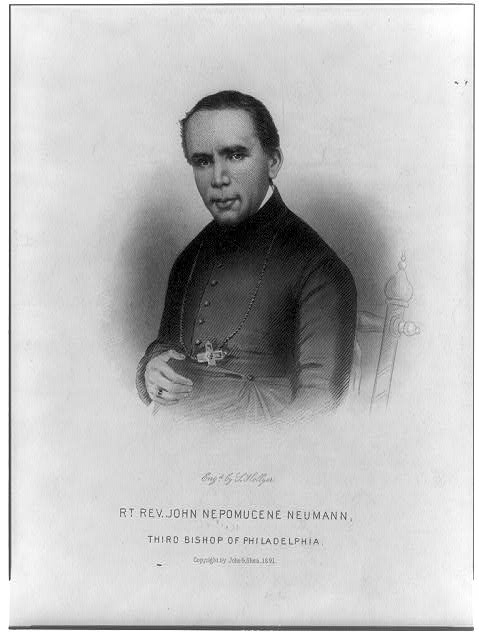
John Neumann reached New York without the security of an established position. The official account describes a European seminarian whose ordination had been delayed and who crossed the Atlantic to serve in America. He eventually became bishop of Philadelphia. [SAINT-SAINT-JOHN-NEUMANN-S01]
The journey matters because his later priorities—immigrant communities, schools, catechesis, and regular parish contact—were answers to problems he had met at ground level. His remains are a separate investigation; his working life already provides a substantial story. [SAINT-SAINT-JOHN-NEUMANN-S01]
Migration into service
His American ministry began after an uncertain Atlantic crossing. [SAINT-SAINT-JOHN-NEUMANN-S01]
Education at scale
Schools and parish formation were central to his episcopate. [SAINT-SAINT-JOHN-NEUMANN-S01]
A separate physical question
Burial and canonization records do not replace anatomical documentation. [SAINT-SAINT-JOHN-NEUMANN-S01]
Explore the chapters
An interrupted route to priesthood
Born in Bohemia in 1811, Neumann studied for priesthood before traveling to America. The papal canonization account says an abundance of candidates had delayed his ordination at home. Bishop John Dubois ordained him in New York in June 1836. The turning point was therefore a move into uncertainty, not a straightforward promotion. [SAINT-SAINT-JOHN-NEUMANN-S01]
Ministry beyond the major city
Neumann first worked in communities near Niagara, including Williamsville and North Bush. The official biography describes service among laborers in the timber country. These assignments put distance and scattered populations into the story: pastoral care required going where people worked and lived. [SAINT-SAINT-JOHN-NEUMANN-S01]
A religious community and immigrant parishes
He entered the Redemptorists and served in Baltimore and Pittsburgh, with particular attention to German-speaking immigrants. Community life and mission were joined rather than opposed. For an immigrant congregation, being understood in worship, instruction, and personal counsel was a practical need, not simply a cultural preference. [SAINT-SAINT-JOHN-NEUMANN-S01]
What a bishop could build
Appointed to Philadelphia in 1852, Neumann promoted Catholic schools and parish life. Paul VI’s canonization account credits him with approximately one hundred schools. The figure belongs to that official account; a school-by-school institutional history would be needed to define precisely what was opened, reorganized, or supported. The broad educational commitment is unmistakable. [SAINT-SAINT-JOHN-NEUMANN-S01]
The theology beneath the organization
Paul VI linked Neumann’s schools, visits, confession ministry, and Eucharistic devotion with pastoral charity. In this interpretation, religious education was service to a child’s whole life, and sacramental worship was intended to form communities of service. That is a more substantial Catholic explanation than treating his administrative success as sufficient evidence of holiness. [SAINT-SAINT-JOHN-NEUMANN-S01]
An unexpectedly short episcopate
Neumann died after a sudden illness in a Philadelphia street on 5 January 1860, before turning forty-nine. His episcopate lasted less than eight years. The official record dates beatification to 1963 and canonization to 1977. The brevity of his adult life makes the institutional legacy particularly striking. [SAINT-SAINT-JOHN-NEUMANN-S01]
What his tomb can and cannot establish
The biography locates his burial at Saint Peter’s in Philadelphia. That supplies a custodial starting point, not a current anatomical assessment. Claims about preserved tissue, reconstruction, and conservation require the examination and treatment history of those particular remains. The educational legacy and the preservation question can be investigated without forcing either to prove the other. [SAINT-SAINT-JOHN-NEUMANN-S01]
Catholic reflection & discussion
Look for the person within the story
Spend a moment with the choices, relationships and hardships in this life. Consider what you might learn from the person as well as from the extraordinary claims examined in the file.
These editorial prompts invite reflection on the article. They are distinct from Church teaching and the evidence findings.
Pause and reflect
- Which choice or experience in this life stays with you, and why?
- What would you like to understand better about the person's faith and the world they lived in?
- Is there a small act of patience, courage or service that this reading invites you to consider?
Discuss with family or a group
Choose questions suited to your readers' ages and experiences. Anyone can pass or keep a response private.
- Ask each person to choose a moment from the life described here. What makes that moment worth remembering?
- Which details have clear sources, and which remain uncertain? How could you tell the story honestly without losing its human meaning?
Questions people ask
Open any question for a fuller answer and its sources.
Was John Neumann born in America?
No. He was born in Bohemia and immigrated before his 1836 ordination in New York. [SAINT-SAINT-JOHN-NEUMANN-S01]
Why are schools so prominent in his story?
The official canonization account connects his pastoral work with sustained development of Catholic education in Philadelphia. [SAINT-SAINT-JOHN-NEUMANN-S01]
Did he work only with German immigrants?
They were a particular focus, but the biography describes broader pastoral responsibilities and an Italian parish in Philadelphia as well. [SAINT-SAINT-JOHN-NEUMANN-S01]
What does his canonization establish?
It establishes Catholic recognition as a saint in 1977. It does not establish the present physical condition or preservation mechanism of his remains. [SAINT-SAINT-JOHN-NEUMANN-S01]
What the evidence can establish
Evidence verdict: unresolved
Does the available evidence establish that the displayed or attributed remains of Saint John Neumann are the naturally preserved, substantially intact body of that person, without undisclosed embalming, reconstruction, wax covering, replacement, or later conservation treatment?
Canonized Catholic saint. Official sources confirm that status or custody for Saint John Neumann. They do not provide the independent anatomical evidence, custody documentation, or treatment history needed to answer whether the remains are naturally preserved.
Sources: [SAINT-SAINT-JOHN-NEUMANN-S01]
Church or institutional status
Canonized Catholic saint
- Authority
- Dicastery for the Causes of Saints
- Scope of the finding
- The cited official record documents the person's Catholic canonization and saintly title.
- Limits of the finding
- It does not authenticate the attributed remains, establish natural preservation, or prove a miracle.
- Official sources
- [SAINT-SAINT-JOHN-NEUMANN-S01]
Sources and notes
Back to the overviewSource labels describe a document's type and role, not the strength of a claim. Where provided, notes explain its use, access limits, and outstanding checks.
- SAINT-SAINT-JOHN-NEUMANN-S01Dicastery for the Causes of Saints profile — Saint John Neumann (opens in a new tab)Official source
Identifies this person and records the stated Catholic beatification/canonization or liturgical status; it does not establish the physical preservation claim. What it does not establish: This institutional record establishes only the stated act, status, teaching, or account; it does not independently establish material identity, preservation mechanism, or supernatural causation.
Corrections and updates
Expanded this file with a sourced narrative, 7 chapters and 4 answers to common questions. The existing evidence verdict label and institutional status are retained. Independent human review remains pending.