
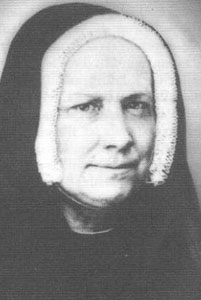
EDUCATOR · RELIGIOUS FOUNDER · GENOA, 1809–1882

Saint Paola Frassinetti

Paola Frassinetti’s educational work grew from household responsibility, a village parish, and a school that its founders struggled to support.

Archival image

Full caption, source, licence, and changes below

Start here

The story, in brief

Paola Frassinetti was nine when her mother died and she took on major household responsibilities. Years later, a stay with her priest brother in Quinto brought her into contact with village girls. The educational vocation that emerged from those relationships became the Sisters of Saint Dorothy. [SAINT-BLESSED-PAULA-FRASSINETTI-S01]

An early responsibility

Family loss shaped Paola’s practical life. [SAINT-BLESSED-PAULA-FRASSINETTI-S01]

A school sustained by sacrifice

The first sisters worked to support education for poor girls. [SAINT-BLESSED-PAULA-FRASSINETTI-S01]

A continuing priority

The later mission grew from that local educational purpose. [SAINT-BLESSED-PAULA-FRASSINETTI-S01]

Human verification is still pending. View the open checks.
Explore the chapters

An education within the household

Born in Genoa in 1809, Paola learned reading and writing at home. After her mother’s death, care for her father and brothers became a demanding part of childhood. Her later concern for young people developed within a life already shaped by practical responsibility and the loss of a parent. [SAINT-BLESSED-PAULA-FRASSINETTI-S01]

Quinto opened another possibility

A period of exhaustion led Paola to stay with her brother Giuseppe, a parish priest in Quinto. The official biography describes gatherings with local girls and the gradual emergence of her ability as an educator. This beginning was relational and local: a community of young women formed around shared conversation, faith, and purpose. [SAINT-BLESSED-PAULA-FRASSINETTI-S01]

Seven women and a very poor school

On August 12,1834, Paola and six companions began their common religious undertaking. They opened a school for very poor girls and worked at night to sustain themselves. The school’s financial strain belongs in the story because offering an education required the founders to solve immediate problems of food, housing, and labor. [SAINT-BLESSED-PAULA-FRASSINETTI-S01]

Why the institute became Dorothean

In 1835, Luca Passi proposed bringing his Work of Saint Dorothy into Paola’s institute. Its concern was reaching vulnerable young women in their own working and living environments. Paola recognized a fit with her educational purpose, and the community adopted the name Sisters of Saint Dorothy. The name marks a concrete partnership and an approach to outreach. [SAINT-BLESSED-PAULA-FRASSINETTI-S01]

The move to Rome and the wider mission

Paola went to Rome in 1841, initially living with companions in very modest rooms. The official history recounts further educational responsibilities and later expansion beyond Italy, including Brazil and Portugal in 1866. The growing institution had to carry its founding priority for young and poor people into new locations. [SAINT-BLESSED-PAULA-FRASSINETTI-S01]

What the Catholic interpretation emphasizes

The biography repeatedly connects education with availability to God’s will and practical love. Paola’s holiness is presented through the organization of a community able to teach and serve amid difficulty. This gives the reader an intelligible religious purpose behind the institutional growth, rather than presenting expansion itself as proof of sanctity. [SAINT-BLESSED-PAULA-FRASSINETTI-S01]

Her title and the question of remains

The Dicastery identifies Paola as a canonized saint. The inherited “blessed” route is an older label. Its biography does not provide a complete anatomical and conservation record for attributed remains, so the physical-preservation question stays separate. Her life already offers substantial evidence of a distinctive educational mission. [SAINT-BLESSED-PAULA-FRASSINETTI-S01]

Catholic reflection & discussion

Look for the person within the story

Spend a moment with the choices, relationships and hardships in this life. Consider what you might learn from the person as well as from the extraordinary claims examined in the file.

These editorial prompts invite reflection on the article. They are distinct from Church teaching and the evidence findings.

Pause and reflect

  1. Which choice or experience in this life stays with you, and why?
  2. What would you like to understand better about the person's faith and the world they lived in?
  3. Is there a small act of patience, courage or service that this reading invites you to consider?
Discuss with family or a group

Choose questions suited to your readers' ages and experiences. Anyone can pass or keep a response private.

  • Ask each person to choose a moment from the life described here. What makes that moment worth remembering?
  • Which details have clear sources, and which remain uncertain? How could you tell the story honestly without losing its human meaning?

Questions people ask

Open any question for a fuller answer and its sources.

Why is she called Paola rather than Paula here?

Paola is the form used by the Dicastery; Paula is an English variant retained in the route. [SAINT-BLESSED-PAULA-FRASSINETTI-S01]

Did she found a school before international missions?

Yes. The initial community opened a school for poor girls in Quinto before later expansion. [SAINT-BLESSED-PAULA-FRASSINETTI-S01]

Why Saint Dorothy?

The name reflects the incorporation of Luca Passi’s educational work into her institute in 1835. [SAINT-BLESSED-PAULA-FRASSINETTI-S01]

Is her body’s preservation established?

The official biography is not a complete physical examination or conservation history. That claim remains open in this file. [SAINT-BLESSED-PAULA-FRASSINETTI-S01]

What the evidence can establish

Evidence verdict: unresolved

Does the available evidence establish that the displayed or attributed remains of Blessed Paula Frassinetti are the naturally preserved, substantially intact body of that person, without undisclosed embalming, reconstruction, wax covering, replacement, or later conservation treatment?

Canonized Catholic saint. Official sources confirm that status or custody for Saint Paola Frassinetti. They do not provide the independent anatomical evidence, custody documentation, or treatment history needed to answer whether the remains are naturally preserved.

Sources: [SAINT-BLESSED-PAULA-FRASSINETTI-S01]

Church or institutional status

Canonized Catholic saint

Authority
Dicastery for the Causes of Saints
Scope of the finding
The cited official record documents the person's Catholic canonization and saintly title.
Limits of the finding
It does not authenticate the attributed remains, establish natural preservation, or prove a miracle.

Sources and notes

Back to the overview

Source labels describe a document's type and role, not the strength of a claim. Where provided, notes explain its use, access limits, and outstanding checks.

  • Identifies this person and records the stated Catholic beatification/canonization or liturgical status; it does not establish the physical preservation claim. What it does not establish: This institutional record establishes only the stated act, status, teaching, or account; it does not independently establish material identity, preservation mechanism, or supernatural causation.

Corrections and updates

  • Expanded this file with a sourced narrative, 7 chapters and 4 answers to common questions. The existing evidence verdict label and institutional status are retained. Independent human review remains pending.

Back to the overview
Biographical and recognition records

Human context

Why this person matters

Paola's story begins with responsibility, not spectacle. Educated at home, she later joined her priest-brother Giuseppe in Quinto and began teaching local girls. In 1834 she and six companions formed a community with almost nothing, opened a school for very poor girls, and worked at night to survive. The congregation expanded to Rome, Brazil, and Portugal during her lifetime. Her sainthood cause later accepted three healings; the separate claim that her body is incorrupt remains a material question, not a canonization finding.

Human context

People in this file

These people materially affect the claim or its recognition history. Their roles are stated so a name never appears without an explanation of why that person matters.

Giuseppe Frassinetti

Paola's brother and a priest at Quinto

His parish gave Paola an early setting in which to gather and teach local girls.

Luca Passi

Priest associated with the Work of Saint Dorothy

His educational work helped shape the congregation's name and mission.

Sister Virginia Caselin

Context pending

Beneficiary of a formally accepted beatification miracle

The 1930 decree identifies her healing from acute purulent catarrhal otitis media with left mastoiditis.

Vincenzo Giovagnoli

Context pending

Beneficiary of a formally accepted beatification miracle

The decree identifies him as a boy healed from osseous-periosteal tuberculosis of the left tarsus.

Maria Maccarone, married Scuteri

Context pending

Beneficiary of the formally accepted canonization miracle

The 1983 decree records a fifty-year-old woman with chronic polyarthritis and irreversible functional loss who was reported suddenly, completely, and durably healed in 1981.

Pius XI

Pope who approved Paola's heroic virtues, miracles, and beatification

He formally recognized the cause's beatification-stage findings and beatified Paola in 1930.

Path to Church recognition

A modern Catholic cause based on a life of heroic virtue

Catholic cause · heroic virtues

Tradition: Roman Catholic Church

Saint; beatified in 1930 and canonized by John Paul II on 11 March 1984

The Church examines the person's life, writings, reputation for holiness, and practice of Christian virtues. In the ordinary modern route, beatification of a confessor requires a miracle attributed after death, and canonization requires another miracle attributed after beatification. The dated record below, rather than this general outline, controls for this person.

Paola's cause crossed two procedural eras. Its beatification phase followed the pre-1983 Sacred Congregation of Rites process; the canonization concluded after John Paul II's 1983 reform while the long-running cause was already pending. The chronology below reports her actual record rather than retrofitting today's simplified ladder.

Documented milestones

  1. Ordinary processes

    Rome and Genoa collected testimony, writings, and evidence about Paola's life and reputation.

  2. Writings approved

    The cause history records approval of Paola's writings.

  3. Introduction authorized

    Pius X signed the commission introducing the cause; the formal decree followed on 22 August.

  4. Absence of unauthorized cult

    The required cultus-nullus determination was issued.

  5. Apostolic processes

    Apostolic inquiries proceeded in Rome and Genoa.

  6. Process validity

    The ordinary and apostolic processes were recognized as juridically valid.

  7. Virtues: antepreparatory review

    The Congregation began its staged examination of heroic virtue.

  8. Virtues: preparatory review

    A preparatory congregation continued the examination.

  9. Virtues: general congregation

    A general congregation considered whether Paola practiced Christian virtues heroically.

  10. Heroic virtues recognized

    Pius XI promulgated the heroic-virtues decree. A later decretal prints 28 August, while the contemporary decree and 1930 history support 15 August; the Vatican HTML also misprints the year as 1918.

  11. Two beatification miracles approved

    The healings of Virginia Caselin and Vincenzo Giovagnoli were formally recognized as miracles attributed to Paola's intercession.

  12. Beatification authorized

    After the 29 April general congregation, Pius XI issued the determination that beatification could safely proceed.

  13. Beatification

    Pius XI beatified Paola in Saint Peter's Basilica.

  14. Canonization cause resumed

    The official history records resumption of the canonization cause.

  15. Mileto inquiry

    An apostolic-authority inquiry examined Maria Maccarone's reported healing in the ecclesiastical Curia of Mileto.

  16. Inquiry validated

    The Congregation recognized the juridical validity of the Mileto inquiry.

  17. Medical Board

    After reports from two appointed experts, the Congregation's Medical Board reviewed the healing.

  18. Theological consultation

    Officials, prelates, and theological consultors considered attribution to Paola's intercession.

  19. Cardinal members' review

    The Congregation's cardinals considered the case with Cardinal Giuseppe Casoria as relator.

  20. Canonization miracle decreed

    John Paul II authorized the decree recognizing Maria Maccarone's healing as a miracle attributed to Paola's intercession.

  21. Consistory

    A consistory gave its vote concerning canonization.

  22. Canonization

    John Paul II canonized Paola in Saint Peter's Basilica.

Formal Catholic decisions

Miracles accepted for this cause

  • Healing of Sister Virginia Caselin

    BEATIFICATION

    Beneficiary: Sister Virginia Caselin

    Decision date:

    The formal decree identifies an instantaneous and complete healing in Rome from acute purulent catarrhal otitis media with mastoiditis of the left ear. It does not give the occurrence date or the later devotional details attached to the case.

  • Healing of Vincenzo Giovagnoli

    BEATIFICATION

    Beneficiary: Vincenzo Giovagnoli

    Decision date:

    The formal decree identifies the instantaneous and complete healing in Rome of a boy with osseous-periosteal tuberculosis of the left tarsus. It does not state the occurrence date or the later handkerchief narrative.

  • Healing of Maria Maccarone, married Scuteri

    CANONIZATION

    Beneficiary: Maria Maccarone, married Scuteri

    Decision date:

    The decree records chronic polyarthritis with irreversible functional loss in all affected joints and an instantaneous, complete, durable recovery on 7 August 1981 after Paola's intercession was invoked. The case passed local inquiry, juridical validation, expert and Medical Board review, theological consultation, cardinal review, and papal authorization.

Separate from accepted miracles

Other reported or examined claims

  • Unnamed post-1935 healing case 1

    Examined · not approved

    One of three healings the official history says was canonically examined after the cause resumed. The public record does not identify the person or condition and says the documentation did not satisfy the cause's medical criteria.

  • Unnamed post-1935 healing case 2

    Examined · not approved

    One of three unnamed cases examined but not used because the available documentation was medically insufficient. This does not establish fraud or that no recovery occurred.

  • Unnamed post-1935 healing case 3

    Examined · not approved

    The third publicly unnamed healing examined during the canonization phase and set aside for insufficient documentation under the cause's medical criteria.

  • Reported bodily incorruption

    Reported · not formally accepted

    The Archdiocese of Genoa says Paola's “incorrupt body” is visible beneath an altar in Rome. No beatification or canonization decree located identifies incorruption as an accepted miracle, and the display's anatomy, identity, alterations, and treatment history remain unresolved.

Additional sources

These sources support this profile and are linked directly. Other source IDs point to the main source list for the case file.

A source map for Saint Paola Frassinetti. Each finding is paired with the limitation recorded for the same source in this case file. Context only: this original diagram organizes the cited records. It is not evidence for historical, medical, or supernatural claims. Arrows connect each source finding to its limit; they do not represent a sequence of events.

Original Corpus Files graphic

BLESSED PAULA FRASSINETTI · SOURCE MAP

Follow each finding to its limit

Does the available evidence establish that the displayed or attributed remains of Blessed Paula Frassinetti are the naturally preserved, substantially intact body of that person, without undisclosed embalming, reconstruction, wax covering, replacement, or later conservation treatment?

Saint Paola Frassinetti

  1. Dicastery for the Causes of Saints profile — Blessed Paula Frassinetti

    SAINT-BLESSED-PAULA-FRASSINETTI-S01

    What the source supports

    Identifies this person and records the stated Catholic beatification/canonization or liturgical status; it does not establish the physical preservation claim.

    Limit of that finding

    This institutional record establishes only the stated act, status, teaching, or account; it does not independently establish material identity, preservation mechanism, or supernatural causation.

Help check this record

Visitors can privately suggest a correction, recommend a stronger or contrary source, or submit a photograph they own. Nothing becomes public automatically; every submission is reviewed privately before any separate publishing decision.

Open the contribution desk →