
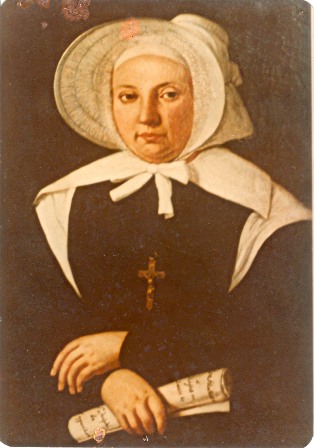
Start here
The story, in brief
Émilie de Vialar began by welcoming poor people into her home. By the time she died in 1856, the religious community she founded had established dozens of houses, with work extending from North Africa to Burma. The scale of that change is the compelling part of her story: an immediate act of care became a lasting institution. [SAINT-BLESSED-EMILY-DE-VIALAR-S01]
A concrete beginning
Hospitality and girls’ education preceded a worldwide institutional legacy. [SAINT-BLESSED-EMILY-DE-VIALAR-S01]
A founder under pressure
The official account records 42 houses despite poverty and opposition. [SAINT-BLESSED-EMILY-DE-VIALAR-S01]
Saint, with separate open questions
Her canonization on June 24, 1951 is documented by the shared canonization act; material records remain a separate inquiry. [EX-01]
Explore the chapters
Gaillac before the international mission
Born in Gaillac in 1797, Émilie organized charitable work with companions before founding a religious institute. The Dicastery’s account describes practical hospitality and the education of girls together. The project therefore had two connected ambitions: meet urgent needs and give young people opportunities extending beyond the moment of assistance. [SAINT-BLESSED-EMILY-DE-VIALAR-S01]
The decisive beginning in 1832
At Christmas 1832 she founded the Sisters of Saint Joseph of the Apparition in Gaillac. This date marks the transition from personal charity to a shared religious undertaking. Companions could now carry the work together and sustain it beyond the founder’s immediate presence. The change in scale helps explain why Émilie is remembered as a founder. [SAINT-BLESSED-EMILY-DE-VIALAR-S01]
What the schools and houses were for
The official biography describes service to people in hardship and instruction for girls as the institute’s purposes. These aims make her Catholic commitment tangible. Religious life was expressed through the organization of care and teaching, with the practical demands that follow whenever a community accepts responsibility for others. [SAINT-BLESSED-EMILY-DE-VIALAR-S01]
Expansion came with difficulties
The Dicastery credits her with founding 42 houses from North Africa to Burma despite poverty, opposition, and persecution. Its brief summary does not reconstruct each local conflict, so those labels should not become invented dramatic episodes. What it does establish is a broad geographical mission and a founder remembered for carrying it through material and institutional difficulty. [SAINT-BLESSED-EMILY-DE-VIALAR-S01]
Why Catholics remember the founder
Émilie’s mission joined the spread of the Gospel with service. That combination explains why her congregation is part of a religious story as well as a history of education and assistance. Her legacy offers a concrete question to readers: how can a community preserve the purpose of personal compassion when the work grows far beyond its original home? [SAINT-BLESSED-EMILY-DE-VIALAR-S01]
The canonization act resolves a date conflict
The Dicastery’s brief biography gives conflicting June dates for the 1951 canonization. The shared canonization formula reproduced with Maria Domenica Mazzarello explicitly names Émilie and dates the act to June 24, 1951. That primary act resolves the discrepancy. Her established title is Saint, despite the older “blessed” wording retained in this route. [SAINT-BLESSED-EMILY-DE-VIALAR-S01] [EX-01]
The remains are a different historical problem
The official profile says her body was transferred to Gaillac in 1972 for veneration. It does not publish an anatomical inventory, treatment history, or full custody documentation. A transfer and a location can be documented without establishing untreated natural preservation. Her educational and charitable achievements do not depend on presenting that separate claim as settled. [SAINT-BLESSED-EMILY-DE-VIALAR-S01]
Catholic reflection & discussion
Look for the person within the story
Spend a moment with the choices, relationships and hardships in this life. Consider what you might learn from the person as well as from the extraordinary claims examined in the file.
These editorial prompts invite reflection on the article. They are distinct from Church teaching and the evidence findings.
Pause and reflect
- Which choice or experience in this life stays with you, and why?
- What would you like to understand better about the person's faith and the world they lived in?
- Is there a small act of patience, courage or service that this reading invites you to consider?
Discuss with family or a group
Choose questions suited to your readers' ages and experiences. Anyone can pass or keep a response private.
- Ask each person to choose a moment from the life described here. What makes that moment worth remembering?
- Which details have clear sources, and which remain uncertain? How could you tell the story honestly without losing its human meaning?
Questions people ask
Open any question for a fuller answer and its sources.
Why does the URL still say “blessed”?
The route preserves an older label. The Holy See’s profile identifies Émilie as a canonized saint. [SAINT-BLESSED-EMILY-DE-VIALAR-S01]
What did she found?
The Sisters of Saint Joseph of the Apparition, begun in Gaillac in 1832 for charitable service and girls’ education. [SAINT-BLESSED-EMILY-DE-VIALAR-S01]
How international did her work become?
The Dicastery reports 42 foundations reaching from North Africa to Burma during her life. The individual houses’ histories would add local detail to that institutional summary. [SAINT-BLESSED-EMILY-DE-VIALAR-S01]
Is the condition of her body established here?
No. The reported 1972 transfer is a custody event; it does not supply the material examination needed to assess preservation. [SAINT-BLESSED-EMILY-DE-VIALAR-S01]
What the evidence can establish
Evidence verdict: unresolved
Does the available evidence establish that the displayed or attributed remains of Blessed Emily de Vialar are the naturally preserved, substantially intact body of that person, without undisclosed embalming, reconstruction, wax covering, replacement, or later conservation treatment?
Canonized Catholic saint. Official sources confirm that status or custody for Saint Émilie de Vialar. They do not provide the independent anatomical evidence, custody documentation, or treatment history needed to answer whether the remains are naturally preserved.
Sources: [SAINT-BLESSED-EMILY-DE-VIALAR-S01]
Church or institutional status
Canonized Catholic saint
- Authority
- Dicastery for the Causes of Saints
- Scope of the finding
- The cited official record documents the person's Catholic canonization and saintly title.
- Limits of the finding
- It does not authenticate the attributed remains, establish natural preservation, or prove a miracle.
- Official sources
- [SAINT-BLESSED-EMILY-DE-VIALAR-S01]
Sources and notes
Back to the overviewSource labels describe a document's type and role, not the strength of a claim. Where provided, notes explain its use, access limits, and outstanding checks.
- SAINT-BLESSED-EMILY-DE-VIALAR-S01Dicastery for the Causes of Saints profile — Blessed Emily de Vialar (opens in a new tab)Official source
Identifies this person and records the stated Catholic beatification/canonization or liturgical status; it does not establish the physical preservation claim. What it does not establish: This institutional record establishes only the stated act, status, teaching, or account; it does not independently establish material identity, preservation mechanism, or supernatural causation.
- EX-01Dicastery for the Causes of Saints — shared canonization act of June 24, 1951, reproduced with Maria Domenica Mazzarello (opens in a new tab)Official sourceCited in this file
Read the source note for the passage used and any limits on what it supports.
The reproduced Pius XII canonization formula names Aemilia de Vialar alongside Maria Dominica Mazzarello and supplies June 24, 1951. This resolves the inconsistent date in Émilie’s short official biography; it does not document her remains.
Corrections and updates
Expanded this file with a sourced narrative, 7 chapters and 4 answers to common questions. The existing evidence verdict label and institutional status are retained. Independent human review remains pending.