
Start here
The story, in brief
Piazza Navona offers a monumental setting for a very personal question: what does it mean to remember a young person killed for her faith? Inside Sant’Agnese in Agone, the church identifies a relic of Agnes’s head in the Chapel of Saint Philip Neri. [AGS-01; AGS-02]
The relic gives the story a physical focus, but Agnes’s importance reaches beyond a display. Her place in Christian memory, the distinction between Rome’s two Agnes shrines, and the unresolved identity of the material each need their own explanation.
The person
Agnes is remembered as a young Roman virgin and martyr.
The location
The head relic is attributed to her by the church of Sant’Agnese in Agone.
The evidence
Custodial attribution is established; biological identity and full transfer history remain open.
Explore the chapters
The young martyr behind the name
The Vatican’s account presents Agnes as a young Roman Christian, traditionally thirteen, whose witness joined virginity and martyrdom. It points to the early remembrance of her by Ambrose and Pope Damasus. Later stories elaborate the threats and violence she faced, but their details are not all identical. A responsible retelling distinguishes the ancient cult of a martyr from a fully recoverable biography. [EX-02]
The Catholic significance of her virginity is a freely given commitment to Christ. Her martyrdom is remembered as fidelity under coercion. This language must never turn violence against a girl into something admirable in itself: the courage belongs to the victim, not to those who harmed her.
Two churches, two parts of the story
Agnes’s burial tradition is associated with the Via Nomentana and the basilica of Sant’Agnese fuori le Mura. Sant’Agnese in Agone is the church at Piazza Navona that identifies the head relic. The similar names can make these locations easy to confuse, but they are distinct sites with distinct roles in her remembrance. [EX-02; AGS-01]
The church’s underground crypt can introduce another confusion. Its own description identifies that space with the Pamphili family’s burials. It is not evidence that Agnes’s original grave lay beneath this chapel. Reading the site carefully prevents the church, the crypt, the head relic, and the ancient burial place from collapsing into one imagined location. [AGS-02]
Why the chapel bears Philip Neri’s name
The chapel’s dedication recalls the Pamphili family’s relationship with the Oratory of Saint Philip Neri. Its painted decoration includes Philip being welcomed into heaven, while the church also calls it the Chapel of Saint Agnes’s Cranium. One room can carry several layers of devotional memory; its name alone does not identify the age or origin of every object it contains. [AGS-01]
The rectorate’s page associates nineteenth-century restoration with the placement history of the head relic, but the institutional accounts contain conflicting chronological details. This file therefore does not present a precise transfer date as settled. The relevant papal and custodial documents still need to be reconciled. [AGS-01; EX-02]
What Catholics mean by honoring a martyr
The Catechism distinguishes worship of Christ from love and honor for his witnesses. Communion with the saints means sharing in a life whose source is Christ, including their intercession for the Church. Agnes’s remains, if correctly identified, would be honored because they belonged to that person; the material would not become a separate divine power. [EX-01]
Applied here, the devotion asks the visitor to look through the precious setting to Agnes’s fidelity. An impressive reliquary can focus attention, but it cannot manufacture holiness. Nor would a future correction to this object’s attribution erase the Church’s remembrance of Agnes.
Seeing an image is not seeing the relic
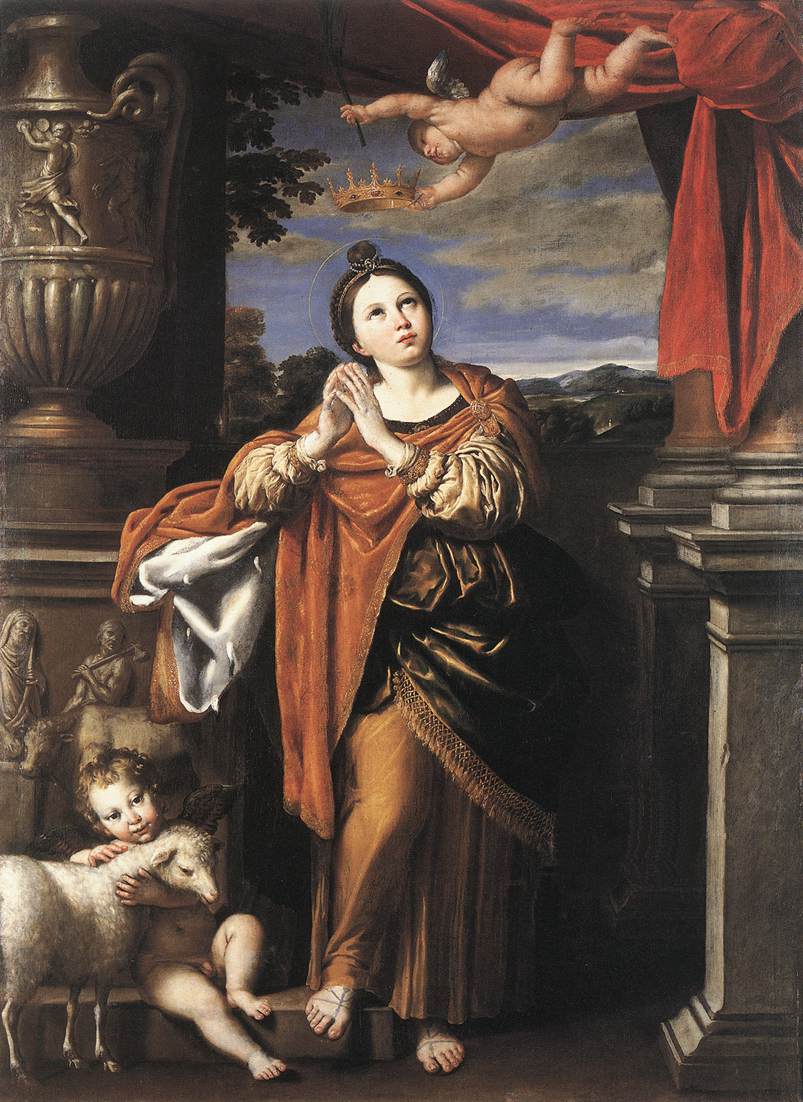
The contextual artwork associated with this file is Domenichino’s painting of Saint Agnes, made many centuries after her lifetime. It is a devotional interpretation of the saint, not a photograph of the cranium or evidence of what Agnes looked like. [MEDIA-01]
Images matter because they show how later generations imagined and communicated sanctity. They answer a question about remembrance. Anatomical examination, inventories, and transfer records would answer questions about the material. Keeping these forms of evidence distinct makes both the art and the relic easier to understand.
What is established, and what would help next
The current church pages establish a clear published attribution: a head or cranium relic of Agnes is identified in this chapel. They do not supply an item-level authenticum, a complete custody sequence, or an independent biological examination. The verdict on identity remains unresolved. [AGS-01; AGS-02]
The most useful next evidence would connect the object’s inventory number and seals with its transfer documents and conservation history. That would enable the historical question to become more precise while leaving visitors free to engage seriously with the martyr’s witness today.
Catholic reflection & discussion
Let the object open a larger question
Pause over what this object brings to mind: a person, a place, an act of devotion, or a question about the past. Let that curiosity guide a careful reading of both its history and its meaning.
These editorial prompts invite reflection on the article. They are distinct from Church teaching and the evidence findings.
Pause and reflect
- What draws your attention to this object, and what are you hoping to understand through it?
- How does the article distinguish the object's documented history from the meaning people give it?
- If an attribution remains uncertain, which questions about faith, memory or devotion would still be worth exploring?
Discuss with family or a group
Choose questions suited to your readers' ages and experiences. Anyone can pass or keep a response private.
- Begin with a familiar family keepsake. What can an object help someone remember, and what would be needed to establish its history?
- Choose one image or description in the file. Which things can you observe, and which would you need a source to know?
Questions people ask
Open any question for a fuller answer and its sources.
Is this Agnes’s original tomb?
Why does the chapel also honor Philip Neri?
Its dedication and decoration reflect the Pamphili family’s connection to Philip’s Oratory. The room also houses the relic attributed to Agnes. [AGS-01]
Is the painting an image of the actual skull?
No. It is a later painting of the saint and is used only as historical and devotional context. [MEDIA-01]
What the evidence can establish
Evidence verdict: unresolved
Does the available evidence establish that the cranium relic at Sant'Agnese in Agone is the skull of Saint Agnes?
The church's current pages identify the chapel as the Chapel of Saint Agnes's Cranium and state that the relic of her head is located there. That establishes the published custodial attribution. It does not establish biological identity, an uninterrupted provenance chain, or the historical transfer chronology, so the identity claim remains unresolved.
Church or institutional status
Official custodian attribution
- Authority
- Rectorate of Sant'Agnese in Agone
- Scope of the finding
- The rectorate-hosted church pages identify a head or cranium relic attributed to Saint Agnes in the Chapel of Saint Philip Neri.
- Limits of the finding
- No item-level authenticum, inventory record, complete chain of custody, or independent anatomical or biological examination was located.
Sources and notes
Back to the overviewSource labels describe a document's type and role, not the strength of a claim. Where provided, notes explain its use, access limits, and outstanding checks.
The current rectorate-hosted page calls the space the Chapel of Saint Agnes's Cranium and identifies the cranium attributed to Agnes there. What it does not establish: This is the custodian's attribution and historical account, not an item-level authenticum, complete chain of custody, or independent biological examination.
States that the Chapel of Saint Philip Neri contains the relic of Saint Agnes's head. What it does not establish: The page does not publish an inventory identifier, authenticum, anatomical assessment, or full provenance.
Documents the image source and Public Domain Mark 1.0 rights record. What it does not establish: Later painting of Agnes; not a photograph of a skull or relic.
- EX-01Catechism of the Catholic Church, paragraphs 946–959: the communion of saints (opens in a new tab)Official sourceCited in this file
Read the source note for the passage used and any limits on what it supports.
Explains Catholic fellowship with the saints, their intercession, and union in Christ; it does not authenticate a particular object.
- EX-02Vatican City State: Saint Agnes, virgin and martyr (opens in a new tab)Official sourceCited in this file
Read the source note for the passage used and any limits on what it supports.
Institutional account of Agnes’s early remembrance, traditions, and Roman sites. Its Pius X transfer chronology conflicts with other institutional accounts; that precise date is not adopted.
Corrections and updates
Expanded this file with a sourced narrative, 6 chapters and 4 answers to common questions. The existing evidence verdict label and institutional status are retained. Independent human review remains pending.