
Start here
The story, in brief
The object called John the Baptist’s head at Amiens is not a complete head. France’s heritage inventory describes the anterior portion of a human cranium, enclosed in a reliquary combining medieval rock crystal with nineteenth-century metalwork. That exact description is the right starting point for a remarkable and easily exaggerated claim. [AMI-02]
Its reported arrival in Amiens in 1206 belongs to the movement of relics after the sack of Constantinople. Its religious meaning reaches farther back, to John’s role in preparing the way for Jesus and his death after confronting power. Neither story should be reduced to a claim that a famous name has been established by a laboratory. [AMI-01; AMI-02; EX-03; EX-04]
The object is a cranium fragment
The official heritage notice describes the front portion of a human skull, not an intact head. [AMI-02]
The medieval arrival has a named tradition
Institutional accounts connect the relic with Walon de Sarton and Amiens in 1206 after the sack of Constantinople. [AMI-02]
Veneration honors a witness, not a spectacle
Catholic reflection centers on John’s truthfulness, prayer, and role in pointing toward Christ. [EX-03]
Explore the chapters
John’s significance begins before his death
The Gospels present John as a preacher of repentance who directs attention toward the one coming after him. Benedict XVI’s reflection emphasizes that he did not seek to keep the center for himself: his mission was to prepare people for Christ. That makes humility as important to his memory as courage. [EX-03]
Prayer, in the same Catholic interpretation, sustains that witness. John’s importance is therefore not confined to the violent manner of his death. The relic should recall a life oriented toward truth and toward someone beyond himself. [EX-03]
How the Gospel tells the execution
Mark describes John imprisoned after criticizing Herod’s marriage. The account moves through a banquet, a rash promise, and a demand for John’s head, ending with his execution and his disciples’ burial of the body. The narrative makes the killing part of a story about power, resentment, and failure to act on a troubled conscience. [EX-04]
Mark does not describe a later route to Constantinople or Amiens. The Gospel supplies the remembered death, while a surviving relic attribution needs its own historical chain. A recognizable scene in art cannot close the centuries separating those two records. [EX-04; AMI-02]
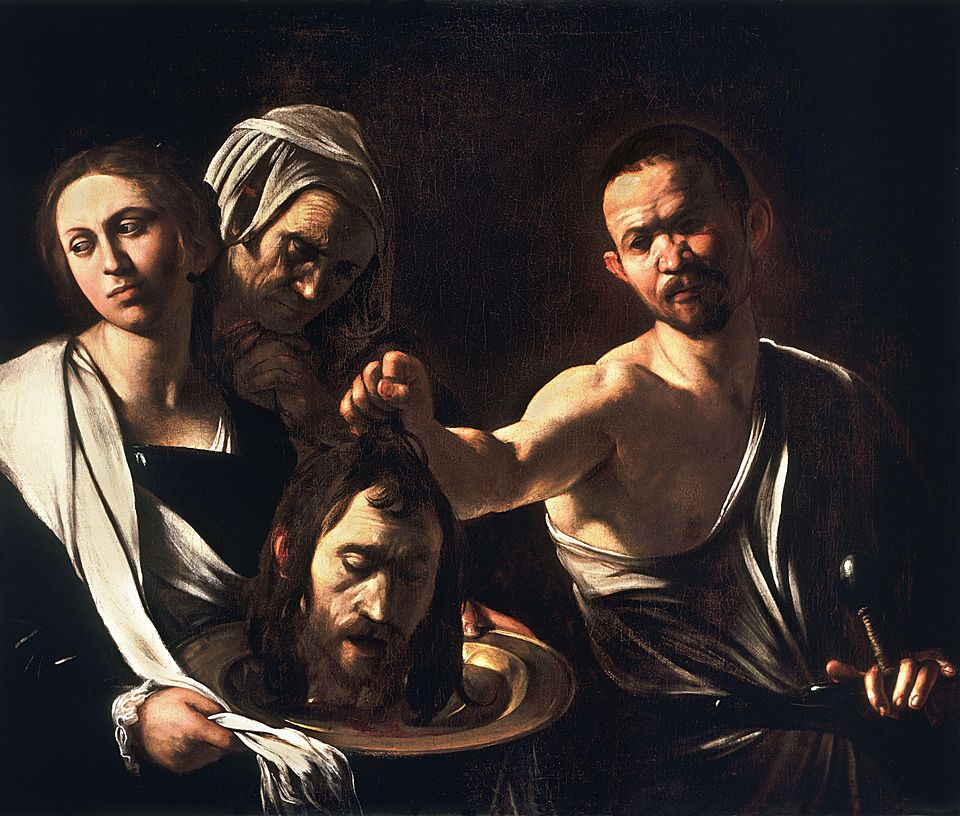
Caravaggio’s later painting of Salome with John’s head belongs to the artistic memory of his death. It should not be read as a portrait of the Amiens cranial relic or as evidence for that object’s provenance. [MEDIA-01]
From Constantinople to Amiens
The French heritage notice names Walon de Sarton, a canon of Saint-Martin at Picquigny, and dates the reported arrival to 17 December 1206 after the 1204 sack of Constantinople. The cathedral’s public history also places the relic in Amiens from 1206. This gives the medieval tradition concrete people, places, and circumstances. [AMI-01; AMI-02]
The transfer story does not establish all earlier custody or the biological identity of the fragment. Conquest and dispersal are consequential historical contexts: they explain why objects moved, while also making documentation of continuity especially important. The inspected sources do not supply an uninterrupted route from John’s burial. [AMI-01; AMI-02]
The reliquary has its own date and history
The current precious-metal setting and cover are associated with the nineteenth-century goldsmith Placide Poussielgue-Rusand, while the rock crystal is medieval. The heritage record also documents a 2020 restoration. The object a visitor sees therefore combines remains, an older protective element, and later presentation. [AMI-02]
These dates describe components and conservation. They are not dates for John’s life and should not be treated as a biological assessment of the cranium. Separating relic from reliquary is essential because the container’s artistic history may be much more accessible than the identity of what it contains. [AMI-02]
Why the cathedral continues to venerate it
The Diocese of Amiens documents liturgical veneration associated with John’s Nativity and describes him as one who bears witness to the light rather than being the light himself. That is a concise explanation of the devotion’s direction: honoring John points toward Christ. The local rite is an institutional fact, not a forensic result. [AMI-03]
Catholic teaching on the communion of saints adds that remembrance is more than admiration for a distant figure. Saints are understood as companions in Christ whose prayers and example support the Church. The head relic can recall the cost of faithful witness without turning violence into entertainment. [EX-01; EX-03]
How to assess competing claims about John’s relics
Other places also preserve traditions associated with John’s head, as the papal audience itself notes. Such claims should not be merged or solved by assuming that every reported head is a complete skull. Each object needs an exact anatomical description and its own custody history. [EX-03; AMI-02]
For Amiens, the inspected record identifies a real cranium fragment and a recognized devotional setting but not the individual biologically. Further evidence would need to address the fragment’s early provenance, material assessment, and relationship to the historical person. The unresolved verdict applies to that identity claim, not to the existence of the object or its medieval importance. [AMI-01; AMI-02; AMI-03]
Catholic reflection & discussion
Let the object open a larger question
Pause over what this object brings to mind: a person, a place, an act of devotion, or a question about the past. Let that curiosity guide a careful reading of both its history and its meaning.
These editorial prompts invite reflection on the article. They are distinct from Church teaching and the evidence findings.
Pause and reflect
- What draws your attention to this object, and what are you hoping to understand through it?
- How does the article distinguish the object's documented history from the meaning people give it?
- If an attribution remains uncertain, which questions about faith, memory or devotion would still be worth exploring?
Discuss with family or a group
Choose questions suited to your readers' ages and experiences. Anyone can pass or keep a response private.
- Begin with a familiar family keepsake. What can an object help someone remember, and what would be needed to establish its history?
- Choose one image or description in the file. Which things can you observe, and which would you need a source to know?
Questions people ask
Open any question for a fuller answer and its sources.
Is the Amiens relic a whole head?
No. The French heritage inventory describes the anterior part of a human cranium. [AMI-02]
How old is its present reliquary?
The object combines medieval rock crystal with a nineteenth-century precious-metal reliquary and cover; restoration is recorded in 2020. [AMI-02]
Does a national heritage listing authenticate the person?
No. It records and protects a historical object under its received name. It does not establish John the Baptist’s biological identity. [AMI-02]
Why does John matter apart from the relic?
Catholic teaching remembers his preparation for Christ, commitment to truth, prayer, and refusal to abandon his witness before powerful people. [EX-03]
What the evidence can establish
Evidence verdict: unresolved
Does the available evidence establish that the anterior cranium fragment in the Amiens treasury is the skull of John the Baptist?
The cathedral and the French Ministry of Culture identify a specific treasury object, and the national object notice describes it as the anterior part of a human cranium. That establishes the current object and institutional attribution. It does not identify the person biologically or establish uninterrupted pre-1206 provenance, so the identity claim remains unresolved.
Church or institutional status
Cathedral custody and veneration
- Authority
- Amiens Cathedral / Diocese of Amiens
- Scope of the finding
- Current cathedral custody, preservation, and veneration of the identified cranium fragment.
- Limits of the finding
- No inspected act authenticates the cranium biologically as John the Baptist.
Sources and notes
Back to the overviewSource labels describe a document's type and role, not the strength of a claim. Where provided, notes explain its use, access limits, and outstanding checks.
- AMI-01Amiens Cathedral / Centre des monuments nationaux — The relic of the head of Saint John the Baptist (opens in a new tab)Official source
Identifies the specific Amiens treasury object, its rock-crystal reliquary, and the custodial tradition dating its arrival to 1206. What it does not establish: Repeats the custodial attribution and does not report biological identification.
Records the Amiens treasury location and describes the relic as the anterior part of a human cranium, with its reliquary materials, state ownership, heritage classification, and 2020 restoration. What it does not establish: The notice calls the object the head of Saint John the Baptist but does not authenticate the person's identity.
- AMI-03Diocese of Amiens — 2025 Nativity of Saint John the Baptist notice (opens in a new tab)Official source
Documents current diocesan preservation and public-veneration context for the Amiens relic. What it does not establish: Liturgical use is not forensic identification.
Documents the image source and Public domain rights record. What it does not establish: Later Caravaggio painting; safe only as artistic context, never as the claimed head.
- EX-01Catechism of the Catholic Church, paragraphs 946–959: the communion of saints (opens in a new tab)Official sourceCited in this file
Read the source note for the passage used and any limits on what it supports.
Explains Catholic fellowship with the saints, their intercession, and union in Christ; it does not authenticate a particular object.
- EX-03Benedict XVI, audience on John the Baptist’s martyrdom, 29 August 2012 (opens in a new tab)Official sourceCited in this file
Read the source note for the passage used and any limits on what it supports.
Explains John’s preparation for Christ, prayer, and witness to truth; mentions other relic traditions without authenticating the Amiens object.
Read the source note for the passage used and any limits on what it supports.
Primary Gospel narrative of John the Baptist’s imprisonment and execution; not a custody record for a surviving cranium.
Corrections and updates
Expanded this file with a sourced narrative, 6 chapters and 4 answers to common questions. The existing evidence verdict label and institutional status are retained. Independent human review remains pending.