
Start here
The story, in brief
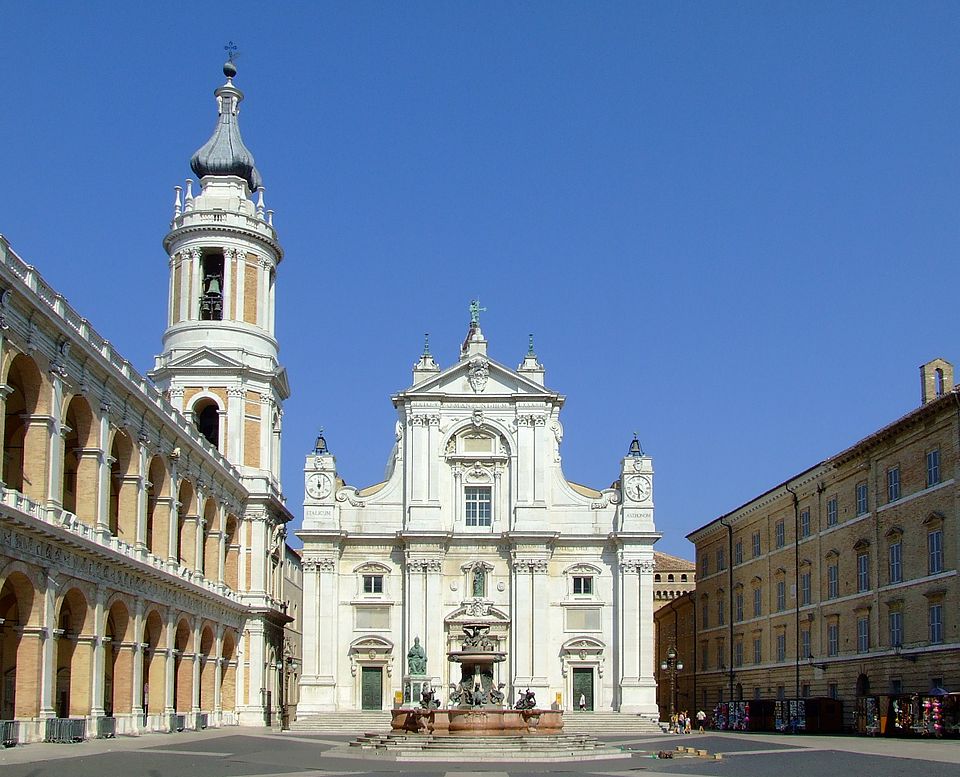
Loreto’s central relic is not something placed inside a small container. It is a small building: three walls traditionally associated with Mary’s home at Nazareth, enclosed within a much larger shrine. The scale changes the question from “who touched this?” to “could part of a house have crossed the Mediterranean?” [LH-01]
The shrine presents architectural and archaeological arguments for that association. It also distinguishes an old tradition of angelic transport from a more recent hypothesis of human transport by sea. The Catholic meaning is more immediately accessible: the Holy House is a place to contemplate the Incarnation and Mary’s response to God within ordinary human life. [LH-01; LH-02; LH-03]
The traditional journey is not a completed custody chain
The alleged transfer belongs to 1291–1294, while the written accounts inspected through the shrine’s synthesis are later. [LH-01]
Architecture offers an argument worth examining
The shrine cites three walls, building techniques, and graffiti as features consistent with Nazareth; the full comparative technical record remains uninspected. [LH-01]
The Church’s recognized devotion centers on the Incarnation
The 2019 liturgical decree explains Mary’s response, the Holy Family, and Christian discipleship without adjudicating the walls’ material identity. [LH-02]
Explore the chapters
Why three walls are the starting point
The shrine argues that the three-wall structure makes sense beside a grotto at Nazareth, where the rock would have supplied the missing boundary. Its account also distinguishes the lower stone sections from later brick additions. The claimed relic is therefore not a complete, unchanged modern house: it is a proposed surviving portion within a longer building history. [LH-01]
That is an intelligible architectural hypothesis. To test it fully, an investigator would need the actual comparative measurements, excavation contexts, and material records from both locations. The public shrine narrative summarizes an argument; it is not the complete field archive needed to independently reproduce it. [LH-01]
The journey told in the tradition
The received story places a departure from Nazareth in 1291 and arrival in the Loreto area in 1294, with intervening locations and movements. The older devotional version attributes transport to angels. The shrine also presents the possibility of a human maritime transfer under providential care. Neither should be quietly substituted for the other as though the mechanism were settled. [LH-01]
The chronological difficulty remains that surviving written narratives are later than the proposed journey. Scholarship on Loreto examines how those accounts developed and circulated. That research helps explain the tradition’s history, but it does not itself trace identifiable stones through each stage of a transfer. [LH-04]
What the excavations are said to support
The official account cites investigations at Nazareth in 1955–1960 and at Loreto in 1962–1965. It emphasizes the foundation arrangement, the relationship to a roadway, features of masonry, and graffiti comparisons. These details make the positive case more specific than a bare appeal to the antiquity of the devotion. [LH-01]
The same details require careful handling because they are presented mainly through a synthesis of Giuseppe Santarelli’s writings. Without the complete stratigraphy, sample catalogue, and specialist comparisons, a reader cannot independently determine how distinctive each resemblance is. Compatibility with an eastern origin is a smaller proposition than identity with one particular dwelling. [LH-01]
A house gives the Incarnation a human scale
The 2019 decree adding the optional memorial of Our Lady of Loreto to the General Roman Calendar explains the shrine through the Word becoming flesh. God’s entrance into human history is contemplated through Mary’s acceptance of the divine call. A home makes that doctrine concrete: Christian faith places the beginning of this story within human dependence, family, and ordinary daily life. [LH-02]
The decree also connects the shrine with discernment of vocation, comfort in suffering, and imitation of Mary’s discipleship. These are the positive reasons the Church gives for the devotion. The walls’ historical attribution is relevant to the relic question, but their proposed transport mechanism is not the content of the liturgical celebration. [LH-02]
Benedict XVI’s movement from the house to the square
Speaking at Loreto in 2007, Benedict XVI described the walls as coming from Nazareth according to tradition. He invited young people to reflect on the relationship between interior prayer and public life. The house represents recollection and reception of God’s word; the square represents encounter with others. [LH-03]
His interpretation does not end with retreat into private devotion. What is received in silence is meant to shape life beyond the sanctuary. He even used the three-sided house as an image of openness to the world. That is a pastoral reading of the place, distinct from an archaeological argument, and it helps explain what a pilgrimage is meant to change. [LH-03]
Why honoring material things is not worship of stones
Catholic theology of sacred matter starts with the Creator’s decision to enter creation, not with a claim that stone becomes a god. Benedict XVI’s account of John Damascene distinguishes worship due to God from veneration that can direct attention through material signs. Matter is honored because of its relationship to the divine work, not as an independent source of divinity. [EX-02]
Applied to Loreto, this means the visitor’s attention should move toward Christ, Mary’s discipleship, and the Christian life represented by the home. A shrine can have real devotional value without a believer being able to reconstruct the physical route of every stone. That distinction is already reflected in the cautious language of the papal and liturgical sources. [LH-02; LH-03]
What remains open—and what does not
The existence of the pontifical shrine and the Church’s liturgical recognition of Our Lady of Loreto are institutional facts. The specific identity of the masonry and its journey remain historical questions. A formal celebration in the calendar is not a substitute for an object-specific provenance or material-authentication determination. [LH-01; LH-02]
The most useful further evidence would expose the proposed matches to independent examination: complete excavation reports, stone and mortar comparisons, dated building phases, and directly inspectable transfer documents. Until then, the positive architectural argument deserves explanation alongside its limits, while the shrine’s Catholic meaning can be stated fully and confidently as teaching about the Incarnation. [LH-01; LH-02]
Catholic reflection & discussion
Let the object open a larger question
Pause over what this object brings to mind: a person, a place, an act of devotion, or a question about the past. Let that curiosity guide a careful reading of both its history and its meaning.
These editorial prompts invite reflection on the article. They are distinct from Church teaching and the evidence findings.
Pause and reflect
- What draws your attention to this object, and what are you hoping to understand through it?
- How does the article distinguish the object's documented history from the meaning people give it?
- If an attribution remains uncertain, which questions about faith, memory or devotion would still be worth exploring?
Discuss with family or a group
Choose questions suited to your readers' ages and experiences. Anyone can pass or keep a response private.
- Begin with a familiar family keepsake. What can an object help someone remember, and what would be needed to establish its history?
- Choose one image or description in the file. Which things can you observe, and which would you need a source to know?
Questions people ask
Open any question for a fuller answer and its sources.
Does the Church require belief that angels carried the house?
Is the human-transport explanation established?
No. The shrine presents maritime transfer as a modern hypothesis. The complete material and documentary chain needed to establish it has not been demonstrated in this file. [LH-01]
Why is the Holy House associated with families?
The official liturgical explanation points to the Holy Family, Mary’s response to God, and virtues to be practiced in Christian life. The house makes those themes concrete. [LH-02]
What the evidence can establish
Evidence verdict: unresolved
Do accessible archaeological and documentary records establish that Loreto's three walls are Mary's Nazareth dwelling and arrived at Loreto in 1294?
The shrine reports architectural and archaeological features consistent with its tradition, but the complete technical record, independent material comparison, and documented transfer chain are not available to establish identity or transport.
Church or institutional status
A pontifical shrine and universal liturgical devotion; no inspected act materially authenticates the structure as Mary's Nazareth dwelling.
- Authority
- The Pontifical Delegation of the Holy House of Loreto and the Dicastery for Divine Worship's 2019 liturgical decree.
- Scope of the finding
- Official Catholic shrine custody and universal liturgical commemoration of Our Lady of Loreto.
- Limits of the finding
- Pontifical shrine status, liturgical commemoration, and papal use of traditional language do not authenticate the walls' Nazareth origin or a transport mechanism.
Sources and notes
Back to the overviewSource labels describe a document's type and role, not the strength of a claim. Where provided, notes explain its use, access limits, and outstanding checks.
- LH-01Pontifical Shrine of the Holy House of Loreto, La Santa Casa (opens in a new tab)Official source
Official shrine synthesis of the tradition and archaeological arguments, largely through Giuseppe Santarelli's writings rather than a complete field record.
- LH-02Dicastery for Divine Worship, decree adding Our Lady of Loreto to the General Roman Calendar, 2019 (opens in a new tab)Official source
Official liturgical recognition of the devotion; it does not adjudicate the walls' material identity.
Official papal statement describing the Nazareth association as tradition; not an archaeological authentication.
Scholarly historical study of formation and transmission of the Loreto narrative; not a material-authentication study.
- EX-02Benedict XVI, audience on John Damascene, 6 May 2009 (opens in a new tab)Official sourceCited in this file
Read the source note for the passage used and any limits on what it supports.
Explains Christian honor for matter, images, and saints’ remains through the Incarnation; it is not an object-specific authentication.
Corrections and updates
Expanded this file with a sourced narrative, 7 chapters and 4 answers to common questions. The existing evidence verdict label and institutional status are retained. Independent human review remains pending.