
Start here
The story, in brief
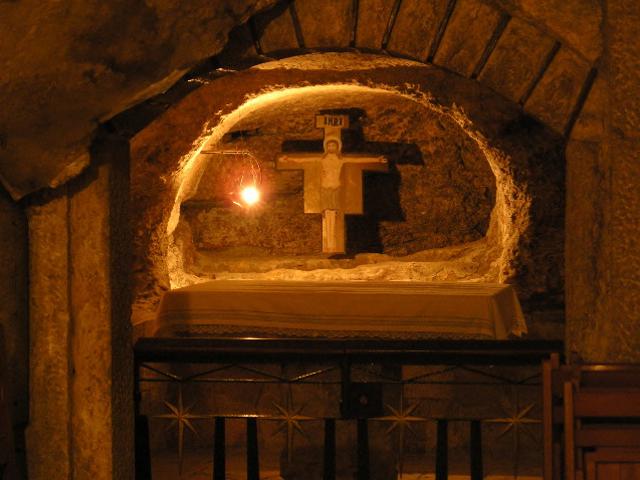
Within Bethlehem’s Nativity complex, the Cave of the Holy Innocents interrupts an easy, sentimental picture of Christmas. It commemorates the children killed in Matthew’s account of Herod’s attempt to destroy Jesus. The Custody of the Holy Land identifies actual funerary features there, but it does not identify excavated remains as those particular children. [SRC-01; EX-03]
A memorial and an authenticated grave differ
The cave belongs to the sanctuary’s Holy Innocents tradition; the inspected record does not establish the identity of the burials. [SRC-01]
The Gospel preserves grief beside the Nativity
Matthew places flight, violence, and mourning within the story of Jesus’s early life. [EX-03]
The devotion has a practical demand
Francis connects remembrance of the Innocents with protecting children from violence, exploitation, and abuse. [EX-04]
Explore the chapters
The story does not end at the manger
After the Magi’s visit, Matthew describes Joseph being warned to take Jesus and Mary into Egypt. Herod then orders the killing of young boys in Bethlehem and the surrounding area. The evangelist gives the grieving families a place in the story through the lament of Rachel mourning her children. [EX-03]
The passage does not name a burial cave, provide an inventory of remains, or describe how the victims were interred. Its relationship to the sanctuary is therefore a relationship of commemoration and tradition. A claim that a particular burial has been identified needs additional archaeological and historical evidence. [EX-03; SRC-01]
What the Custody describes underground
The official sanctuary guide locates the Grotto of the Innocents near the Grotto of Saint Joseph and describes three arcosolium-type tombs containing multiple sepulchers. It also discusses older funerary features and adjoining caves associated with later Christian memory. These are concrete parts of a complex burial landscape. [SRC-01]
The guide describes the massacre as commemorated here and refers to earlier remembrance in an adjoining cave. That language matters. A cave containing graves can become a place where an event is remembered without the occupants of each grave having been individually identified as participants in that event. [SRC-01]
Why the Church remembers children who could not speak for themselves
Francis’s letter for the feast begins with Christmas joy but insists that the Gospel does not hide tragedy and grief. In his reading, Christian hope cannot be separated from hearing the pain of children and families. The Innocents are not a decorative contrast to the Nativity; they make demands on how that Nativity is understood. [EX-04]
The positive religious meaning is protection of vulnerable life. Joseph’s response becomes an example of attending to danger and acting, while the mourning families remind the Church that a celebration can become hollow if it ignores suffering around it. This application is theological and moral; it does not purport to authenticate the Bethlehem graves. [EX-04]
The feast also confronts the Church’s failures
The same papal letter explicitly acknowledges children abused by clergy and the wrongs of failure to help, concealment, and denial. Remembering the Holy Innocents therefore includes examination of the Church’s own conduct. It is not only a judgment on distant rulers or harms committed by other people. [EX-04]
For a visitor, that makes the site a place to think about responsibility as well as loss. A devotional encounter can lead toward practical care and protection rather than curiosity about remains. The significance lies in the lives being remembered and the living children whose dignity calls for action now. [EX-04]
What an archaeological claim would require
The public custodian’s guide establishes the setting and the memorial tradition. It does not provide an excavated group securely dated to Herod’s period and independently identified as the victims in Matthew’s account. Nor would the mere discovery of children’s bones at Bethlehem establish that attribution. Context, chronology, and the specific historical connection would all matter. [SRC-01; EX-03]
The unresolved verdict applies to the burial claim. It does not erase the site’s place in Christian memory or the meaning of the feast. A careful description lets the visitor encounter a real sacred place while understanding the difference between what is commemorated there and what archaeology has established about its occupants. [SRC-01; EX-04]
Catholic reflection & discussion
Let the object open a larger question
Pause over what this object brings to mind: a person, a place, an act of devotion, or a question about the past. Let that curiosity guide a careful reading of both its history and its meaning.
These editorial prompts invite reflection on the article. They are distinct from Church teaching and the evidence findings.
Pause and reflect
- What draws your attention to this object, and what are you hoping to understand through it?
- How does the article distinguish the object's documented history from the meaning people give it?
- If an attribution remains uncertain, which questions about faith, memory or devotion would still be worth exploring?
Discuss with family or a group
Choose questions suited to your readers' ages and experiences. Anyone can pass or keep a response private.
- Begin with a familiar family keepsake. What can an object help someone remember, and what would be needed to establish its history?
- Choose one image or description in the file. Which things can you observe, and which would you need a source to know?
Questions people ask
Open any question for a fuller answer and its sources.
Does the cave prove the massacre happened?
The inspected sanctuary guide identifies a commemorative setting and funerary features. It does not publish archaeological proof of the massacre or identify its victims. [SRC-01]
Does Matthew locate the children’s burial here?
No. Matthew 2 recounts the killing and mourning but does not identify a cave or describe the burials. [EX-03]
Why is such a sad feast connected with Christmas?
The Catholic reflection represented by Francis’s letter holds joy and grief together: the Incarnation calls Christians to face suffering and protect vulnerable life. [EX-04]
Is this page claiming the visible graves are first-century victims?
No. That specific identification remains unresolved; the official source supports the cave’s memorial tradition and physical funerary setting. [SRC-01]
What the evidence can establish
Evidence verdict: unresolved
Does the Bethlehem sanctuary identify a cave as a memorial connected with the Holy Innocents, and is it an authenticated burial site?
The Custody of the Holy Land presents the cave within the Nativity complex's tradition; it does not establish that victims of Herod were buried there.
Sources: [SRC-01]
Church or institutional status
Official holy place custody
- Authority
- Custody of the Holy Land
- Scope of the finding
- The cave's place in the sanctuary's memorial tradition.
- Limits of the finding
- Custody and liturgical memory do not authenticate burials.
- Official sources
- [SRC-01]
Sources and notes
Back to the overviewSource labels describe a document's type and role, not the strength of a claim. Where provided, notes explain its use, access limits, and outstanding checks.
- SRC-01Custody of the Holy Land — Bethlehem, Basilica of the Nativity (opens in a new tab)Official source
Identifies the cave/tombs within the sanctuary's devotional and historical topography. What it does not establish: Does not provide archaeological identification of victims as the Holy Innocents.
Read the source note for the passage used and any limits on what it supports.
Primary Gospel narrative of the Magi, flight into Egypt, and massacre of the infants; does not identify a surviving relic.
- EX-04Francis, letter to bishops on the Holy Innocents, 28 December 2016 (opens in a new tab)Official sourceCited in this file
Read the source note for the passage used and any limits on what it supports.
Explains the feast as a call to hear children’s suffering and protect them, including acknowledgment of abuse within the Church; not archaeological authentication.
Corrections and updates
Expanded this file with a sourced narrative, 5 chapters and 4 answers to common questions. The existing evidence verdict label and institutional status are retained. Independent human review remains pending.