
Start here
The story, in brief
The Milk Grotto is remembered through an intimate image: Mary feeding her child. The Custody of the Holy Land describes local Christian and Muslim women visiting the cave to ask her intercession, while explicitly calling the account of spilled milk whitening the stone a legend. The human devotion and the physical claim deserve to be understood on their own terms. [SRC-01]
The source calls it a legend
The whitening of the cave by Mary’s milk is a received narrative. [SRC-01]
A shared place of hope
The custodian records Christian and Muslim women’s devotion. [SRC-01]
No treatment is established
The cited material gives no clinical evidence for stone powder. [SRC-01]
Explore the chapters
A place within Bethlehem’s sacred landscape
The Custody situates the grotto among the places associated with the Nativity, nearby devotional sites, and routes followed by pilgrims. Its significance comes partly from that setting: visitors encounter a sequence of places that make the family life of Jesus and Mary imaginable. Their association with a narrative does not independently establish that every remembered episode occurred at its precise location. [SRC-01]
What the milk legend says
The custodian recounts a tradition that milk spilled while Mary breastfed Jesus and explains that believers connect this with the cave’s white stone. The source labels the story as a legend. That wording should remain visible: it identifies a received religious explanation of the place’s appearance, without presenting geological evidence that the event caused the color. [SRC-01]
Why motherhood belongs in the Christian story
Luke presents the newborn Jesus being wrapped and cared for by Mary. Within Christian belief, the Incarnation includes genuine infancy and dependence, not only an adult teacher’s public ministry. The grotto’s maternal imagery develops that concern in local devotion. The specific spilled-milk episode, however, is not part of Luke’s account. [EX-01] [SRC-01]
A devotion crossing a religious boundary
The Custody specifically mentions Christian and Muslim women seeking Mary’s intercession there. This is a distinctive part of the site’s importance: people with different religious commitments share a place associated with maternal concern. It documents a devotional practice, without implying agreement on every Christian doctrine or proving that every petition has the desired outcome. [SRC-01]
The cave also has an architectural history
The custodian records restoration completed in 2007, including cleaning the cave walls, and describes the newer church above it. A connected monastery and chapel provide a setting for Eucharistic adoration and silent prayer. These concrete spaces show how an inherited place of devotion is maintained and given forms of worship for later generations. [SRC-01]
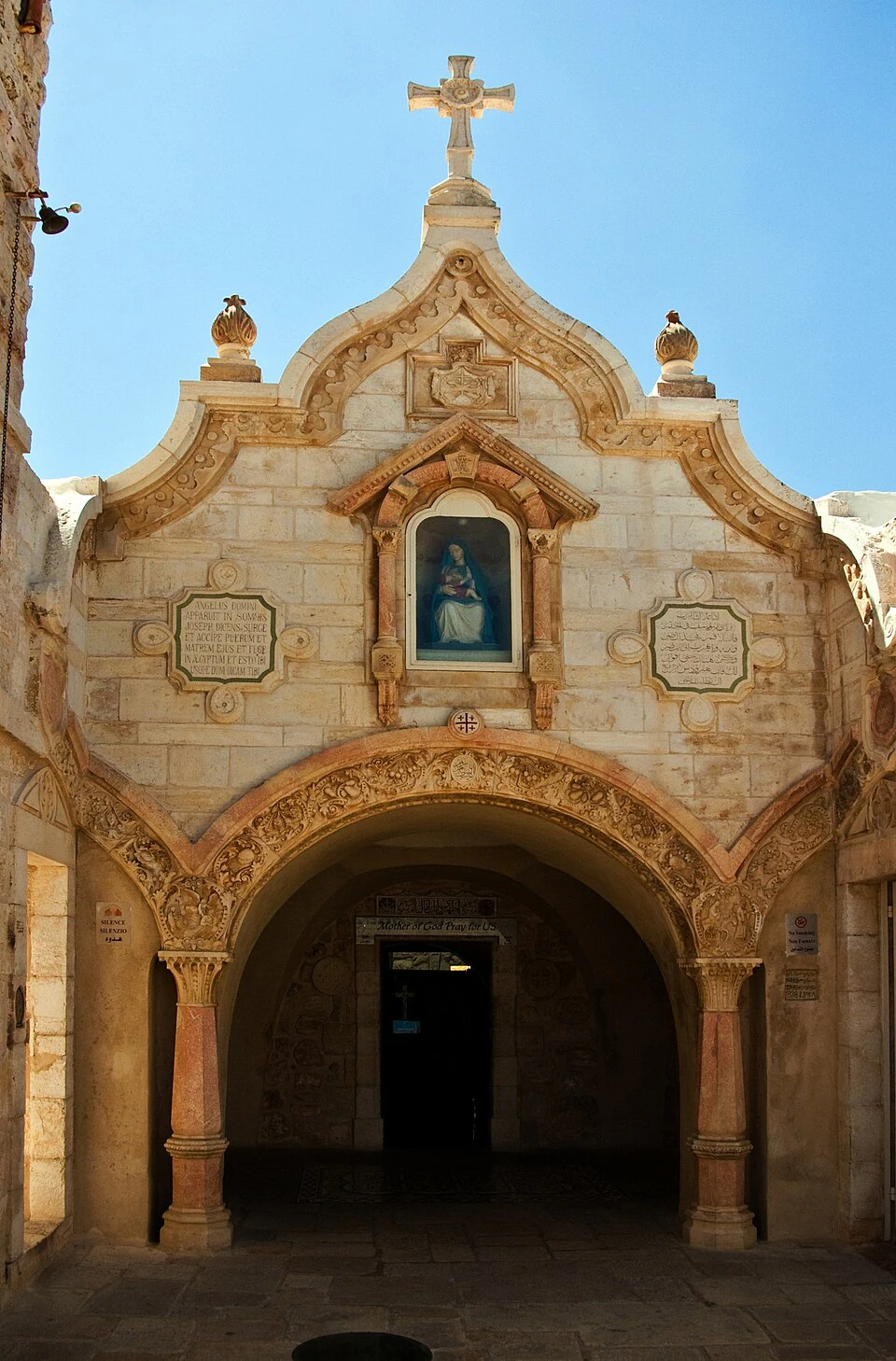
The accompanying photograph shows the exterior of the Milk Grotto chapel. It locates the devotion in an actual built environment and helps distinguish the shrine from an imagined biblical scene. A photograph of the chapel cannot establish how the cave’s stone acquired its color or whether any material has medicinal effects. [MEDIA-01]
Prayer and a medical claim require different evidence
The source documents intercession and the white-stone legend, but supplies no clinical evidence that material from the grotto treats infertility or any other condition. A reported blessing or an individual testimony would not by itself establish a medicine’s effects. Nothing in that record supports using stone powder as a treatment or promising pregnancy or healing. [SRC-01]
What remains valuable without overstating the legend
The Milk Grotto can be explored as a history of local religious memory, maternal hope, and shared pilgrimage. The custodian’s account gives a basis for those subjects. Evidence that Mary’s milk physically altered the rock, or that the stone possesses supernatural therapeutic properties, would require something beyond the devotional tradition described here. [SRC-01]
Catholic reflection & discussion
Let the object open a larger question
Pause over what this object brings to mind: a person, a place, an act of devotion, or a question about the past. Let that curiosity guide a careful reading of both its history and its meaning.
These editorial prompts invite reflection on the article. They are distinct from Church teaching and the evidence findings.
Pause and reflect
- What draws your attention to this object, and what are you hoping to understand through it?
- How does the article distinguish the object's documented history from the meaning people give it?
- If an attribution remains uncertain, which questions about faith, memory or devotion would still be worth exploring?
Discuss with family or a group
Choose questions suited to your readers' ages and experiences. Anyone can pass or keep a response private.
- Begin with a familiar family keepsake. What can an object help someone remember, and what would be needed to establish its history?
- Choose one image or description in the file. Which things can you observe, and which would you need a source to know?
Questions people ask
Open any question for a fuller answer and its sources.
Does the Gospel describe milk turning this cave white?
Do only Catholics visit?
The official custodian describes local Christian and Muslim women visiting to ask Mary’s intercession. [SRC-01]
Is the stone established as a fertility treatment?
The cited source supplies no medical study establishing that claim. Its description of a shrine and devotional tradition is not evidence of therapeutic efficacy. [SRC-01]
What the evidence can establish
Evidence verdict: unresolved
Does the Custody of the Holy Land maintain the Milk Grotto tradition, and is there historical or scientific evidence for the milk-related claim?
The official custodian documents the shrine and its devotional tradition. It does not establish the legend's event or a supernatural property of the stone.
Sources: [SRC-01]
Church or institutional status
Official holy place custody
- Authority
- Custody of the Holy Land
- Scope of the finding
- The shrine and its devotional tradition.
- Limits of the finding
- No formal supernatural finding or medical evidence is documented.
- Official sources
- [SRC-01]
Sources and notes
Back to the overviewSource labels describe a document's type and role, not the strength of a claim. Where provided, notes explain its use, access limits, and outstanding checks.
- SRC-01Custody of the Holy Land — Bethlehem, Basilica of the Nativity (opens in a new tab)Official source
Documents the Milk Grotto within the Bethlehem sanctuary tradition. What it does not establish: Does not establish that Mary's milk changed the rock or that powder has medical effects.
Documents the image source and CC BY-SA 3.0 rights record. What it does not establish: Exact Milk Grotto chapel context; does not evidence the legend or healing/fertility claims.
- EX-01United States Conference of Catholic Bishops — Luke 2 (opens in a new tab)Official sourceCited in this file
Read the source note for the passage used and any limits on what it supports.
Describes the Nativity and Mary’s care of Jesus. It does not contain the Milk Grotto legend or claims about the stone’s properties.
Corrections and updates
Expanded this file with a sourced narrative, 7 chapters and 4 answers to common questions. The existing evidence verdict label and institutional status are retained. Independent human review remains pending.