
Start here
The story, in brief
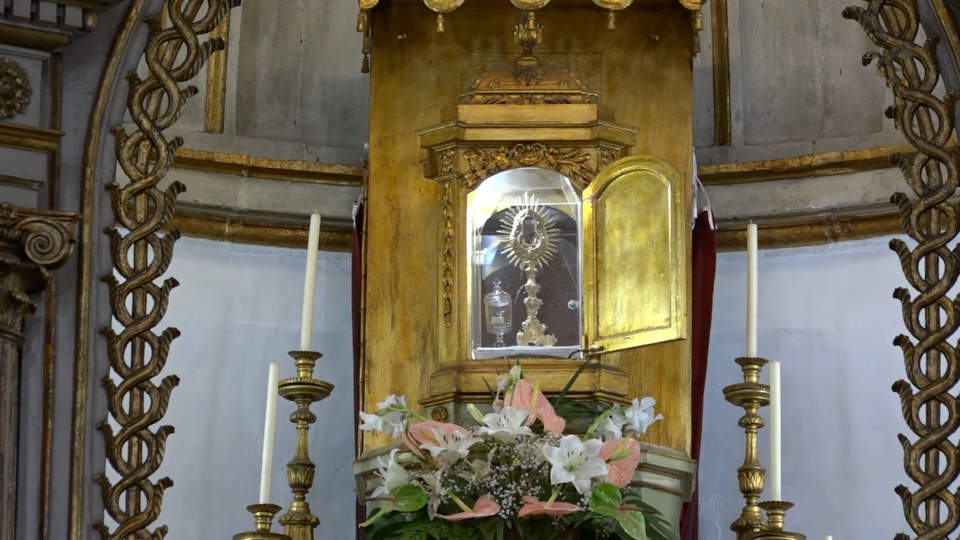
At Santarém, an old story and a recent institutional decision meet. The tradition concerns a woman’s improper reception of Communion and a host reported to have begun bleeding. In 2024 the bishop established the shrine’s diocesan status and legal personality. Those two parts of the account should be understood on their own terms. [SAN-01]
The decree’s practical emphasis is striking: welcoming pilgrims, hearing the Word of God, celebrating reconciliation, and deepening Eucharistic life. It invites visitors into Catholic practice rather than supplying a new laboratory investigation of the medieval relic. [SAN-01]
The dates are not uniform
The ecclesial report gives 1247, while the heritage tradition also transmits 1266. A precise event date is not settled by these summaries. [SAN-01; SAN-02]
The 2024 action has a defined scope
The reported decree establishes diocesan sanctuary status and juridical personality. [SAN-01]
The shrine’s purpose is Eucharistic life
Its stated mission centers on worship, the sacraments, and the welcome of pilgrims. [SAN-01]
Explore the chapters
The medieval claim in its setting
The tradition associates the event with the church of Santo Estêvão and a host taken through sacrilegious Communion. The reported bleeding gives the story its Eucharistic focus. The short ecclesial report does not provide a contemporary witness statement or a complete chain for the surviving material, so the narrative should remain explicitly attributed. [SAN-01]
Why the competing years should be visible
The received dates of 1247 and 1266 point to a problem of transmission, not a difference a modern writer should quietly solve. Establishing which date appears in which early text would help reconstruct the tradition. Repeating the most familiar date would increase apparent precision without supplying the missing evidence. [SAN-01; SAN-02]
From parish church to diocesan sanctuary
The episcopal conference’s news agency reports an earlier sanctuary designation in 1997 and the decree dated 31 October 2024. The latter grants canonical and civil legal personality. That is an identifiable institutional development with practical consequences for the shrine’s life; it is not automatically a newly performed examination of the original event. [SAN-01]
What the Catholic explanation actually is
Catholic teaching holds that Christ is wholly present in the consecrated Eucharist even when bread and wine retain their ordinary appearances. The reported sign at Santarém is interpreted in relation to that existing belief. It would draw attention to the sacrament’s reality, rather than imply that only an unusually colored host contains Christ. [EX-01]
Why the sanctuary emphasizes participation
The decree’s reported mission joins pilgrimage to prayer, Scripture, reconciliation, and the Eucharist. In Catholic terms, the desired result is a renewed relationship with Christ and participation in the Church’s worship. A visitor who only asks whether a stain is extraordinary can miss why the shrine exists, even though the question about the object remains legitimate. [SAN-01; EX-01]
What the heritage record contributes
The national heritage record is useful for the church and the tradition attached to it. Such a record can establish a monument’s cultural significance and preservation history without deciding whether a reported biological transformation occurred. Building history, a relic’s individual provenance, and a supernatural interpretation should therefore be read as different evidentiary questions. [SAN-02]
Where the public evidence stops
The cited sources do not furnish a complete medieval dossier, independently documented material history, or modern analytical report. Permission and pastoral encouragement explain the Church’s relationship to the shrine; they cannot fill those historical and scientific gaps. The case remains a living Catholic tradition whose particular extraordinary origin is not independently established by this public record. [SAN-01; SAN-02]
Catholic reflection & discussion
Hold wonder and careful questions together
Notice what this account awakens in you: hope, curiosity, gratitude, or a difficult question. Give that response room while examining what the sources actually support.
These editorial prompts invite reflection on the article. They are distinct from Church teaching and the evidence findings.
Pause and reflect
- What makes this account meaningful to you, and which part would you most want to understand better?
- How do the article's evidence and its Catholic interpretation answer different questions?
- What response might this reading invite in ordinary life, even while a historical or scientific question remains open?
Discuss with family or a group
Choose questions suited to your readers' ages and experiences. Anyone can pass or keep a response private.
- Let each person describe what surprised them before discussing whether they found the account convincing.
- Pick one precise claim. What supports it, what remains uncertain, and what would a stronger source need to show?
Questions people ask
Open any question for a fuller answer and its sources.
Did the bishop approve a sanctuary in 2024?
Yes. The episcopal conference’s agency reports the decree dated 31 October and its grant of diocesan sanctuary status and legal personality. [SAN-01]
Did that decree publish new scientific proof?
The cited report describes the shrine’s standing and mission. It does not supply a new laboratory investigation. [SAN-01]
Which medieval date should be used?
What the evidence can establish
Evidence verdict: unresolved
What is established about the Santarém tradition, its date, and the identity of the displayed object?
The Diocese's 2024 decree documents an active diocesan sanctuary and current custody of the relic. Portugal's heritage record calls the account a legend and records a 1247/1266 date conflict. Neither source establishes a complete event-object chain or modern compositional verification.
Church or institutional status
Diocesan sanctuary and veneration
- Authority
- Diocese of Santarém
- Scope of the finding
- Operation of the diocesan sanctuary and current devotional display
- Limits of the finding
- The inspected decree establishes sanctuary status, not the supernatural event or material identity.
- Official sources
- [SAN-01]
Sources and notes
Back to the overviewSource labels describe a document's type and role, not the strength of a claim. Where provided, notes explain its use, access limits, and outstanding checks.
- SAN-01Agência ECCLESIA (Portuguese Episcopal Conference), Santarém diocesan-sanctuary decree report (opens in a new tab)Official source
Reports and quotes the Diocese's 31 October 2024 decree establishing diocesan-sanctuary status, juridic personality, the 1997 predecessor act, prayer and pilgrimage roles, and custody of the relic. What it does not establish: This official institutional report establishes the decree's governance and custody scope; it does not authenticate the event, date, object continuity, or composition.
Treats the account as legend and records the same 1247/1266 chronological disagreement. What it does not establish: A heritage record does not perform material authentication.
- EX-01Catechism of the Catholic Church, 1373–1381 (opens in a new tab)Official sourceCited in this file
Read the source note for the passage used and any limits on what it supports.
Official teaching on the Real Presence, transubstantiation, reservation, and Eucharistic worship; general doctrine, not a ruling on this reported event.
Corrections and updates
Expanded this file with a sourced narrative, 7 chapters and 4 answers to common questions. The existing evidence verdict label and institutional status are retained. Independent human review remains pending.