
Start here
The story, in brief
Anna Maria Taigi’s road to public veneration ran through a household. Born in Siena in 1769, she moved to Rome as a child after her family encountered financial difficulty, worked to help support it, married, and became a mother of seven. The Vatican’s profile presents these responsibilities as the setting of her holiness. [SAINT-BLESSED-ANNA-MARIA-TAIGI-S01]
Holiness at home
Marriage, work, motherhood, and bereavement belong to Taigi’s actual story. [SAINT-BLESSED-ANNA-MARIA-TAIGI-S01]
A documented title
Benedict XV beatified her in 1920. [SAINT-BLESSED-ANNA-MARIA-TAIGI-S02]
A distinct material inquiry
The display’s construction requires evidence beyond the beatification act. [SAINT-BLESSED-ANNA-MARIA-TAIGI-S03] [SAINT-BLESSED-ANNA-MARIA-TAIGI-S04]
Explore the chapters
A family’s move to Rome
The move from Siena to Rome was a response to financial difficulty. Anna Maria received schooling with the Maestre Pie Filippine and later took humble jobs to support her family. Those details ground a life often remembered through extraordinary mystical claims in ordinary economic vulnerability: education, work, and household survival came first. [SAINT-BLESSED-ANNA-MARIA-TAIGI-S01]
Marriage was her vocation
She married Domenico Taigi and remained a laywoman. The Vatican profile describes a long marriage marked by daily patience and charity, and records that three of their seven children died young. Her Catholic significance includes bereavement and responsibility for surviving children. She offers a model of religious commitment lived within family obligations, rather than requiring departure from them. [SAINT-BLESSED-ANNA-MARIA-TAIGI-S01]
Prayer with an open front door
Her home also became a place where people sought spiritual counsel. The official account names Cardinal Pedicini and Monsignor Raffaele Natali among her spiritual directors and says people from different social backgrounds visited. The household and the spiritual life intersected: the same woman caring for her family was asked to help others think about theirs. [SAINT-BLESSED-ANNA-MARIA-TAIGI-S01]
What joining the Trinitarians meant here
On December 26, 1808, she entered the Trinitarian Third Order. The Vatican profile places devotion to the Trinity, the Eucharist, Christ’s Passion, and Mary at the center of her prayer. Her affiliation belongs to her identity as a committed lay Catholic; it did not turn her biography into that of a cloistered nun. The Order continues to include her in its liturgical memory. [SAINT-BLESSED-ANNA-MARIA-TAIGI-S01] [SAINT-BLESSED-ANNA-MARIA-TAIGI-S03]
The extraordinary claim needs its own category
The Vatican devotional biography recounts a long-lasting vision described as a mystical sun, associated with knowledge of events and souls. That is a reported charism within a devotional account. The record inspected here does not establish a modern test of these experiences, nor should a broad biography be treated as a dossier approving each prediction later circulated under her name. [SAINT-BLESSED-ANNA-MARIA-TAIGI-S01]
What Benedict XV actually recognized
Taigi died in 1837. Benedict XV’s apostolic letter documents her beatification on May 30, 1920, and authorizes public veneration. This is a concrete ecclesiastical act. It establishes her title as Blessed; the page does not supply the complete underlying cause evidence or identify every miracle accepted in that process. Those records remain worth recovering. [SAINT-BLESSED-ANNA-MARIA-TAIGI-S01] [SAINT-BLESSED-ANNA-MARIA-TAIGI-S02]
The figure at San Crisogono
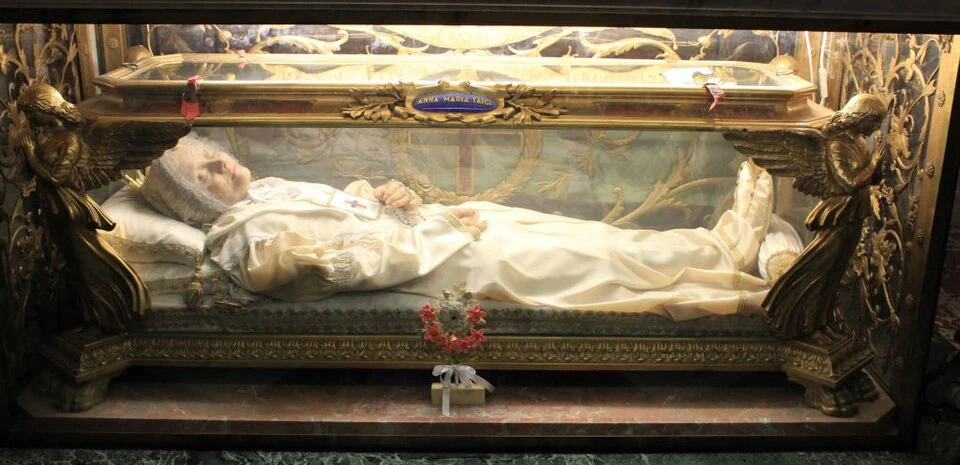
Official sources locate remains associated with Taigi in San Crisogono, Rome. They do not describe every component of the displayed figure. An independent architectural guide reports waxwork containing bones, but that statement still requires confirmation from the custodian. The honest present description is venerated remains with unresolved display construction, not an authenticated intact body. [SAINT-BLESSED-ANNA-MARIA-TAIGI-S01] [SAINT-BLESSED-ANNA-MARIA-TAIGI-S03] [SAINT-BLESSED-ANNA-MARIA-TAIGI-S04]
Catholic reflection & discussion
Look for the person within the story
Spend a moment with the choices, relationships and hardships in this life. Consider what you might learn from the person as well as from the extraordinary claims examined in the file.
These editorial prompts invite reflection on the article. They are distinct from Church teaching and the evidence findings.
Pause and reflect
- Which choice or experience in this life stays with you, and why?
- What would you like to understand better about the person's faith and the world they lived in?
- Is there a small act of patience, courage or service that this reading invites you to consider?
Discuss with family or a group
Choose questions suited to your readers' ages and experiences. Anyone can pass or keep a response private.
- Ask each person to choose a moment from the life described here. What makes that moment worth remembering?
- Which details have clear sources, and which remain uncertain? How could you tell the story honestly without losing its human meaning?
Questions people ask
Open any question for a fuller answer and its sources.
Was Anna Maria Taigi a nun?
She was a wife, mother, laywoman, and member of the Trinitarian Third Order. Her recognized life of prayer developed within that setting. [SAINT-BLESSED-ANNA-MARIA-TAIGI-S01]
Is her title Saint or Blessed?
The documented title is Blessed. The formal act inspected is Benedict XV’s 1920 beatification. [SAINT-BLESSED-ANNA-MARIA-TAIGI-S02]
Does her beatification certify every prophecy attributed to her?
The beatification establishes authorized veneration. This file has not established a cause-level decision on every extraordinary statement circulated under her name. Specific prophecies require their own authentic texts and judgments. [SAINT-BLESSED-ANNA-MARIA-TAIGI-S01] [SAINT-BLESSED-ANNA-MARIA-TAIGI-S02]
Are visitors looking at her untouched body?
That has not been established. A direct inventory and conservation description from San Crisogono would distinguish attributed human remains from any wax, supports, or other display materials. [SAINT-BLESSED-ANNA-MARIA-TAIGI-S03] [SAINT-BLESSED-ANNA-MARIA-TAIGI-S04]
What the evidence can establish
Evidence verdict: unresolved
Does the available evidence establish that the displayed or attributed remains at San Crisogono are Anna Maria Taigi's naturally preserved, substantially intact body, without a wax covering, internal reconstruction, replacement material, embalming, or later conservation treatment?
Official Catholic sources establish Taigi's beatification and report that remains associated with her are venerated at San Crisogono. They do not disclose enough about the displayed figure's anatomy, waxwork or reconstruction, preservation treatment, or biological identification to establish a naturally preserved intact body. The physical claim remains unresolved.
Sources: [SAINT-BLESSED-ANNA-MARIA-TAIGI-S01; SAINT-BLESSED-ANNA-MARIA-TAIGI-S02; SAINT-BLESSED-ANNA-MARIA-TAIGI-S03]
Church or institutional status
Beatified Catholic
- Authority
- Holy See and Trinitarian Order
- Scope of the finding
- Roman Catholic Blessed, formally beatified by Benedict XV on 30 May 1920, as documented in the inspected apostolic letter. Beatification does not verify natural incorruption.
- Limits of the finding
- Ecclesial recognition or custodial attribution does not authenticate the attributed remains, establish natural preservation, or prove supernatural causation.
Sources and notes
Back to the overviewSource labels describe a document's type and role, not the strength of a claim. Where provided, notes explain its use, access limits, and outstanding checks.
- SAINT-BLESSED-ANNA-MARIA-TAIGI-S01vaticanstate.va — Blessed Anna Maria Taigi (opens in a new tab)Official source
Identifies her as Blessed Anna Maria Taigi, gives the 30 May 1920 beatification, and states that her body is venerated in San Crisogono in Rome. What it does not establish: A current devotional profile; it gives no anatomical description, exhumation report, conservation history, or display-construction disclosure.
- SAINT-BLESSED-ANNA-MARIA-TAIGI-S02vatican.va — Blessed Anna Maria Taigi (opens in a new tab)Official source
Documents Benedict XV's formal beatification act and authorization of public veneration. What it does not establish: The act concerns ecclesial recognition. It does not authenticate every material now displayed under her name or establish preservation mechanism.
- SAINT-BLESSED-ANNA-MARIA-TAIGI-S03trinitari.org — Blessed Anna Maria Taigi PDF (opens in a new tab)Official source
States that her remains rest in the Basilica of San Crisogono and confirms her place in the Order's liturgical life. What it does not establish: Liturgical/custodial language is not a forensic description.
- SAINT-BLESSED-ANNA-MARIA-TAIGI-S04churches-of-rome.info — Blessed Anna Maria Taigi PDF (opens in a new tab)Official source
Reports that the visible figure is a waxwork containing bones. This is a material warning that must be checked with the custodian. What it does not establish: It is not the basilica, diocese, Order, or a scientific examination; do not convert this lead into a published fact without confirmation.
Corrections and updates
Expanded this file with a sourced narrative, 7 chapters and 4 answers to common questions. The existing evidence verdict label and institutional status are retained. Independent human review remains pending.