
Start here
The story, in brief
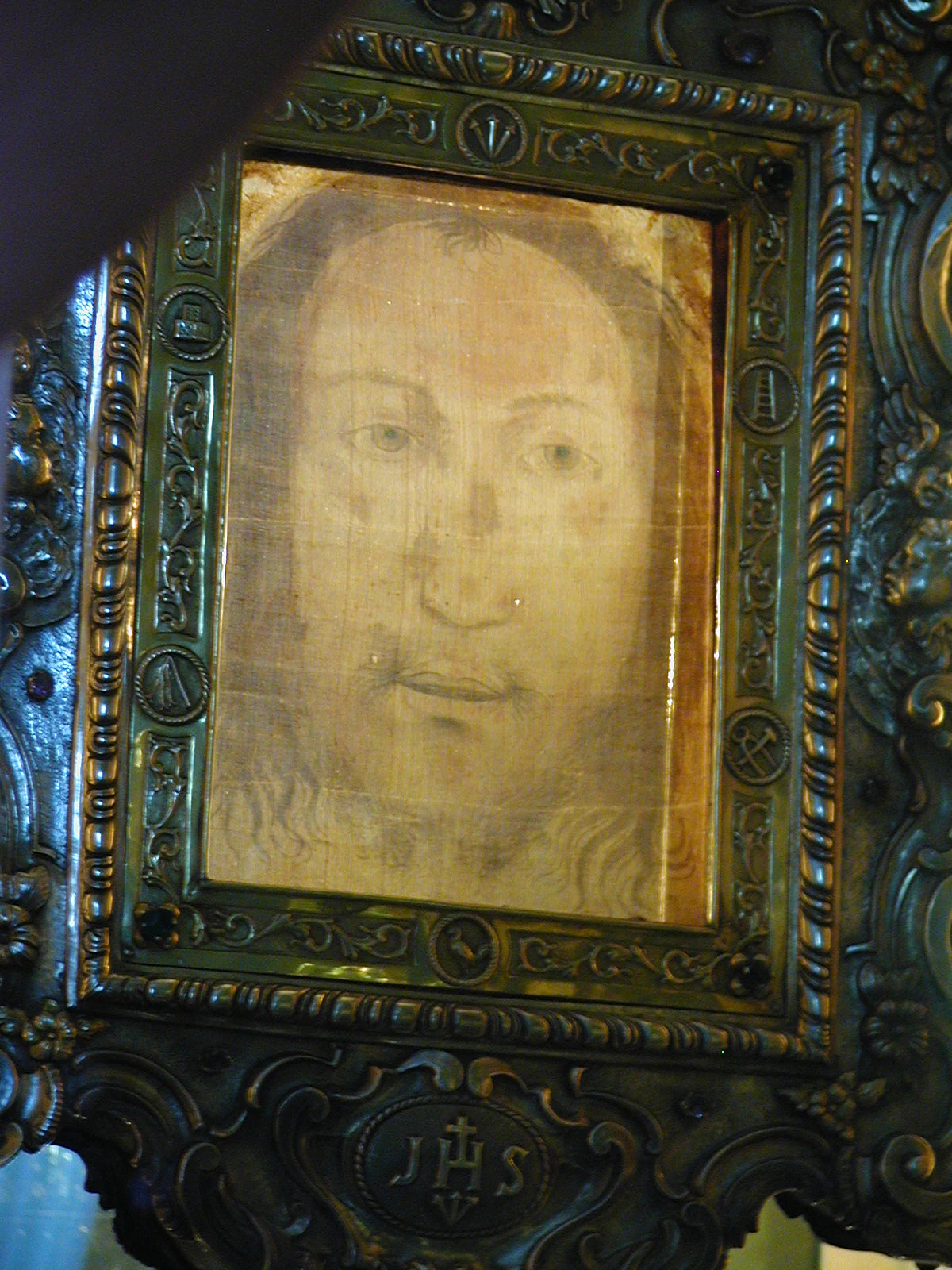
The Manoppello image is a face on a small, partly transparent cloth, visible from both sides. Its appearance changes with illumination. That unusual visual behavior is the starting point of published optical research, and it helps explain why visitors find the object so intriguing. [EX-02]
The shrine preserves a much older story of an unknown pilgrim, a family treasure and a transfer to the Capuchins. Catholic devotion adds another question: how can contemplating a face help a person encounter Christ? History, optics and prayer each contribute something specific. [SRC-02; EX-01]
A seventeenth-century narrative anchors the tradition
The shrine publishes Donato da Bomba’s 1640 account, which looks back to an arrival said to have occurred around 1506. [SRC-02]
Unusual optics can be investigated
Published studies propose physical explanations involving the open weave, translucent threads and lighting. Some material identifications remain hypotheses. [EX-02; EX-03]
A papal visit had a devotional purpose
Benedict XVI’s 2006 address invites contemplation of Christ and recognition of him in others; it does not announce a scientific authentication. [EX-01]
Explore the chapters
The pilgrim who disappears from the story
Donato da Bomba’s account begins with Giacom’Antonio Leonelli receiving a wrapped image from an unfamiliar pilgrim in Manoppello. When Leonelli tries to thank him, the visitor cannot be found. The narrative interprets this disappearance in heavenly terms and describes the image becoming a treasured family possession. [SRC-02]
The source is explicitly a 1640 account of events placed around 1506. It is valuable evidence for the tradition known to the Capuchins, but it is not a surviving deposition written on the supposed day of arrival. The chronological distance should remain part of the story.
From private possession to a Capuchin shrine
The same narrative describes a family dispute, removal of the image by Pancrazio Petrucci and its sale by his wife Marzia to Donat’Antonio De Fabritiis in 1618. It then recounts damaged surrounding fabric being trimmed and the image placed between glass before its eventual gift to the Capuchins. [SRC-02]
These details matter because they describe interventions and changes of ownership rather than an untouched object moving invisibly through history. They are the custodian’s received account; independently preserved deeds, inventories and examination records would help test its individual stages.
What the optical research actually examines
A 2018 study by Liberato De Caro, Emilio Matricciani and Giulio Fanti analyzes microscopy, optical observations and photographs. The authors estimate that a substantial portion of the cloth consists of spaces between very thin threads. They propose that translucent fibers, possibly treated with starch, help explain the mixture of transmitted and reflected light. [EX-02]
Their conclusion describes linen and starch as probable or proposed identifications and calls for further chemical characterization. A proposed physical model should not be upgraded into a completed chemical analysis. It nevertheless makes the visual phenomenon more intelligible: the lighting, threads and open spaces work together. [EX-02]
The accompanying photograph identifies the Manoppello Holy Face in its display. It provides visual context for this particular object; the optical measurements and material hypotheses come from the research papers, not from the photograph alone. [MEDIA-01]
Why a face can appear to change
The researchers compare views produced by light falling from the front, back and at a grazing angle. They also discuss distortion of the face caused by deformation of the weave. Their digital restoration attempts to compensate for those distortions; it does not physically restore the historical cloth. [EX-02; EX-03]
A processed image can be useful for comparing shapes, but readers need to know what was changed. The corrected result is an analytical reconstruction based on assumptions about the fabric, not a newly discovered photograph of the original face. This distinction is especially important when small anatomical similarities carry a large historical claim.
Does a photographic pattern prove a miracle?
The second 2018 paper reports image statistics closer to those found in photographs of faces than in its comparison category of painted portraits. This result concerns the processed image and the chosen statistical analysis. The authors also discuss possible retouching and call for further non-destructive examination of the colors and fabric. [EX-03]
A statistical resemblance does not identify the sitter, establish a date or demonstrate supernatural production. Those conclusions would require additional arguments and evidence. The study is worth explaining in its actual terms because “science says it is a photograph of Jesus” omits the most important steps.
The proposed connection with the Turin Shroud
A 2019 paper by the same researchers compares digitally processed images from Manoppello and Turin and reports close overlap in facial profiles. The authors interpret this as evidence of a relationship between the images while acknowledging that their formation mechanisms remain unresolved. [EX-04]
Even if an image relationship were established, several historical relationships would remain possible, including artistic influence. Similarity alone cannot show that both cloths touched the same person, that they are equally old or that one is the missing object from another shrine. The comparison is a hypothesis to examine, not a completed chain of custody.
What Benedict XVI came to contemplate
At Manoppello on 1 September 2006, Benedict XVI described the search for Christ’s face as a search for deeper knowledge of him. He linked contemplation with becoming like Christ in love and recognizing him in the poor and vulnerable. The image’s purpose was therefore relational and practical, not simply visual fascination. [EX-01]
This explains the Catholic attraction more fully than saying a pope visited. A face invites the believer to consider the person of Jesus, his humanity and his relation to the Father. The address gives that theology without declaring the cloth’s age, fiber composition or identity with Veronica’s veil. [EX-01]
What remains open—and worth pursuing
The shrine’s custody is documented, and published optical studies exist. Neither the cited historical account nor those studies establish a continuous first-century provenance or a demonstrated supernatural image mechanism. The existing unresolved finding remains appropriate to those questions. [SRC-01; SRC-02; EX-02; EX-03; EX-04]
Useful advances would include reproducible material characterization, transparent access to original image data and documentary work on the transfers described in the shrine history. These could refine the account without diminishing the separate Catholic invitation to contemplation and charity.
Catholic reflection & discussion
Let the object open a larger question
Pause over what this object brings to mind: a person, a place, an act of devotion, or a question about the past. Let that curiosity guide a careful reading of both its history and its meaning.
These editorial prompts invite reflection on the article. They are distinct from Church teaching and the evidence findings.
Pause and reflect
- What draws your attention to this object, and what are you hoping to understand through it?
- How does the article distinguish the object's documented history from the meaning people give it?
- If an attribution remains uncertain, which questions about faith, memory or devotion would still be worth exploring?
Discuss with family or a group
Choose questions suited to your readers' ages and experiences. Anyone can pass or keep a response private.
- Begin with a familiar family keepsake. What can an object help someone remember, and what would be needed to establish its history?
- Choose one image or description in the file. Which things can you observe, and which would you need a source to know?
Questions people ask
Open any question for a fuller answer and its sources.
Is the image visible from both sides?
Has the fabric been conclusively proved to be sea silk?
The cited optical study instead proposes linen with a possible starch treatment and calls for further chemical characterization. A devotional claim about material should not be presented as a settled laboratory result. [EX-02]
Did Benedict XVI authenticate the cloth scientifically?
His 2006 address explains the spiritual meaning of seeking Christ’s face. It does not issue a scientific finding about the object. [EX-01]
Does overlap with the Shroud establish the same historical person?
The 2019 study argues for a relationship between processed facial images. Similarity does not by itself identify the person, date either cloth or prove physical contact. [EX-04]
What the evidence can establish
Evidence verdict: unresolved
Does the Manoppello shrine preserve the displayed cloth, and do current sources establish its age, creator, or supernatural image formation?
The official shrine documents the cloth's custody and devotional history. It does not independently establish a first-century date, identity with Veronica's veil, or supernatural image formation.
Church or institutional status
Official shrine custody and veneration
- Authority
- Sanctuary of the Holy Face, Manoppello
- Scope of the finding
- The cloth displayed at the sanctuary.
- Limits of the finding
- No cited act establishes identity with Veronica's veil or supernatural origin.
Sources and notes
Back to the overviewSource labels describe a document's type and role, not the strength of a claim. Where provided, notes explain its use, access limits, and outstanding checks.
Documents current shrine custody and veneration of the displayed cloth. What it does not establish: Does not supply independent dating or authentication.
Provides the custodian's provenance tradition. What it does not establish: Institutional devotional history; gaps and scientific claims require independent sources.
Documents the image source and CC BY-SA 2.5 rights record. What it does not establish: Exact displayed cloth; not proof of age, identity, or supernatural image formation.
- EX-01Benedict XVI — Manoppello pilgrimage address, 1 September 2006 (opens in a new tab)Official sourceCited in this file
Read the source note for the passage used and any limits on what it supports.
Explains contemplation of Christ’s face and its relation to charity; does not authenticate the cloth.
- EX-02De Caro, Matricciani and Fanti — Imaging Analysis and Digital Restoration, Part I (2018) (opens in a new tab)Peer-reviewed researchCited in this file
Read the source note for the passage used and any limits on what it supports.
Primary optical research and proposed fabric model; distinguish measured observations, inferred material properties and digitally corrected imagery.
- EX-03De Caro, Matricciani and Fanti — Imaging Analysis and Digital Restoration, Part II (2018) (opens in a new tab)Peer-reviewed researchCited in this file
Read the source note for the passage used and any limits on what it supports.
Primary spectral and image-statistical analysis; does not establish identity, date or supernatural causation.
- EX-04De Caro, Matricciani and Fanti — comparison with the Turin Shroud (2019) (opens in a new tab)Peer-reviewed researchCited in this file
Read the source note for the passage used and any limits on what it supports.
Primary comparison of processed images; its proposed relationship is not an object-level chain of custody.
Corrections and updates
Expanded this file with a sourced narrative, 8 chapters and 5 answers to common questions. The existing evidence verdict label and institutional status are retained. Independent human review remains pending.