
Start here
The story, in brief
La Naval’s image was made by an unnamed Chinese artist, adorned through generations of donations, and sheltered at the University of Santo Tomas during the Second World War. Its history is more than a victory legend. It brings together Asian craftsmanship, Spanish colonial conflict, local devotion, and an institution’s effort to preserve a treasured object. [SRC-01] [SRC-03]
A material history comes first
Ivory, wood, and later ornaments identify an image with several historical layers. [SRC-01]
Recognition has a record
The papal grant and 1907 coronation are documented by the university. [SRC-03]
Survival involved human custody
UST sheltered the image from 1941 until 1954. [SRC-03]
Explore the chapters
Begin with the object that survives
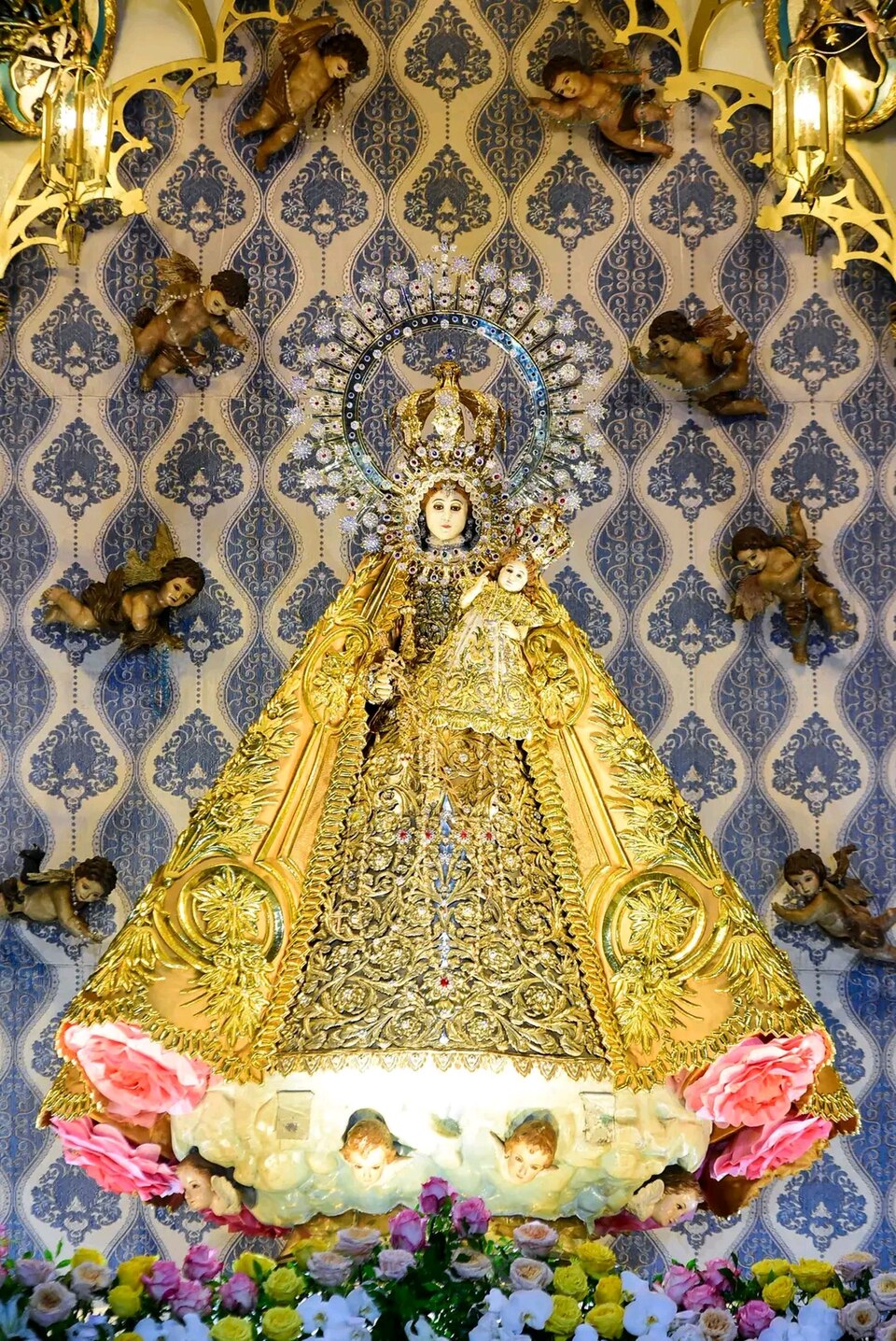
The Cultural Center of the Philippines dates the image to 1593 and describes a figure with ivory head and hands attached to a wooden structure, with the Christ Child carved in ivory. It attributes the work to a non-Christian Chinese artist from Ilocos under a Spanish patron’s direction. The object emerged from cultural encounter rather than from a single homogeneous artistic world. [SRC-01]
Why it came to be called La Naval
The cultural encyclopedia connects the name with Spanish victories over a Dutch fleet in 1646, which devotees attributed to Marian intercession. The battles belong to a colonial struggle for power; the religious interpretation belongs to the history of devotion. Reporting both makes clear what believers claimed without turning the military outcome itself into proof of a supernatural cause. [SRC-01]
The church was repeatedly lost and rebuilt
The Intramuros Administration describes successive Santo Domingo churches, from modest early materials to a large neo-Gothic building, and records the destruction of the Intramuros church in 1941. The image’s story therefore includes the vulnerability of its institutional home. A shrine’s apparent permanence can conceal repeated episodes of rebuilding and displacement. [SRC-02]
How the coronation was organized
The University of Santo Tomas recounts an initiative promoted in its press in 1904, a petition to Pius X, papal permission granted in 1906, and the canonical coronation on October 5, 1907. Committees, publications, fundraising, and donated jewels helped prepare the ceremony. The recognition is a documented historical process with participants and dates, not simply an honor implied by popular affection. [SRC-03]
What a crowned image signifies
The university presents the coronation as recognition of an old and widely venerated Marian image. The crowns honor Mary and the Christ Child within that devotional tradition; they do not canonize a statue as a person. Nor does approval of the coronation by itself establish that Mary caused a particular seventeenth-century naval victory. [SRC-03]
Refuge preserved the link through wartime
After the 1941 destruction, the university chapel sheltered the image until its new shrine in Quezon City was ready in 1954. The university’s official account treats that custody as an expression of a longstanding relationship. This episode gives the image’s survival a concrete institutional explanation: people arranged a place of refuge and maintained it through years of displacement. [SRC-03]
A living tradition has historical layers
The image, later ornaments, 1907 crowns, processions, and wartime transfers come from different periods. Studying those layers reveals how devotion develops over time. The official cultural and university sources establish substantial artistic and custodial history. A judgment about miraculous intervention would need the relevant ecclesiastical record and historical evidence for the particular claim being made. [SRC-01] [SRC-02] [SRC-03]
The accompanying photograph records the appearance of the venerated La Naval image. It offers direct visual context for the object discussed here, while its visible dress and ornaments cannot by themselves date every component or demonstrate miraculous intervention. Those questions depend on the separate documentary and ecclesiastical records. [MEDIA-01]
Catholic reflection & discussion
Let the object open a larger question
Pause over what this object brings to mind: a person, a place, an act of devotion, or a question about the past. Let that curiosity guide a careful reading of both its history and its meaning.
These editorial prompts invite reflection on the article. They are distinct from Church teaching and the evidence findings.
Pause and reflect
- What draws your attention to this object, and what are you hoping to understand through it?
- How does the article distinguish the object's documented history from the meaning people give it?
- If an attribution remains uncertain, which questions about faith, memory or devotion would still be worth exploring?
Discuss with family or a group
Choose questions suited to your readers' ages and experiences. Anyone can pass or keep a response private.
- Begin with a familiar family keepsake. What can an object help someone remember, and what would be needed to establish its history?
- Choose one image or description in the file. Which things can you observe, and which would you need a source to know?
Questions people ask
Open any question for a fuller answer and its sources.
What the evidence can establish
Evidence verdict: unresolved
What is the documented identity and custodial history of the La Naval devotional image, separate from miracle claims?
Philippine cultural institutions document the late-sixteenth-century image, its attribution, movement, and current public significance; reported victories or miracles require separate evidence.
Church or institutional status
Image canonically crowned; miracle interpretation separate
- Authority
- Pope Pius X / Dominican custodians
- Scope of the finding
- The 1907 canonical coronation of the La Naval devotional image.
- Limits of the finding
- Canonical coronation recognizes the image's cult; it does not prove that Marian intervention caused the 1646 naval victories.
- Official sources
- [SRC-03]
Sources and notes
Back to the overviewSource labels describe a document's type and role, not the strength of a claim. Where provided, notes explain its use, access limits, and outstanding checks.
- SRC-01Cultural Center of the Philippines Encyclopedia — La Naval image (opens in a new tab)Official source
Documents the object's date, attribution, materials, and cultural history. What it does not establish: Not a Church decree and not evidence for supernatural intercession.
Documents the shrine's historical setting and ritual history. What it does not establish: Does not authenticate miracle claims.
- SRC-03University of Santo Tomas — 115th Anniversary of the Canonical Coronation of La Naval de Manila PDF (opens in a new tab)Official source
Documents the 1906 papal grant, 1907 canonical coronation, Dominican institutional history, and later custody of the image. What it does not establish: An official Dominican university commemoration, not the original papal instrument and not evidence for reported miraculous intervention.
Documents the image source and CC BY-SA 4.0 rights record. What it does not establish: Exact devotional image; documents appearance only, not reported intercession or victories.
Corrections and updates
Expanded this file with a sourced narrative, 7 chapters and 4 answers to common questions. The existing evidence verdict label and institutional status are retained. Independent human review remains pending.