
Start here
The story, in brief
Bruges’s Holy Blood relic is small enough to fit within a rock-crystal vial, yet its story extends across the city’s streets, civic institutions, and sacred art. The famous account says Count Thierry of Alsace brought it from Jerusalem in 1150. The custodians themselves explain why historians doubt that familiar beginning. [HBB-01; HBB-02]
The more secure story begins in the thirteenth century and grows into a remarkable public devotion. Separating those histories lets us take the city’s religious life seriously without mistaking a medieval legend, a container’s style, or a procession’s grandeur for identification of the substance inside. [HBB-01; HBB-03]
The famous arrival is a legend
Official histories distinguish the 1150 Thierry narrative from the later documentary evidence. [HBB-01; HBB-02]
The medieval devotion is well documented
The relic is evidenced in Bruges by 1256, with a procession recorded in 1291. [HBB-01; HBB-02]
Biological identity remains unresolved
The inspected record contains no authenticated item-specific biological analysis establishing the contents as Jesus’s blood. [HBB-01]
Explore the chapters
The crusader’s story—and its missing century
The received narrative brings Thierry of Alsace home from the Second Crusade with a sacred gift from Jerusalem, accompanied by figures connected with his court and religious life. The procession’s own historical account labels this a legend. Its appeal is clear: it gives the city a direct narrative connection with the Holy Land and a heroic founder for the devotion. [HBB-02]
The problem is chronological. The official accounts identify 1256 as the earliest documentary evidence for the relic in Bruges and point to the lack of a twelfth-century record connecting it with Thierry and the chapel. The intervening century cannot be treated as documented merely because a later story fills it neatly. [HBB-01; HBB-02]
Could the route have passed through Constantinople?
The alternative hypothesis places the relic’s arrival after the sack of Constantinople in 1204, when sacred objects moved westward amid conquest and plunder. The crystal container’s reported stylistic association with Constantinople around 1200 fits that possibility. The city’s official presentations regard this route as historically plausible. [HBB-01; HBB-02]
A possible route is still not an established transfer. A container’s style can suggest a production milieu without identifying its contents or every later owner. The underlying technical object study was not directly inspected for this file, and the documentary gap before 1256 remains. [HBB-01; HBB-02]
How the relic became part of the city
The procession appears in the record in 1291 and developed through the participation of civic groups, guilds, and clergy. Scholarly history places it within the broader ceremonial and religious organization of medieval Bruges. The relic’s importance was therefore expressed collectively, beyond private prayer in a chapel. [HBB-01; HBB-03]
That context changes what the procession can teach a modern observer. It is evidence of a community repeatedly staging its memory and commitments in public space. The durability of that practice is historically significant even though public participation cannot answer a biological question about the vial. [HBB-03]
The building tells two stories at once
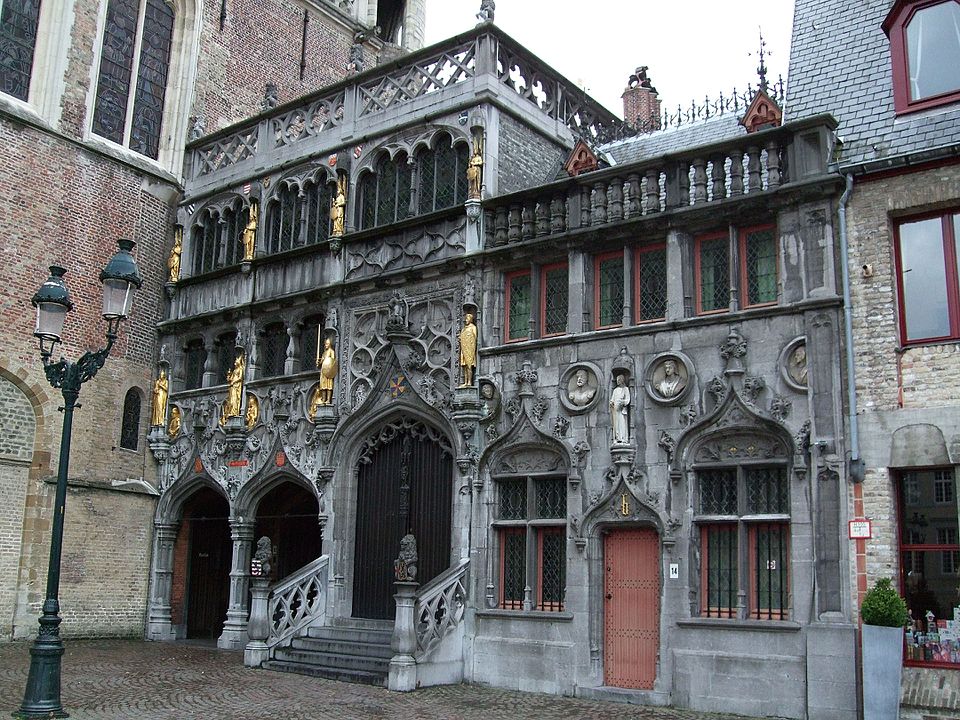
The lower chapel of Saint Basil preserves the site’s Romanesque setting, while the upper chapel underwent later transformations. The basilica’s own account traces additions, rebuilt access, and layers of artwork. A visitor is encountering centuries of interpretation rather than an untouched medieval room. [HBB-04]
A large painting behind the altar places Christ’s Passion above the traditional transfer of the relic to Bruges. The Eucharistic altar also carries a Last Supper relief. These juxtapositions show how the sanctuary joins the Gospel story, the local legend, and the Church’s worship. They are religious interpretations made visible in art, not documents proving the legend’s chronology. [HBB-04]
What “the blood of Christ” means in this devotion
The basilica explains the devotion through Christ’s self-giving love on the cross. In Christian language, his blood signifies a life given for others and redemption from sin. The point is not fascination with an unusual biological specimen; it is contemplation of the person whose sacrifice Christians believe reconciles humanity to God. [HBB-01]
Catholic theology permits material signs to support that contemplation because the Incarnation gives bodily human life a place within God’s saving work. Honor passes toward Christ rather than treating the container or its contents as a separate divine power. That positive account of devotion can be understood without deciding the relic’s disputed material identity. [EX-02]
What the official status covers
The basilica documents continuing veneration and the conferral of basilica status on the chapels in 1923. Those facts establish an authorized devotional setting. They do not supply a first-century custody chain, a laboratory identification of human blood, or a demonstration of supernatural preservation. [HBB-01; HBB-04]
The distinction is especially important here because the sources use devotional names confidently while qualifying the origin narrative. A reader should neither delete the Church’s actual religious practice nor convert its language of veneration into a scientific conclusion it has not established. [HBB-01; HBB-02]
What a careful visitor can take away
Bruges offers a well-attested medieval relic tradition, a major civic procession, and a sanctuary that explains the Passion through worship and art. Those are substantive reasons to investigate the case. The earlier route and biological identity of the contents remain open questions with different evidential requirements. [HBB-01; HBB-03; HBB-04]
The most useful future work would connect directly inspected inventories and transfer documents with a full object study. Until then, the strongest narrative is the one the custodians already make possible: a living devotion whose medieval history is clearer than the famous story of its beginning. [HBB-01; HBB-02]
Catholic reflection & discussion
Let the object open a larger question
Pause over what this object brings to mind: a person, a place, an act of devotion, or a question about the past. Let that curiosity guide a careful reading of both its history and its meaning.
These editorial prompts invite reflection on the article. They are distinct from Church teaching and the evidence findings.
Pause and reflect
- What draws your attention to this object, and what are you hoping to understand through it?
- How does the article distinguish the object's documented history from the meaning people give it?
- If an attribution remains uncertain, which questions about faith, memory or devotion would still be worth exploring?
Discuss with family or a group
Choose questions suited to your readers' ages and experiences. Anyone can pass or keep a response private.
- Begin with a familiar family keepsake. What can an object help someone remember, and what would be needed to establish its history?
- Choose one image or description in the file. Which things can you observe, and which would you need a source to know?
Questions people ask
Open any question for a fuller answer and its sources.
Did Thierry definitely bring the relic to Bruges in 1150?
Has the crystal vial been dated to Jesus’s lifetime?
Why does the procession matter if authenticity is unresolved?
It is important evidence of Bruges’s religious and civic history and a continuing public expression of Christian devotion. Those questions do not depend on a laboratory identification. [HBB-03]
Is this the same phenomenon as San Gennaro’s liquefaction?
No. This file concerns Bruges’s vial, custody tradition, and devotion. Evidence concerning another relic’s reported flow behavior cannot identify this object’s contents. [HBB-01]
What the evidence can establish
Evidence verdict: unresolved
Does historical and material evidence establish that the substance kept in the Bruges vial is blood of Jesus and that it arrived by the traditional 1150 route?
The public record establishes a medieval relic and devotion by the thirteenth century, while the official histories themselves doubt the 1150 account. No inspected custody chain to first-century Jerusalem or authenticated biological test establishes the substance's identity.
Church or institutional status
The vial is officially preserved and venerated at a Catholic basilica; the inspected sources do not supply an item-level authentication of its contents.
- Authority
- The Basilica of the Holy Blood and its Catholic custodial authorities; the official basilica history reports the 1923 basilica title.
- Scope of the finding
- Continuing authorized veneration, procession, and institutional status of the church that houses the vial.
- Limits of the finding
- Custody, daily veneration, procession, and a basilica title recognize a devotional institution. They do not establish the vial's biological contents, first-century identity, arrival route, or supernatural preservation.
Sources and notes
Back to the overviewSource labels describe a document's type and role, not the strength of a claim. Where provided, notes explain its use, access limits, and outstanding checks.
- HBB-01Basilica of the Holy Blood, significance, history, and procession (opens in a new tab)Official source
Official custodial synthesis that distinguishes the received 1150 story from the thirteenth-century documentary floor and discusses the 1204 hypothesis; it is not a biological report.
- HBB-02Procession of the Holy Blood, official historical background: Legend (opens in a new tab)Official source
Official procession-site account explicitly framing the 1150 transfer as legend and outlining the possible Constantinople route.
- HBB-03Andrew Brown, Civic Ceremony and Religion in Medieval Bruges c.1300–1520, Cambridge University Press (2011) (opens in a new tab)Scholarly source
Scholarly history of Bruges's civic-religious institutions and Holy Blood procession; it does not establish the relic's biological identity or supernatural origin.
- HBB-04Basilica of the Holy Blood, history of the basilica and Saint Basil chapel (opens in a new tab)Official source
Official site and institutional history, including the reported 1923 basilica title; it does not authenticate the vial or its contents.
- EX-02Benedict XVI, audience on John Damascene, 6 May 2009 (opens in a new tab)Official sourceCited in this file
Read the source note for the passage used and any limits on what it supports.
Explains Christian honor for matter, images, and saints’ remains through the Incarnation; it is not an object-specific authentication.
Corrections and updates
Expanded this file with a sourced narrative, 7 chapters and 4 answers to common questions. The existing evidence verdict label and institutional status are retained. Independent human review remains pending.