
Start here
The story, in brief
A hungry mule is offered food while Anthony holds the Eucharist. In the tradition, the animal approaches the sacrament and kneels, and its owner changes his mind about the Catholic faith. The image is memorable because the animal supposedly recognizes what a human disputant refuses to acknowledge. [EX-02]
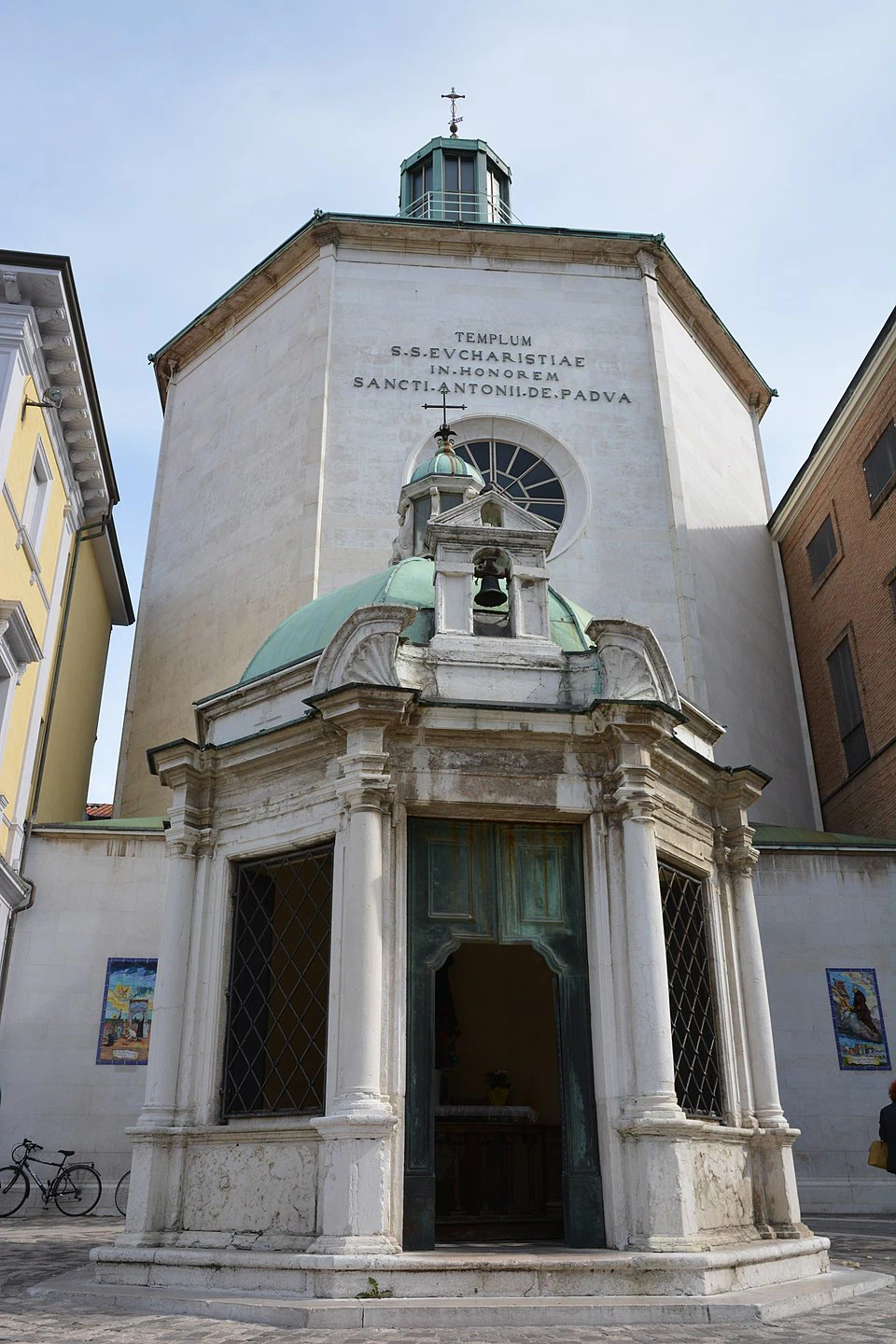
But where did this happen? Rimini has a local commemorative tradition, while the Basilica of Saint Anthony places the mule story in Toulouse and assigns a separate fish sermon to Rimini. That disagreement prevents a secure Rimini localization. [RIM-01; RIM-02]
The mule story is not the fish sermon
The basilica treats them as separate accounts and locates them in different cities. [RIM-01]
Commemoration does not settle location
Rimini’s monument witnesses to its local tradition, not independently to the medieval event’s geography. [RIM-02]
The story points beyond the animal
Its Catholic meaning concerns Christ’s presence in the Eucharist, which does not depend on animal behavior. [EX-01; EX-02]
Explore the chapters
What the basilica’s account says
The custodian’s telling describes a public dispute over the Eucharist, a challenge involving the mule, three days without food, and an assembly where fodder and the sacrament are placed before it. The reported kneeling produces reconciliation with the Church. These are elements of a devotional narrative; they should not be narrated as observations recorded by this file’s author. [EX-02]
Why the scene has such force
The story reverses an expectation: hunger should draw the animal toward its food, yet it turns toward the Eucharist. The basilica uses that reversal to invite reflection on recognition of Christ. Understanding the literary and theological purpose does not establish a supernatural cause, but it explains why the episode has been repeatedly remembered. [EX-02]
Rimini’s claim and Toulouse’s claim
The municipal account associates Rimini’s Tempietto di Sant’Antonio with the mule tradition. Anthony’s basilica gives Toulouse as the setting. Neither modern presentation supplies a critical comparison of the earliest witnesses. Selecting one simply because its institution is official would confuse institutional authority with historical proof of location. [RIM-01; RIM-02]
A second Anthony story should stay separate
The basilica places the sermon to the fishes in Rimini: creatures respond when the human audience will not listen. That similarity of theme makes confusion understandable, but the fish sermon is not corroboration that the mule episode happened in the same city. Distinct stories need distinct textual histories. [RIM-01]
Why Catholics adore an ordinary-looking host
The Catechism teaches that the whole Christ is present under the Eucharistic appearances through consecration. The change is one of substance, while bread and wine ordinarily retain their sensible qualities. Adoration follows from who Catholics believe is present. It is not a reward granted to a host only after an animal, vision, or laboratory supplies an exceptional sign. [EX-01]
Could animal behavior establish the doctrine?
Even a securely observed kneeling animal would leave questions about training, circumstances, and interpretation. Those questions cannot be resolved from the devotional retelling alone. More fundamentally, Catholic faith in the sacrament rests on Christ’s promise; an extraordinary event is considered in relation to that faith rather than functioning as a repeatable animal test of it. [EX-01; EX-02]
What the verdict means for the visitor
The rejected claim is that the story is securely localized to Rimini. The local monument and the saint’s devotional tradition remain real subjects of interest. A stronger historical assessment would compare the earliest Franciscan accounts and identify when each location entered the transmission before claiming either an established setting or an authenticated event. [RIM-01; RIM-02]
Catholic reflection & discussion
Hold wonder and careful questions together
Notice what this account awakens in you: hope, curiosity, gratitude, or a difficult question. Give that response room while examining what the sources actually support.
These editorial prompts invite reflection on the article. They are distinct from Church teaching and the evidence findings.
Pause and reflect
- What makes this account meaningful to you, and which part would you most want to understand better?
- How do the article's evidence and its Catholic interpretation answer different questions?
- What response might this reading invite in ordinary life, even while a historical or scientific question remains open?
Discuss with family or a group
Choose questions suited to your readers' ages and experiences. Anyone can pass or keep a response private.
- Let each person describe what surprised them before discussing whether they found the account convincing.
- Pick one precise claim. What supports it, what remains uncertain, and what would a stronger source need to show?
Questions people ask
Open any question for a fuller answer and its sources.
Does the basilica place the mule in Rimini?
No. Its account places the mule story in Toulouse and the fish sermon in Rimini. [RIM-01]
Does the Rimini monument prove the basilica is wrong?
It establishes a competing local tradition. A monument alone cannot decide which version has the earlier or stronger textual foundation. [RIM-02]
Is the animal’s behavior a required Catholic belief?
The Catholic doctrine explained here concerns Christ’s Eucharistic presence. Its basis does not depend on authenticating the mule narrative. [EX-01]
What the evidence can establish
Evidence verdict: debunked
Is the mule miracle securely localized to Rimini?
Rimini's official tourism authority presents the local Rimini tradition, while the official Basilica of Saint Anthony places the heretic's mule story in Toulouse and separately places the fish sermon at Rimini. A confident Rimini localization is therefore contradicted by the relevant saint's official custodian.
Church or institutional status
Conflicting devotional localizations
- Authority
- Basilica of Saint Anthony of Padua as the saint's official custodian
- Scope of the finding
- Official devotional localization of the mule story to Toulouse, contrasted with Rimini's local memorial tradition
- Limits of the finding
- No formal miracle decree or source-critical localization was located.
Sources and notes
Back to the overviewSource labels describe a document's type and role, not the strength of a claim. Where provided, notes explain its use, access limits, and outstanding checks.
Places the Heretic's Mule in Toulouse and the Sermon to the Fishes in Rimini. What it does not establish: A devotional custodian page does not establish that either miracle occurred, but it directly contradicts a secure Rimini localization for the mule story.
Documents Rimini's local tradition and monument associating the mule account with the city. What it does not establish: Local commemoration is not proof of event location.
- EX-01Catechism of the Catholic Church, 1373–1381 (opens in a new tab)Official sourceCited in this file
Read the source note for the passage used and any limits on what it supports.
Official teaching on the Real Presence, transubstantiation, reservation, and Eucharistic worship; general doctrine, not a ruling on this reported event.
- EX-02Basilica of Saint Anthony: the mule tradition and its Eucharistic meaning (opens in a new tab)Official sourceCited in this file
Read the source note for the passage used and any limits on what it supports.
Official custodian’s complete devotional telling, localized to Toulouse; a modern presentation and meditation, not a contemporary deposition or formal event decree.
Corrections and updates
Expanded this file with a sourced narrative, 7 chapters and 4 answers to common questions. The existing evidence verdict label and institutional status are retained. Independent human review remains pending.